


Wydawcy
Katalog tematyczny
- Archeologia (109)
- Ekonomia, finanse, business (13704)
- Filozofia (1445)
- Historia (3040)
- Języki i językoznawstwo (2356)
- Lifestyle, hobby i rozrywka (475)
- Medycyna (9704)
- Nauki humanistyczne (4)
- Nauki o Ziemi i środowisku (2638)
- Nauki ścisłe (20412)
- Nauki społeczne (8486)
- Nauki techniczne (13450)
- Budownictwo lądowe (1045)
- Chemia przemysłowa (2258)
- Elektronika i telekomunikacja (3287)
- Energetyka (1122)
- Inne nauki stosowane (363)
- Inżynieria biochemiczna (507)
- Inżynieria transportu (232)
- Mechanika i materiały (3316)
- Nauka o środowisku (321)
- Rolnictwo (507)
- Technika, ogólnie (475)
- Prawo (1696)
- Publikacje informacyjne i interdyscyplinarne (1288)
- Religia i wierzenia (917)
- Technika komputerowa (4067)
- Zdrowie, relacje międzyludzkie i rozwój osobisty (657)





Informacje szczegółowe o książce
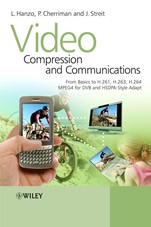
Video Compression and Communications: From Basics to H.261, H.263, H.264, MPEG4 for DVB and HSDPA–Style Adaptive Turbo–Transceivers
ISBN 9780470518496
Autor: Lajos Hanzo, Peter Cherriman, Jurgen Streit
Wydawca: Wiley
Dostępność: 3-6 tygodni
Cena: 859,95 zł
Przed złożeniem zamówienia prosimy o kontakt mailowy celem potwierdzenia ceny.
ISBN13: |
9780470518496 |
ISBN10: |
0470518499 |
Autor: |
Lajos Hanzo, Peter Cherriman, Jurgen Streit |
Oprawa: |
Hardback |
Rok Wydania: |
2007-09-21 |
Ilość stron: |
702 |
Wymiary: |
254x171 |
Tematy: |
TJ |
Since the publication of Wireless Video Communications five years ago, the area of video compression and wireless transceivers has evolved even further. This new edition addresses a range of recent developments in these areas, giving cognizance to the associated transmission aspects and issues of error resilience.
Video Compression and Communications has been updated and condensed yet remains all–encompassing, giving a comprehensive overview of the subject. Covering compression issues, coding delay, implementational complexity and bitrate, the book also looks at the historical perspective to video communication.
New edition of successful and informative text, Wireless Video CommunicationsSubstantial new material has been added on areas such as H.264, MPEG4 coding and transceiversClear presentation and broad scope make it essential for anyone interested in wireless communicationsSystematically converts the lessons of Shannon′s information theory into design principles applicable to practical wireless systems.
This book is ideal for postgraduates and researchers in communication systems but will also be a valuable reference to undergraduates, development and systems engineers of video compression applications as well as industrialists, managers and visual communications practitioners.
Spis treści:
About the Authors.
Other Wiley and IEEE Press Books on Related Topics.
Preface.
Acknowledgments.
1 Introduction.
1.1 A Brief Introduction to Compression Theory.
1.2 Introduction to Video Formats.
1.3 Evolution of Video Compression Standards.
1.3.1 The International Telecommunications Union’s H.120 Standard.
1.3.2 Joint Photographic Expert Group.
1.3.3 The ITU H.261 Standard.
1.3.4 The Motion Pictures Expert Group.
1.3.5 The MPEG–2 Standard.
1.3.6 The ITU H.263 Standard.
1.3.7 The ITU H.263+/H.263++
Standards.
1.3.8 The MPEG–4 Standard.
1.3.9 The H.26L/H.264 Standard.
1.4 Video Communications..
1.5 Organisation of the Monograph.
I Video Codecs for HSDPA–Style Adaptive Videophones.
2 Fractal Image Codecs.
2.1 Fractal Principles.
2.2 One–Dimensional Fractal Coding.
2.2.1 Fractal Codec Design.
2.2.2 Fractal Codec Performance.
2.3 Error Sensitivity and Complexity.
2.4 Summary and Conclusions.
3 Low Bit–Rate DCT Codecs and HSDPA–Style Videophones.
3.1 Video Codec Outline.
3.2 The Principle of Motion Compensation.
3.2.1 Distance Measures.
3.2.2 Motion Search Algorithms.
3.2.2.1 Full or Exhaustive Motion Search.
3.2.2.2 Gradient–Based Motion Estimation.
3.2.2.3 Hierarchical or Tree Search.
3.2.2.4 Subsampling Search.
3.2.2.5 Post–Processing of Motion Vectors.
3.2.2.6 Gain–Cost–Controlled Motion Compensation.
3.2.3 Other Motion Estimation Techniques.
3.2.3.1 Pel–Recursive Displacement Estimation.
3.2.3.2 Grid Interpolation Techniques.
3.2.3.3 MC Using Higher Order Transformations.
3.2.3.4 MC in the Transform Domain.
3.2.4 Conclusion.
3.3 Transform Coding.
3.3.1 One–Dimensional Transform Coding.
3.3.2 Two–Dimensional Transform Coding.
3.3.3 Quantizer Training for Single–Class DCT.
3.3.4 Quantizer Training for Multiclass DCT.
3.4 The Codec Outline.
3.5 Initial Intra–Frame Coding.
3.6 Gain–Controlled Motion Compensation.
3.7 The MCER Active/Passive Concept.
3.8 Partial Forced Update of the Reconstructed Frame Buffers.
3.9 The Gain/Cost–Controlled Inter–Frame Codec.
3.9.1 Complexity Considerations and Reduction Techniques.
3.10 The Bit–Allocation Strategy.
3.11 Results.
3.12 DCT Codec Performance under Erroneous Conditions.
3.12.1 Bit Sensitivity.
3.12.2 Bit Sensitivity of Codec I and II.
3.13 DCT–Bas
ed Low–Rate Video Transceivers.
3.13.1 Choice of Modem.
3.13.2 Source–Matched Transceiver.
3.13.2.1 System 1.
3.13.2.1.1 System Concept.
3.13.2.1.2 Sensitivity–Matched Modulation.
3.13.2.1.3 Source Sensitivity.
3.13.2.1.4 Forward Error Correction.
3.13.2.1.5 Transmission Format.
3.13.2.2 System 2.
3.13.2.2.1 Automatic Repeat Request.
3.13.2.3 Systems 3–5.
3.14 System Performance.
3.14.1 Performance of System 1.
3.14.2 Performance of System 2.
3.14.2.1 FER Performance.
3.14.2.2 Slot Occupancy Performance.
3.14.2.3 PSNR Performance.
3.14.3 Performance of Systems 3–5.
3.15 Summary and Conclusions.
4 Low Bit–Rate VQ Codecs and HSDPA–Style Videophones.
4.1 Introduction.
4.2 The Codebook Design.
4.3 The Vector Quantizer Design.
4.3.1 Mean and Shape Gain Vector Quantization.
4.3.2 Adaptive Vector Quantization.
4.3.3 Classified Vector Quantization.
4.3.4 Algorithmic Complexity.
4.4 Performance under Erroneous Conditions.
4.4.1 Bit–Allocation Strategy.
4.4.2 Bit Sensitivity.
4.5 VQ–Based Low–Rate Video Transceivers.
4.5.1 Choice of Modulation.
4.5.2 Forward Error Correction.
4.5.3 Architecture of System 1.
4.5.4 Architecture of System 2.
4.5.5 Architecture of Systems 3–6.
4.6 System Performance.
4.6.1 Simulation Environment.
4.6.2 Performance of Systems 1 and 3.
4.6.3 Performance of Systems 4 and 5.
4.6.4 Performance of Systems 2 and 6.
4.7 Joint Iterative Decoding of Trellis–Based VQ–Video and TCM.
4.7.1 Introduction.
4.7.2 System Overview.
4.7.3 Compression.
4.7.4 Vector quantization decomposition.
4.7.5 Serial concatenation and iterative decoding.
4.7.6 Transmission Frame Structure.
4.7.7 Frame difference decomposition.
4.7.8 VQ codebook.
4.7.9 VQ–induced code constraints.
4.7.10 VQ trellis structure.
4.7.11 VQ Encoding.
4
.7.12 VQ Decoding.
4.7.13 Results.
4.8 Summary and Conclusions.
5 Low Bit–Rate Quad–Tree–Based Codecs and HSDPA–Style Videophones.
5.1 Introduction.
5.2 Quad–Tree Decomposition.
5.3 Quad–Tree Intensity Match.
5.3.1 Zero–Order Intensity Match.
5.3.2 First–Order Intensity Match.
5.3.3 Decomposition Algorithmic Issues.
5.4 Model–Based Parametric Enhancement.
5.4.1 Eye and Mouth Detection.
5.4.2 Parametric Codebook Training.
5.4.3 Parametric Encoding.
5.5 The Enhanced QT Codec.
5.6 Performance under Erroneous Conditions.
5.6.1 Bit Allocation.
5.6.2 Bit Sensitivity.
5.7 QT–Codec–Based Video Transceivers.
5.7.1 Channel Coding and Modulation.
5.7.2 QT–Based Transceiver Architectures.
5.8 QT–Based Video–Transceiver Performance.
5.9 Summary of QT–Based Video Transceivers.
5.10 Summary of Low–Rate Codecs/Transceivers.
II High–Resolution Video Coding.
6 Low–Complexity Techniques.
6.1 Differential Pulse Code Modulation.
6.1.1 Basic Differential Pulse Code Modulation.
6.1.2 Intra/Inter–Frame Differential Pulse Code Modulation.
6.1.3 Adaptive Differential Pulse Code Modulation.
6.2 Block Truncation Coding.
6.2.1 The Block Truncation Algorithm.
6.2.2 Block Truncation Codec Implementations.
6.2.3 Intra–Frame Block Truncation Coding.
6.2.4 Inter–Frame Block Truncation Coding.
6.3 Subband Coding.
6.3.1 Perfect Reconstruction Quadrature Mirror Filtering.
6.3.1.1 Analysis Filtering.
6.3.1.2 Synthesis Filtering.
6.3.1.3 Practical QMF Design Constraints.
6.3.2 Practical Quadrature Mirror Filters.
6.3.3 Run–Length–Based Intra–Frame Subband Coding.
6.3.4 Max–Lloyd–Based Subband Coding.
6.4 Summary and Conclusions.
7 High–Resolution DCT Coding.
7.1 Introducti
Koszyk
Książek w koszyku: 0 szt.
Wartość zakupów: 0,00 zł
Informacje


Kontakt
Gambit
Centrum Oprogramowania
i Szkoleń Sp. z o.o.
Al. Pokoju 29b/22-24
31-564 Kraków
Siedziba Księgarni
ul. Kordylewskiego 1
31-542 Kraków
+48 12 410 5991
+48 12 410 5987
+48 12 410 5989
Subskrypcje
Administratorem danych osobowych jest firma Gambit COiS Sp. z o.o. Na podany adres będzie wysyłany wyłącznie biuletyn informacyjny.
Autoryzacja płatności

Informacje na temat autoryzacji płatności poprzez PayU.

© Copyright 2012: GAMBIT COiS Sp. z o.o. Wszelkie prawa zastrzeżone.
Projekt i wykonanie: Alchemia Studio Reklamy