


Wydawcy
Katalog tematyczny
- Archeologia (109)
- Ekonomia, finanse, business (13704)
- Filozofia (1445)
- Historia (3040)
- Języki i językoznawstwo (2356)
- Lifestyle, hobby i rozrywka (475)
- Medycyna (9704)
- Nauki humanistyczne (4)
- Nauki o Ziemi i środowisku (2638)
- Nauki ścisłe (20412)
- Astronomia (294)
- Biologia (5119)
- Chemia (6540)
- Fizyka (3309)
- Elektryczność i magnetyzm (90)
- Fizyka atomowa i molekularna (110)
- Fizyka cząstek elementarnych (36)
- Fizyka jądra atomowego (36)
- Fizyka kwantowa (210)
- Fizyka matematyczna (121)
- Fizyka relatywistyczna (36)
- Fizyka statystyczna (51)
- Fizyka stosowana (498)
- Mechanika klasyczna (186)
- Optyka i światło (133)
- Stany materii (202)
- Matematyka (4574)
- Nauki ścisłe, ogólnie (503)
- Nauki społeczne (8486)
- Nauki techniczne (13450)
- Prawo (1696)
- Publikacje informacyjne i interdyscyplinarne (1288)
- Religia i wierzenia (917)
- Technika komputerowa (4067)
- Zdrowie, relacje międzyludzkie i rozwój osobisty (657)





Informacje szczegółowe o książce
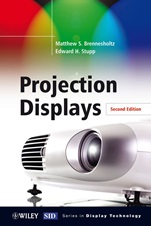
Projection Displays
ISBN 9780470518038
Autor: Matthew S. Brennesholtz, Edward H. Stupp
Wydawca: Wiley
Dostępność: 3-6 tygodni
Cena: 662,55 zł
Przed złożeniem zamówienia prosimy o kontakt mailowy celem potwierdzenia ceny.
ISBN13: |
9780470518038 |
ISBN10: |
0470518030 |
Autor: |
Matthew S. Brennesholtz, Edward H. Stupp |
Oprawa: |
Hardback |
Rok Wydania: |
2008-08-26 |
Numer Wydania: |
2nd Edition |
Ilość stron: |
452 |
Wymiary: |
251x181 |
Tematy: |
PH |
Projection is a technology for generating large, high resolution images at a price point end users can afford. This allows it to be used in a wide variety of large–screen markets such as television and cinema. In addition, there are emerging small screen markets where a pocketable miniaturized projector can display images from mobile information devices such as smart phones or portable media players.
Fully revised, this second edition of Projection Displays provides up–to–date coverage of the optical and mechanical systems in electronic projection displays. It takes into account major new developments in the many technologies needed to manufacture a projector display system. It presents a comprehensive review of projector architectures, systems, components and devices. Key new and updated features include:
•new material on light sources for projection displays;
•updated information on the human factors of projection displays including color gamuts, resolution and speckle;
•coverage of new image generating systems including LCOS and scanned laser systems;
•up to date information on front and rear projection screens;
•practical examples of projection display applications;
•models for predicting the performance of optical and mechanical systems
This book is aimed at practicing engineers and researchers involved in the research, development, design and manufacture of projection displays. It includes key aspects from the many technologies contributing to projection systems such as illumination sources, optical design, electronics, semiconductor design, microdisplay systems and mechanical engineering. The book will also be of interest to graduate students taking courses in display technology and imaging science, as well as students of the many other engineering, physics and optics disciplines that lead into the field of projection displays.
Spis treści:
Forewo
rd.
Preface to the Second Edition.
About the Authors.
1. Introduction.
1.1 Overview of Projection Displays.
1.2 Book Organization.
1.3 What Is Not Covered.
2. Markets and Applications.
2.1 Overview.
2.2 Applications and Performance Requirements.
3. Emissive Image Sources.
3.1 Projection CRTs.
3.2 Field–emission Devices.
4. Liquid Crystal Light Valves and Microdisplays.
4.1 Active Matrices.
4.2 Liquid Crystal Effects.
5. Micro–electromechanical Devices.
5.1 DMD.
5.2 Linear MEMS Arrays.
5.3 MEMS Scanning Mirrors.
6. Filters, Integrators and Polarization Components.
6.1 Factors Affecting Projector Optical Performance.
6.2 Component Efficiency.
6.3 Spectral Filters.
6.4 Integrators.
6.5 Polarization Components.
7. Projection Lenses and Screens.
7.1 Projection Lenses.
7.2 Projection Screens.
7.3 Speckle in Projected Images.
8. Light Sources for Light–valve and Microdisplay Projection Systems.
8.1 Lamp Parameters.
8.2 Types of Projection Lamps.
8.3 Lasers as Projection Light Sources.
8.4 Light Emitting Diodes as Projection Light Sources.
8.5 Efficacy and Lumen Output.
8.6 Spectral Characteristics of Lamps.
8.7 Light Distribution from a HID Lamp.
8.8 Lamp Life.
8.9 Reflectors and Other Collection Systems.
8.10 Lamp Ballasts and Ignitors.
9. Scanned Projection Systems.
9.1 CRT Projectors.
9.2 Scanned Laser Projectors.
10. Microdisplay System Architectures.
10.1 Microdisplay Systems.
10.2 Three Systems with Transmissive Microdisplays.
10.3 Three–panel LCoS Projector Architectures.
10.4 Single–panel Projectors.
10.5 Two–panel Systems.
10.6 Schlieren Optics Based Projectors.
10.7 Stereoscopic 3D Projectors.
11. Modeling Lumen Output.
11.1 Simplified Model.
11.2 Light Collection and Étendue.
11.3 Integrato
rs and Lumen Throughput.
11.4 Microdisplay and Light–valve Properties.
11.5 Full Colorimetric Model of the Projector.
11.6 Problems with Lumen Throughput Calculations.
11.7 Lumen Output Variation in Production.
12. Projector Lumen Throughput.
12.1 Throughput of a Simple Transmissive Projector.
12.2 Throughput in a Three–panel Projector.
12.3 Throughput Estimate Using the Full Colorimetric Model.
13. Characteristics and Characterization.
13.1 Characteristics of the Human Visual System.
13.2 Spatial Characteristics of the Image.
13.3 Luminance, Contrast and Color.
13.4 Image Content–dependent Adaptive Processes.
14. Image Artifacts.
14.1 Spatial Artifacts.
14.2 Temporal Artifacts.
Appendix 1 Radiometry and Photometry.
Appendix 2 Colorimetry.
Appendix 3 Lumen vs Étendue Parametric Model.
Appendix 4 Glossary.
Index.
Okładka tylna:
Projection is a technology for generating large, high resolution images at a price point end users can afford. This allows it to be used in a wide variety of large–screen markets such as television and cinema. In addition, there are emerging small screen markets where a pocketable miniaturized projector can display images from mobile information devices such as smart phones or portable media players.
Fully revised, this second edition of Projection Displays provides up–to–date coverage of the optical and mechanical systems in electronic projection displays. It takes into account major new developments in the many technologies needed to manufacture a projector display system. It presents a comprehensive review of projector architectures, systems, components and devices. Key new and updated features include:
•new material on light sources for projection displays;
•updated information on the human factors of projection displays including color gamuts, resolution and s
peckle;
•coverage of new image generating systems including LCOS and scanned laser systems;
•up to date information on front and rear projection screens;
•practical examples of projection display applications;
•models for predicting the performance of optical and mechanical systems
This book is aimed at practicing engineers and researchers involved in the research, development, design and manufacture of projection displays. It includes key aspects from the many technologies contributing to projection systems such as illumination sources, optical design, electronics, semiconductor design, microdisplay systems and mechanical engineering. The book will also be of interest to graduate students taking courses in display technology and imaging science, as well as students of the many other engineering, physics and optics disciplines that lead into the field of projection displays.
Koszyk
Książek w koszyku: 0 szt.
Wartość zakupów: 0,00 zł
Informacje


Kontakt
Gambit
Centrum Oprogramowania
i Szkoleń Sp. z o.o.
Al. Pokoju 29b/22-24
31-564 Kraków
Siedziba Księgarni
ul. Kordylewskiego 1
31-542 Kraków
+48 12 410 5991
+48 12 410 5987
+48 12 410 5989
Subskrypcje
Administratorem danych osobowych jest firma Gambit COiS Sp. z o.o. Na podany adres będzie wysyłany wyłącznie biuletyn informacyjny.
Autoryzacja płatności

Informacje na temat autoryzacji płatności poprzez PayU.

© Copyright 2012: GAMBIT COiS Sp. z o.o. Wszelkie prawa zastrzeżone.
Projekt i wykonanie: Alchemia Studio Reklamy