


Wydawcy
Katalog tematyczny
- Archeologia (109)
- Ekonomia, finanse, business (13704)
- Filozofia (1445)
- Historia (3040)
- Języki i językoznawstwo (2356)
- Lifestyle, hobby i rozrywka (475)
- Medycyna (9704)
- Nauki humanistyczne (4)
- Nauki o Ziemi i środowisku (2638)
- Nauki ścisłe (20412)
- Nauki społeczne (8486)
- Nauki techniczne (13450)
- Budownictwo lądowe (1045)
- Chemia przemysłowa (2258)
- Elektronika i telekomunikacja (3287)
- Energetyka (1122)
- Inne nauki stosowane (363)
- Inżynieria biochemiczna (507)
- Inżynieria transportu (232)
- Mechanika i materiały (3316)
- Nauka o środowisku (321)
- Rolnictwo (507)
- Technika, ogólnie (475)
- Prawo (1696)
- Publikacje informacyjne i interdyscyplinarne (1288)
- Religia i wierzenia (917)
- Technika komputerowa (4067)
- Zdrowie, relacje międzyludzkie i rozwój osobisty (657)





Informacje szczegółowe o książce
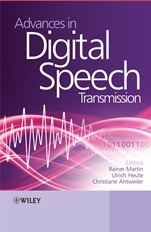
Advances in Digital Speech Transmission
ISBN 9780470517390
Autor: Rainer Martin, Prof Ulrich Heute, Christiane Antweiler
Wydawca: Wiley
Dostępność: 3-6 tygodni
Cena: 596,40 zł
Przed złożeniem zamówienia prosimy o kontakt mailowy celem potwierdzenia ceny.
ISBN13: |
9780470517390 |
ISBN10: |
0470517395 |
Autor: |
Rainer Martin, Prof Ulrich Heute, Christiane Antweiler |
Oprawa: |
Hardback |
Rok Wydania: |
2008-01-11 |
Ilość stron: |
572 |
Wymiary: |
252x180 |
Tematy: |
TJ |
Speech processing and speech transmission technology are expanding fields of active research. New challenges arise from the ′anywhere, anytime′ paradigm of mobile communications, the ubiquitous use of voice communication systems in noisy environments and the convergence of communication networks toward Internet based transmission protocols (such as Voice over IP). As a consequence, new speech coding, new enhancement and error concealment, and new quality assessment methods are emerging.
Advances in Digital Speech Transmission provides an up–to–date overview of the field, including topics such as speech coding in heterogeneous communication networks, wideband coding, and the quality assessment of modern speech transmission systems.
Provides an insight into the latest developments in speech processing and speech transmission, making it an essential reference to those working in these fields
Offers a balanced overview of technology and applications
Presents a unique in–depth discussion of soft–decision source decoding, joint source–channel coding and Turbo DeCodulation techniques
Explains speech signal processing in hearing instruments and human–machine interfaces from applications point of view
Covers speech coding for Voice over IP, source localization, digital hearing aids and speech processing for automatic speech recognition
Advances in Digital Speech Transmission serves as an essential link between the basics and the type of technology and applications (prospective) engineers work on in industry labs and academia. The book will also be of interest to advanced students, researchers, and other professionals who need to brush up their knowledge in this field.
Spis treści:
Preface.
1. Introduction (Rainer Martin, Ulrich Heute, Christiane Antweiler).
I. Speech Quality Assessment.
2. Speech–T
ransmission Quality: Aspects and Assessment for Wideband vs. Narrowband Signals (Ulrich Heute)
2.1 Introduction.
2.2 Speech Signals.
2.3 Telephone–Band Speech Signals.
2.4 Wideband Speech Signals.
2.5 Speech–Quality Assessment.
2.6 Wideband Speech–Quality Assessment.
2.7 Concluding Remarks.
3. Parametric Quality Assessment of Narrowband Speech (Marc Werner).
3.1 Introduction.
3.2 Simulations of GSM and UMTS Speech Transmissions.
3.3 Speech Quality Measures based on Transmission Parameters.
3.4 Discussion and Conclusions.
II. Adaptive Algorithms in Acoustic Signal Processing.
4. Kalman Filtering in Acoustic Echo Control: A Smooth Ride on a Rocky Road (Gerald Enzner).
4.1 Introduction.
4.2 A Comprehensive Theory of Acoustic Echo Control.
4.3 The Kalman Filter for Conditional Mean and Covariance Estimation.
4.4 AEC Performance of the Frequency–Domain Adaptive Kalman Filter.
4.5 Discussion and Conclusions.
5. Noise Reduction – Statistical Analysis and Control of Musical Noise (Colin Breithaupt, Rainer Martin).
5.1 Introduction.
5.2 Speech Enhancement in the DFT Domain.
5.3 Measurement and Assessment of Unnatural Fluctuations.
5.4 Avoidance of Processing Artifacts.
5.5 Control of Spectral Fluctuations in the Cepstral Domain.
5.6 Discussion and Conclusions.
5.7 Acknowledgements.
5.8 Appendix.
6 Acoustic Source Localization with Microphone Arrays (Nilesh Madhu, Rainer Martin).
6.1 Introduction.
6.2 SignalModel.
6.2.1 Continuous Time Model.
6.3 Localization Approach Taxonomy.
6.4 Indirect Localization Approaches.
6.5 Direct Localization Approaches.
6.6 Evaluation of Localization Algorithms.
6.7 Conclusions.
7. Multi–Channel System Identification with Perfect Sequences (Christiane Antweiler).
7.1 Introduction.
7.2 System Identification with Perfect Sequenc
es.
7.3 Multi–Channel System Identification.
7.4 Applications.
7.5 Discussion and Conclusions.
III. Speech Coding for Heterogeneous Networks.
8. Embedded Speech Coding: From G.711 to G.729.1 (Bernd Geiser, St´ephane Ragot, Herv´e Taddei).
8.1 Introduction.
8.2 Theory and Tools of Embedded Speech Coding.
8.3 Embedded Speech Coding Methods.
8.4 Standardized Embedded Speech Coders.
8.5 Network Aspects of Embedded Speech Coding.
8.6 Conclusions and Perspectives.
Bibliography.
9. Backwards Compatible Wideband Telephony (Peter Jax).
9.1 Introduction.
9.2 From Narrowband Telephony to Wideband Telephony.
9.3 Stand–Alone Bandwidth Extension.
9.4 Embedded Wideband Coding Using Bandwidth Extension Techniques.
9.5 Combination of Bandwidth Extension with Watermarking.
9.6 Advanced Transmission of Highband Parameters.
9.7 Conclusions.
Bibliography.
IV. Joint Source–Channel Coding.
10 Parameter Models and Estimators in Soft Decision Source Decoding (Tim Fingscheidt).
10.1 Introduction.
10.2 Overview to Soft Decision Source Decoding.
10.3 The Markovian Parameter Model.
10.4 Basic Extrapolative Estimators.
10.5 Joint Extrapolative Estimation of Two Different Parameters.
10.6 Extrapolative Estimation with Repeated Parameter Transmission.
10.7 Interpolative Estimation of a Parameter.
10.8 Discussion and Conclusions.
11 Optimal MMSE Estimation for Vector Sources with Spatially and Temporally Correlated Elements (Stefan Heinen, Marc Adrat).
11.1 Introduction.
11.2 Source Model.
11.3 Transmission Channel.
11.4 Optimal MMSE Parameter Estimator.
11.5 Near–Optimal MMSE Parameter Estimator.
11.6 Illustrative Comparison.
11.7 Simulation Results.
11.8 Conclusions.
12. Source Optimized Channel Codes & Source Controlled Channel Decoding (Stefan Heinen, Thomas Hindelang).
12.1 Introduction.
12.2 The Transmission System Used as Reference.
12.3 Source Optimized Channel Coding (SOCC).
12.4 Source Controlled Channel Decoding (SCCD).
12.5 Comparison of SOCC versus SCCD.
12.6 Conclusions.
13. Iterative Source–Channel Decoding & Turbo DeCodulation (Marc Adrat, Thorsten Clevorn, Laurent Schmalen).
13.1 Introduction.
13.2 The Key of the Turbo Principle: Extrinsic Information.
13.3 Iterative Source–Channel Decoding (ISCD).
13.4 Turbo DeCodulation (TDeC).
13.5 Conclusions.
Bibliography.
V. Speech Processing in Hearing Instruments.
14. Binaural Signal Processing in Hearing Aids (Volkmar Hamacher, Ulrich Kornagel, Thomas Lotter, Henning Puder).
14.1 Introduction.
14.2 Wireless System for Hearing Aids.
14.3 Binaural Classification Systems.
14.4 Binaural Beamformer.
14.5 Blind Source Separation (BSS).
14.6 Conclusions.
15. Auditory–profile–based Physical Evaluation of Multi–microphone Noise Reduction Techniques in Hearing Instruments (Koen Eneman, Arne Leijon, Simon Doclo, Ann Spriet, Marc Moonen, Jan Wouters).
15.1 Introduction.
15.2 Multi–microphone Noise Reduction in Hearing Instruments.
15.3 Auditory–profile–based Physical Evaluation.
15.4 Test Conditions.
15.5 Simulation Results.
15.6 Discussion.
15.7 Conclusions.
Bibliography.
VI. Speech Processing for Man–Machine Interfaces.
16. Automatic Speech Recognition in Adverse Acoustic Conditions (Hans–Gunter Hirsch).
16.1 Introduction.
16.2 Structure of Speech Recognition Systems.
16.3 Acoustic Scenarios during Speech Input.
16.4 Improving the Recognition Performance in Adverse Conditions.
16.5 Conclusions.
17. Speaker Classification for Next–Generation Voice–Dialog Systems (Felix Burkhardt, Florian Metze, Joachim Stegmann).
17.1 Introdu
Koszyk
Książek w koszyku: 0 szt.
Wartość zakupów: 0,00 zł
Informacje


Kontakt
Gambit
Centrum Oprogramowania
i Szkoleń Sp. z o.o.
Al. Pokoju 29b/22-24
31-564 Kraków
Siedziba Księgarni
ul. Kordylewskiego 1
31-542 Kraków
+48 12 410 5991
+48 12 410 5987
+48 12 410 5989
Subskrypcje
Administratorem danych osobowych jest firma Gambit COiS Sp. z o.o. Na podany adres będzie wysyłany wyłącznie biuletyn informacyjny.
Autoryzacja płatności

Informacje na temat autoryzacji płatności poprzez PayU.

© Copyright 2012: GAMBIT COiS Sp. z o.o. Wszelkie prawa zastrzeżone.
Projekt i wykonanie: Alchemia Studio Reklamy