


Wydawcy
Katalog tematyczny
- Archeologia (109)
- Ekonomia, finanse, business (13704)
- Filozofia (1445)
- Historia (3040)
- Języki i językoznawstwo (2356)
- Lifestyle, hobby i rozrywka (475)
- Medycyna (9704)
- Nauki humanistyczne (4)
- Nauki o Ziemi i środowisku (2638)
- Nauki ścisłe (20412)
- Astronomia (294)
- Biologia (5119)
- Chemia (6540)
- Chemia analityczna (361)
- Chemia fizyczna (346)
- Chemia nieorganiczna (137)
- Chemia organiczna (535)
- Krystalografia (27)
- Minerologia (46)
- Fizyka (3309)
- Matematyka (4574)
- Nauki ścisłe, ogólnie (503)
- Nauki społeczne (8486)
- Nauki techniczne (13450)
- Prawo (1696)
- Publikacje informacyjne i interdyscyplinarne (1288)
- Religia i wierzenia (917)
- Technika komputerowa (4067)
- Zdrowie, relacje międzyludzkie i rozwój osobisty (657)





Informacje szczegółowe o książce
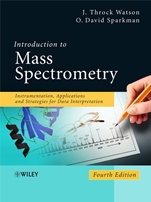
Introduction to Mass Spectrometry: Instrumentation, Applications, and Strategies for Data Interpretation
ISBN 9780470516348
Autor: J. Throck Watson, O. David Sparkman
Wydawca: Wiley
Dostępność: 3-6 tygodni
Cena: 521,85 zł
Przed złożeniem zamówienia prosimy o kontakt mailowy celem potwierdzenia ceny.
ISBN13: |
9780470516348 |
ISBN10: |
0470516348 |
Autor: |
J. Throck Watson, O. David Sparkman |
Oprawa: |
Hardback |
Rok Wydania: |
2007-10-05 |
Numer Wydania: |
4th Edition |
Ilość stron: |
862 |
Wymiary: |
255x192 |
Tematy: |
PN |
Completely revised and updated, this text provides an easy–to–read guide to the concept of mass spectrometry and demonstrates its potential and limitations. Written by internationally recognised experts and utilising "real life" examples of analyses and applications, the book presents real cases of qualitative and quantitative applications of mass spectrometry. Unlike other mass spectrometry texts, this comprehensive reference provides systematic descriptions of the various types of mass analysers and ionisation, along with corresponding strategies for interpretation of data. The book concludes with a comprehensive 3000 references.
This multi–disciplined text covers the fundamentals as well as recent advance in this topic, providing need–to–know information for researchers in many disciplines including pharmaceutical, environmental and biomedical analysis who are utilizing mass spectrometry
Spis treści:
Chapter 1: Introduction.
I. What is Mass Spectrometry.
II. History.
III. Applications.
IV. The Data of Mass Spectrometry and Its Presentation.
1. Spectra.
2. Total Ion Current.
3. Mass Chromatograms and Profiles.
V. Definition of Terms.
1. Mass–To–Charge Ratio (m/z).
2. Multiple–Charge Ions.
3. Ions Representing an Intact Molecule.
4. Resolution/Resolving Power.
5. Intensity vs Abundance.
Chapter 2: The Mass Spectrometer.
I. Introduction.
II. Ion Guides.
III. Types of m/z Analyzers.
1. Time–Of–Flight.
A. Linear.
1) Resolving Power of the Linear TOF Instrument.
2) Time–Lag Focusing.
3) Beam Deflection.
B. Reflectron.
C. Orthogonal Acceleration.
D. Ion Detection in the TOF Analyzer.
1) Time Slice Detection.
2) Time Array Detection.
3) TAD with Transient Recorders.
4) TAD with an Integrating Transient Recorder.
5) Hadamard Transform TOF MS.
2. Quadrupole Ion Traps.
A. 3D
Quadrupole Ion Traps.
B. Linear Quadrupole Ion Traps.
3. Orbitrap.
A. Historical Aspects.
B. Operating Principles.
4. Transmission Quadrupoles.
A. QMF Equations of Motion.
B. The Stability Diagram.
C. Characteristics of Output.
D. Spectral Skewing.
E. Performance Limitations.
5. Sector instruments.
A. Single–focusing Instruments.
1) Operating Principles.
2) Performance Limitations.
B. Double–Focusing Instruments.
6. FTICR–MS.
C. Hardware Configuration.
D. Operational Considerations.
E. Representative Applications.
IV. Calibration of the m/z Scale.
1. Electron Ionizaton (GC/MS).
2. Chemical Ionization (GC/MS).
3. Electrospray and Other Atmospheric Pressure Ionization Techniques.
V. Ion Detection.
1. General Considerations.
2. Types of Detectors.
A. Faraday Cup.
B. Electron Multiplier.
1) Discrete–Dynode Version.
2) Continuous–Dynode Version.
C. Negative–Ion Detection.
D. Post–Acceleration Detection and Detection of High–Mass Ions.
E. Channel Electron Multiplier Array (CEMA).
F. Electro–Optical Ion Detection.
G. The Daly Detector.
H. Cryogenic Detectors.
VI. Vacuum Systems.
1. Introduction.
2. Definitions.
3. Pressure Gauges.
A. Thermal–Conductivity Gauges.
B. Ionization Gauges.
4. Types of Pumps.
A. Mechanical Pumps (Low Vacuum).
1) Rotary Vane.
2) Scroll.
3) Diaphram.
B. High Vacuum.
1) Turbomolecular Pumps.
2) Diffusion Pumps.
3) Sputter–Ion Pumps.
4) Cryogenic Pumps.
Chapter 3: Mass Spectrometry/Mass Spectrometry.
I. Introduction.
1. Concept and Definitions.
2. Nomenclature.
II. Ion Dissociation.
1. Metastable Ions.
III. Instrumentation for MS/MS.
1. MS/MS in Space.
A. Tandem MS/MS.
1) Triple–Quadrupole Mass Spectrometer.
2) BEqQ Hybrid Instrument.
B. Double–Focusing Instruments.
2. MS/MS
in Time.
IV. Specialized Techniques and Applications.
1. In–Source CAD.
2. CAD in Conjunction with Soft Ionization.
3. Selected Reaction Monitoring.
4. Precursor–Ion Scan.
5. Neutral Loss (Common Loss) Scan.
6. Ion/Molecule Reactions.
V. Identification of Unknowns from CAD Data.
1. Accurate Mass Measurements.
2. Library Search Utilities.
A. Other Databases.
B. Substructure Information.
C. Use of MS Interpreter.
Chapter 4: Inlet Systems.
I. Introduction.
II. Batch Inlets.
1. Heated Reservoir Inlet.
2. Direct Inlet Probe (DIP).
A. The Chromatoprobe.
3. Direct Exposure Probe (Desorption Chemical Ionization [DCI]).
4. Pyrolysis.
III. Continuous Inlets.
1. Membrane Introduction MS (MIMS).
2. Supercritical Fluid Chromatography.
3. Electrophoretic Inlet.
IV. Ionization Inlet Systems.
1. Direct Analysis in Real Time (DART).
2. Desorption Electrospray Ionization (DESI).
3. Desorption Atmospheric Pressure Chemical Ionization (DAPCI).
V. 4. Speciality Interfaces.
1. Selected Ion Flow–Tube Mass Spectrometry (SIFT–MS).
2. Fast Atom Bombardment (FAB) and Liquid Secondary Ion Mass Spectrometry (LSIMS).
3. Chemical Reaction Interface Mass Spectrometry (CRIMS).
4. ICP.
Chapter 5: Strategies for Data Interpretation (Other than Fragmentation).
I. Introduction.
II. Some Important Definitions.
III. The Possible Information That Can be Obtained from the Mass Spectrum.
IV. Elemental Composition of an Ion and the Ratios of Its Isotope Peaks.
1. Definition of Terms Related to the Matter of Mass Spectrometry.
2. Nitrogen Rule.
3. Elemental Composition of an Ion Based on Intensities of Isotope Peaks.
B. Use of Isotope Peaks Intensities to Determine the Elemental Composition of Ions.
C. Isotope Peaks Patterns for Ions Containing Various Combinations of Cl and/or Br.
D. Constraints on the Number of Atoms of a Given Element
.
E. Relationship between the Spacing of Isotope Peaks and the Charge State of an Ion.
3) Ions of Low–Charge State.
4) Ions of High–Charge State.
F. Steps to Assigning an Elemental Composition Based on Isotope Peaks Intensities.
G. Validating the Putative Elemental Composition of an Ion.
H. Some Illustrative Examples.
I. Potential Problems Arising from Adjacent Peaks.
4. Accurate Mass Measurements.
A. Appearance of Mass Spectra of High–m/z Value Ions.
5. Use of the NIST Mass Spectral Search Program in the Determination of a Structure from an Elemental Composition.
6. Does the Result Make Sense?
V. Identifying the Molecular Mass of an Analyte.
1. Identification of a Molecular–Ion Peak.
2. Identification of a Protonated–Molecule Peak.
A. The Role of Adduct–Ion Peaks.
3. Recognition of the Deprotonated Molecule ([M – H] – ) Peak in Soft Ionization.
VI. Recognition of Spurious Peaks in the Mass Spectrum.
1. Noise Spikes.
2. Peaks Corresponding to Contaminants in GC/MS and LC/MS.
A. Phthalate Ion.
B. GC Column Bleed.
C. Solvent Clusters.
VII. Obtaining Structural Information from Mass Spectra.
Chapter 6: Electron Ionization.
I. Introduction.
II. Ionization Process.
III. Strategy for Data Interpretation.
1. Assumptions.
2. The Ionization Process.
IV. Types of Fragmentation Pathways.
1. Sigma–Bond Cleavage.
2. Homolytic Cleavage.
3. Heterolytic Cleavage.
4. Rearrangements.
A. Hydrogen Shift Rearrangements.
B. Hydride Shift Rearrangements.
V. Representative Fragmentations (Spectra) of Classes of Compound.
1. Hydrocarbons.
A. Saturated Hydrocarbons.
1) Straight Chain.
2) Branched.
3) Cyclic.
B. Unsaturated.
C. Aromatic.
2. Alkyl Halides.
3. Oxygen–Containing Compounds.
A. Aliphatic Alcohols.
B. Aliphatic Ethers.
C. Aromatic Alcohol.
D. Cylic Ethers.
E. Keton
Koszyk
Książek w koszyku: 0 szt.
Wartość zakupów: 0,00 zł
Informacje


Kontakt
Gambit
Centrum Oprogramowania
i Szkoleń Sp. z o.o.
Al. Pokoju 29b/22-24
31-564 Kraków
Siedziba Księgarni
ul. Kordylewskiego 1
31-542 Kraków
+48 12 410 5991
+48 12 410 5987
+48 12 410 5989
Subskrypcje
Administratorem danych osobowych jest firma Gambit COiS Sp. z o.o. Na podany adres będzie wysyłany wyłącznie biuletyn informacyjny.
Autoryzacja płatności

Informacje na temat autoryzacji płatności poprzez PayU.

© Copyright 2012: GAMBIT COiS Sp. z o.o. Wszelkie prawa zastrzeżone.
Projekt i wykonanie: Alchemia Studio Reklamy