


Wydawcy
Katalog tematyczny
- Archeologia (109)
- Ekonomia, finanse, business (13704)
- Filozofia (1445)
- Historia (3040)
- Języki i językoznawstwo (2356)
- Lifestyle, hobby i rozrywka (475)
- Medycyna (9704)
- Chirurgia (272)
- Inne gałęzie medycyny (1871)
- Medycyna kliniczna (4187)
- Medycyna niekonwencjonalna (14)
- Medycyna przedkliniczna (269)
- Medycyna, ogólnie (1740)
- Historia medycyny (3)
- Lekarze, sprawy zawodowe (8)
- Medycyna, aspekty prawne (10)
- Służba zdrowia (36)
- Wyposażenie medyczne (157)
- Zdrowie publiczne (460)
- Medyczne służby pomocnicze (745)
- Studia medyczne (16)
- Weterynaria (548)
- Nauki humanistyczne (4)
- Nauki o Ziemi i środowisku (2638)
- Nauki ścisłe (20412)
- Nauki społeczne (8486)
- Nauki techniczne (13450)
- Prawo (1696)
- Publikacje informacyjne i interdyscyplinarne (1288)
- Religia i wierzenia (917)
- Technika komputerowa (4067)
- Zdrowie, relacje międzyludzkie i rozwój osobisty (657)





Informacje szczegółowe o książce
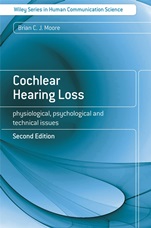
Cochlear Hearing Loss: Physiological, Psychological and Technical Issues
ISBN 9780470516331
Autor: Brian C. J. Moore
Wydawca: Wiley
Dostępność: 3-6 tygodni
Cena: 473,55 zł
Przed złożeniem zamówienia prosimy o kontakt mailowy celem potwierdzenia ceny.
ISBN13: |
9780470516331 |
ISBN10: |
047051633X |
Autor: |
Brian C. J. Moore |
Oprawa: |
Paperback |
Rok Wydania: |
2007-10-19 |
Numer Wydania: |
2nd Edition |
Ilość stron: |
346 |
Wymiary: |
232x165 |
Tematy: |
MB |
Hearing loss caused by damage to the cochlea is amongst the most common forms of hearing loss in the developed world and affects approximately 7% of the population. Over the last 20 years there has been a revolution in our understanding of the mechanisms of sound analysis in the normal cochlea. The mechanisms associated with cochlear hearing loss are also better understood as a result. Most advances in understanding, however, have been related to physiological mechanisms.
Cochlear Hearing Loss, 2e focuses on the perceptual changes in hearing associated with cochlear hearing loss and relates those to the underlying physiological mechanisms. The book provides a theoretical framework for understanding and interpreting the perceptual changes in hearing experienced by sufferers so that readers will understand not just what happens, but also why it happens. A discussion of the limitations and benefits of hearing aids is also provided, along with an overview of digital hearing aids.
Topics discussed within Cochlear Hearing Loss, 2e include:the physiology of the peripheral auditory system;absolute thresholds;frequency selectivity and masking;loudness, pitch and speech perception;sound localisation and binaural processing;signal processing in hearing aids, and methods of adjusting hearing aids to suit the individual.
This revised and substantially updated 2nd edition contains essential reading for audiologists, hearing–aid dispensers, hearing–aid acousticians, researchers in hearing science, otologists, ENT specialists and students in related disciplines.
Spis treści:
Preface.
Chapter 1. Physiological Aspects of Cochlear Hearing Loss.
I. INTRODUCTION.
II.LINEAR AND NONLINEAR SYSTEMS.
III. STRUCTURE AND FUNCTION OF THE OUTER AND MIDDLE EAR.
IV. STRUCTURE AND FUNCTION OF THE NORMAL COCHLEA.
1. The cochlea, the basilar membrane and the organ of Corti.
2. Tuning on
the basilar membrane.
3. The nonlinearity of input–output functions on the BM.
4. Two–tone suppression.
5. Combination tone generation.
6. Responses of the BM to complex sounds.
7. Otoacoustic emissions.
V. NEURAL RESPONSES IN THE NORMAL AUDITORY NERVE.
1. Spontaneous firing rates and thresholds.
2. Tuning curves and iso–rate contours.
3. Rate–versus–level functions.
4. Two–tone suppression.
5. Phase locking.
VI. TYPES OF HEARING LOSS.
VII. PHYSIOLOGY OF THE DAMAGED COCHLEA.
1. BM responses.
2. Neural responses.
3. Structure–function correlation.
4. Otoacoustic emissions.
5. Phase locking.
VIII. CONCLUSIONS.
Chapter 2. Absolute Thresholds.
I. INTRODUCTION.
II. MEASURES OF ABSOLUTE THRESHOLD.
1. Minimum audible pressure (MAP).
2. Minimum audible field (MAF).
3. Comparison of MAP and MAF.
4. The audiogram.
III. DESCRIPTIONS OF THE SEVERITY OF HEARING LOSS.
IV. CAUSES OF HEARING LOSS DUE TO COCHLEAR DAMAGE.
V. PERCEPTUAL CONSEQUENCES OF ELEVATED ABSOLUTE THRESHOLDS.
Chapter 3. Masking, Frequency Selectivity and BM Nonlinearity.
I. INTRODUCTION.
II. THE MEASUREMENT OF FREQUENCY SELECTIVITY USING MASKING.
1. Introduction.
2. The power spectrum model.
3. Estimating the shape of a filter.
III. ESTIMATING FREQUENCY SELECTIVITY FROM MASKING EXPERIMENTS.
1. Psychophysical tuning curves.
2. The notched–noise method.
IV. CHARACTERISTICS OF THE AUDITORY FILTER IN NORMAL HEARING.
1. Variation with centre frequency.
2. Variation with level.
3. Summary.
V. MASKING PATTERNS AND EXCITATION PATTERNS.
1. Masking patterns.
2. Relationship of the auditory filter to the excitation pattern.
3. Changes in excitation patterns with level.
4. Possible effects of suppression.
VI. NON–SIMULTANEOUS MASKING.
1. Basic properties of non–
simultaneous masking.
2. Evidence for suppression from non–simultaneous masking.
3. The enhancement of frequency selectivity revealed in non–simultaneous masking.
4. Relation between the growth of forward masking and the BM input–output function.
VII. THE AUDIBILITY OF PARTIALS IN COMPLEX TONES.
VIII. EFFECTS OF COCHLEAR DAMAGE ON FREQUENCY SELECTIVITY IN SIMULTANEOUS MASKING.
1. Complicating factors.
2. Psychophysical tuning curves.
3. Auditory filter shapes measured with notched noise.
IX. THE USE OF MASKING TO DIAGNOSE DEAD REGIONS.
1. The TEN test.
2. The TEN(HL) test.
3. Prevalence of dead regions assessed using the TEN(HL) test.
X. EFFECTS OF COCHLEAR DAMAGE ON FORWARD MASKING AND SUPPRESSION .
XI. EFFECTS OF COCHLEAR HEARING LOSS ON BM INPUT–OUTPUT FUNCTIONS.
XII. PERCEPTUAL CONSEQUENCES OF REDUCED FREQUENCY SELECTIVITY, LOSS OF SUPPRESSION AND STEEPER BM INPUT–OUTPUT FUNCTIONS.
1. Susceptibility to masking.
2. Timbre perception.
3. Perceptual consequences of dead regions.
Chapter 4. Loudness Perception and Intensity Resolution.
I. INTRODUCTION.
II. LOUDNESS PERCEPTION FOR NORMALLY HEARING PEOPLE.
1. Equal–loudness contours and loudness level.
2. The scaling of loudness.
3. The detection of intensity changes.
III. EFFECTS OF COCHLEAR HEARING LOSS ON LOUDNESS PERCEPTION.
IV. A MODEL OF NORMAL LOUDNESS PERCEPTION.
V. A MODEL OF LOUDNESS PERCEPTION APPLIED TO COCHLEAR HEARING LOSS.
1. Introduction.
2. Elevation of absolute threshold.
3. Reduced compressive nonlinearity.
4. Reduced IHC/neural function.
5. Reduced frequency selectivity.
6. Complete loss of functioning IHCs or neurones (dead regions).
7. Using the model to account for loudness recruitment.
VI. EFFECTS OF BANDWIDTH ON LOUDNESS .
1. Normal hearing.
2. Impaired hearing.
VII. EFFECTS OF COCHLEAR
HEARING LOSS ON INTENSITY RESOLUTION.
VIII. PERCEPTUAL CONSEQUENCES OF ALTERED LOUDNESS PERCEPTION.
1. Consequences of loudness recruitment and reduced dynamic range.
2. Perceptual consequences of reduced loudness summation.
3. Perceptual consequences of altered intensity discrimination.
Chapter 5. Temporal Resolution and Temporal Integration.
I. INTRODUCTION.
II. MODELLING WITHIN–CHANNEL TEMPORAL RESOLUTION IN NORMAL HEARING.
1. Bandpass filtering.
2. The nonlinearity.
3. The sliding temporal integrator.
4. The decision device.
5. Characterising the nonlinear device and the sliding temporal integrator.
III. TEMPORAL RESOLUTION IN NORMAL HEARING.
1. The effect of centre frequency on gap detection.
2. Temporal modulation transfer functions.
3. The rate of recovery from forward masking.
IV. TEMPORAL RESOLUTION IN PEOPLE WITH COCHLEAR DAMAGE.
1. The influence of sound level on gap detection and the rate of decay of forward masking.
2. The influence of audible bandwidth on TMTFs and gap detection.
3. The influence of changes in the compressive nonlinearity.
V. TEMPORAL INTEGRATION AT THRESHOLD.
1. Temporal integration in normally hearing people.
2. Temporal integration in people with cochlear hearing loss.
3. Explanations for reduced temporal integration in people with cochlear hearing loss.
VI. TEMPORAL INTEGRATION AT SUPRATHRESHOLD LEVELS.
VII. PERCEPTUAL CONSEQUENCES OF ABNORMAL TEMPORAL PROCESSING IN PEOPLE WITH COCHLEAR HEARING LOSS.
1. Consequences of abnormal temporal resolution.
2. Consequences of reduced temporal integration.
Chapter 6. Pitch Perception and Frequency Discrimination.
I. INTRODUCTION.
II. THEORIES OF PITCH PERCEPTION.
III. THE PERCEPTION OF THE PITCH OF PURE TONES BY NORMALLY HEARING PEOPLE.
1. The frequency discrimination of pure tones.
2. The perception of musical intervals.
3. The effect of l
Koszyk
Książek w koszyku: 0 szt.
Wartość zakupów: 0,00 zł
Informacje


Kontakt
Gambit
Centrum Oprogramowania
i Szkoleń Sp. z o.o.
Al. Pokoju 29b/22-24
31-564 Kraków
Siedziba Księgarni
ul. Kordylewskiego 1
31-542 Kraków
+48 12 410 5991
+48 12 410 5987
+48 12 410 5989
Subskrypcje
Administratorem danych osobowych jest firma Gambit COiS Sp. z o.o. Na podany adres będzie wysyłany wyłącznie biuletyn informacyjny.
Autoryzacja płatności

Informacje na temat autoryzacji płatności poprzez PayU.

© Copyright 2012: GAMBIT COiS Sp. z o.o. Wszelkie prawa zastrzeżone.
Projekt i wykonanie: Alchemia Studio Reklamy