


Wydawcy
Katalog tematyczny
- Archeologia (109)
- Ekonomia, finanse, business (13704)
- Filozofia (1445)
- Historia (3040)
- Języki i językoznawstwo (2356)
- Lifestyle, hobby i rozrywka (475)
- Medycyna (9704)
- Nauki humanistyczne (4)
- Nauki o Ziemi i środowisku (2638)
- Nauki ścisłe (20412)
- Astronomia (294)
- Biologia (5119)
- Chemia (6540)
- Chemia analityczna (361)
- Chemia fizyczna (346)
- Chemia nieorganiczna (137)
- Chemia organiczna (535)
- Krystalografia (27)
- Minerologia (46)
- Fizyka (3309)
- Matematyka (4574)
- Nauki ścisłe, ogólnie (503)
- Nauki społeczne (8486)
- Nauki techniczne (13450)
- Prawo (1696)
- Publikacje informacyjne i interdyscyplinarne (1288)
- Religia i wierzenia (917)
- Technika komputerowa (4067)
- Zdrowie, relacje międzyludzkie i rozwój osobisty (657)





Informacje szczegółowe o książce
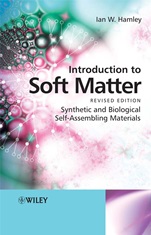
Introduction to Soft Matter: Synthetic and Biological Self–Assembling Materials
ISBN 9780470516102
Autor: Ian W. Hamley
Wydawca: Wiley
Dostępność: 3-6 tygodni
Cena: 284,55 zł
Przed złożeniem zamówienia prosimy o kontakt mailowy celem potwierdzenia ceny.
ISBN13: |
9780470516102 |
ISBN10: |
0470516100 |
Autor: |
Ian W. Hamley |
Oprawa: |
Paperback |
Rok Wydania: |
2007-09-07 |
Ilość stron: |
342 |
Wymiary: |
229x152 |
Tematy: |
PN |
Soft matter materials include polymers, colloids, emulsions, amphiphiles, surfactants, membranes, liquid crystals and biomaterials. Although these materials seem very different, they have common structural and dynamic properties that are somewhere between those of crystalline solids and simple molecular liquids and gases. Soft matter is an interdisciplinary subject drawing not only from physics, chemistry and materials science but also from biology, biochemistry and engineering. These materials have a wide range of applications, such as in structural and packaging materials, foams and adhesives, detergents and cosmetics, paints, food additives and biological materials.
Written in an “easy–to–follow style”, this textbook provides an introduction to this exciting subject with chapters covering natural and synthetic polymers, colloids, surfactants, biological soft matter and liquid crystals and the many and varied applications of these materials. It has been newly edited and has chapters with updated coverage of recent aspects of polymer science. A series of questions and answers is also provided at the end of each chapter. The book contains a new chapter on biological soft matter, which adds significantly to the discussion of proteins, DNA and lipid membranes in the previous edition.
The book will appeal to students of polymer, biomaterial, colloid, surface and interface science. Experienced researchers in the field will also find this a good introductory text for revising their knowledge of the basics.
Reviews of the First Edition
"A timely and concise textbook on "soft matter" suitable for both undergraduate students and researchers."
Advanced Materials
"It is well written in an easy–to–follow style and deals with some quite complex topics by good use of analogy and comparison."
Chemistry in Britain
Spis treści:
Preface to the revised Edition.
Preface to the First
Edition.
1. Introduction.
1.1 Introduction.
1.2 Intermolecular Interactions.
1.3 Structural Organization.
1.4 Dynamics.
1.5 Phase Transitions.
1.6 Order Parameters.
1.7 Scaling Laws.
1.8 Polydispersity.
1.9 Experimental Techniques for Investigating Soft Matter.
1.10 Computer Simulation.
Further Reading.
2. Polymers.
2.1 Introduction.
2.2 Synthesis.
2.3 Polymer Chain Conformation.
2.4 Characterization.
2.5 Polymer Solutions.
2.6 Amorphous Polymers.
2.7 Crystalline Polymers.
2.8 Plastics.
2.9 Rubber.
2.10 Fibres.
2.11 Polymer Blends and Block Copolymers.
2.12 Dendrimers and Hyperbranched Polymers.
2.13 Polyelectrolytes.
2.14 Electronic and Opto–electronic Polymers.
Further Reading.
Questions.
3. Colloids.
3.1 Introduction.
3.2 Types of Colloids.
3.3 Forces Between Colloidal Particles.
3.4 Characterization of Colloids.
3.5 Charge Stabilization.
3.6 Steric Stabilization.
3.7 Effect of Polymers on Colloid Stability.
3.8 Kinetic Properties.
3.9 Sols.
3.10 Gels.
3.11 Clays.
3.12 Foams.
3.13 Emulsions.
3.14 Food Colloids.
3.15 Concentrated Colloidal Dispersions.
Further Reading.
Questions.
4. Amphiphiles.
4.1 Introduction.
4.2 Types of Amphiphile.
4.3 Surface Activity.
4.4 Surfactant Monolayers and Langmuir–Blodgett Films.
4.5 Adsorption at Solid Interfaces.
4.6 Micellization and the Critical Micelle Concentration.
4.7 Detergency.
4.8 Solubilization in Micelles.
4.9 Interfacial Curvature and Its Relationship to Molecular Structure.
4.10 Liquid Crystal Phases at High Concentrations.
4.11 Membranes.
4.12 Templated Structures.
Further Reading.
Questions.
5. Liquid Crystals.
5.1 Introduction.
5.2 Types of Liquid Crystals.
5.3 Characteristics of Liquid Crystal Phases.
5.4 Identification of Liquid Crystal Phases.
5.5 Orientational O
rder.
5.6 Elastic Properties.
5.7 Phase Transitions in Liquid Crystals.
5.8 Applications of Liquid Crystals.
Further Reading.
Questions.
6. Biological Soft Matter.
6.1 Introduction.
6.2 Lipid Membranes.
6.3 DNA.
6.4 Proteins.
6.5 Polysaccharides and Glycoproteins.
6.6 Macromolecular Assemblies.
Further Reading.
Questions.
Numerical Solutions to Questions.
Index.
Okładka tylna:
Soft matter materials include polymers, colloids, emulsions, amphiphiles, surfactants, membranes, liquid crystals and biomaterials. Although these materials seem very different, they have common structural and dynamic properties that are somewhere between those of crystalline solids and simple molecular liquids and gases. Soft matter is an interdisciplinary subject drawing not only from physics, chemistry and materials science but also from biology, biochemistry and engineering. These materials have a wide range of applications, such as in structural and packaging materials, foams and adhesives, detergents and cosmetics, paints, food additives and biological materials.
Written in an “easy–to–follow style”, this textbook provides an introduction to this exciting subject with chapters covering natural and synthetic polymers, colloids, surfactants, biological soft matter and liquid crystals and the many and varied applications of these materials. It has been newly edited and has chapters with updated coverage of recent aspects of polymer science. A series of questions and answers is also provided at the end of each chapter. The book contains a new chapter on biological soft matter, which adds significantly to the discussion of proteins, DNA and lipid membranes in the previous edition.
The book will appeal to students of polymer, biomaterial, colloid, surface and interface science. Experienced researchers in the field will also find this a good introductory text for revising their knowledge
of the basics.
Reviews of the First Edition
"A timely and concise textbook on "soft matter" suitable for both undergraduate students and researchers."
Advanced Materials
"It is well written in an easy–to–follow style and deals with some quite complex topics by good use of analogy and comparison."
Chemistry in Britain
Koszyk
Książek w koszyku: 0 szt.
Wartość zakupów: 0,00 zł
Informacje


Kontakt
Gambit
Centrum Oprogramowania
i Szkoleń Sp. z o.o.
Al. Pokoju 29b/22-24
31-564 Kraków
Siedziba Księgarni
ul. Kordylewskiego 1
31-542 Kraków
+48 12 410 5991
+48 12 410 5987
+48 12 410 5989
Subskrypcje
Administratorem danych osobowych jest firma Gambit COiS Sp. z o.o. Na podany adres będzie wysyłany wyłącznie biuletyn informacyjny.
Autoryzacja płatności

Informacje na temat autoryzacji płatności poprzez PayU.

© Copyright 2012: GAMBIT COiS Sp. z o.o. Wszelkie prawa zastrzeżone.
Projekt i wykonanie: Alchemia Studio Reklamy