


Wydawcy
Katalog tematyczny
- Archeologia (109)
- Ekonomia, finanse, business (13704)
- Filozofia (1445)
- Historia (3040)
- Języki i językoznawstwo (2356)
- Lifestyle, hobby i rozrywka (475)
- Medycyna (9704)
- Nauki humanistyczne (4)
- Nauki o Ziemi i środowisku (2638)
- Nauki ścisłe (20412)
- Astronomia (294)
- Biologia (5119)
- Chemia (6540)
- Fizyka (3309)
- Matematyka (4574)
- Nauki ścisłe, ogólnie (503)
- Nauki społeczne (8486)
- Nauki techniczne (13450)
- Prawo (1696)
- Publikacje informacyjne i interdyscyplinarne (1288)
- Religia i wierzenia (917)
- Technika komputerowa (4067)
- Zdrowie, relacje międzyludzkie i rozwój osobisty (657)





Informacje szczegółowe o książce
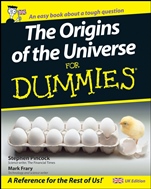
The Origins of the Universe for Dummies
ISBN 9780470516065
Autor: Stephen Pincock, Mark Frary
Wydawca: Wiley
Dostępność: 3-6 tygodni
Cena: 135,45 zł
Przed złożeniem zamówienia prosimy o kontakt mailowy celem potwierdzenia ceny.
ISBN13: |
9780470516065 |
ISBN10: |
0470516062 |
Autor: |
Stephen Pincock, Mark Frary |
Oprawa: |
Paperback |
Rok Wydania: |
2007-10-26 |
Ilość stron: |
346 |
Wymiary: |
235x187 |
Tematy: |
PD |
Do you want to learn about the physical origin of the Universe, but don’t have the rest of eternity to read up on it? Do you want to know what scientists know about where you and your planet came from, but without the science blinding you? ‘Course you do – and who better than For Dummies to tackle the biggest, strangest and most wonderful question there is!
The Origins of the Universe For Dummies covers:
Early ideas about our universeModern cosmologyBig Bang theoryDark matter and gravityGalaxies and solar systemsLife on earthFinding life elsewhereThe Universe’s forecast
Spis treści:
Cheat Sheet.
Introduction.
About this book.
Conventions used in this book.
What you’re not to read.
Foolish assumptions.
How this book is organized.
Icons used in this book.
Where to go from here.
Part I: In the beginning—early ideas about our universe.
Chapter 1: Exploring the universe.
Overview of the whole book, beginning with the ideas of ancient civilizations and moving right through to our modern understanding of an expanding universe.
Overview.
Ancients.
Newton and gravity.
Einstein.
Hubble’s view of the universe.
Big Bang and other theories.
What you need to make a universe.
Time.
The end of the Universe.
Did the Universe start just like that?
Why do we think there is an origin at all?
Science v religion.
Why science doesn’t have all the answers.
Chapter 2: Looking up at the stars.
The main purpose of this book is to explain what modern science has taught us about the evolution of our universe. But it’s important to remember that for most of human history, people came up with explanations based only on what they could see in the sky at night and during the day. So in this chapter we’ll take a
side–trip through history to chart how the modern view of the world developed from those early beliefs.
Making a home for the Gods
The earliest explanations for the movements of the sun and stars were religious and spiritual: Ancient Egypt and Babylon; India and China.
Taking a scientific approach.
Roughly 2000 years ago, the early Greeks produced the first cosmology based on science.
Anaxagoras of Clazomenae (moon shines reflected sunlight; lunar eclipses).
Thales’ prediction of a solar eclipse in 585 BC. Pythagoras and the mathematical universe.
4th C BC, fixed stars and wandering stars. Aristarchus of Samos heliocentric model explained this, but was rejected by Aristotle.
Aristotle’s On the Heavens, the basis of a system accepted until Copernican revolution 1800 years later.
Ptolemy’s Almagest popularized and perfected Aristotle’s views; epicycles etc.
Launching a revolution.
Copernicus’ De Revolutionibus Orbium turned things on their head.
although his results were no better than Ptolemy’s because they were still based on the idea that planets orbit in circles, not ellipses.
Shaded box on his life
Chapter 3: The apple drops: Newton, gravity and the rotation of the planets.
How the observations of astronomers were finally linked with an overarching theory of gravity and the consequences for the human view of the Universe.
Ditching perfection.
Tcho Brahe and observations of planetary motion.
How Johannes Kepler threw away the concept of circular orbits and came up with ellipses (by trial and error).
Kepler’s laws explained.
Explaining Gravity.
Shaded box on the life of Isaac Newton.
The Universal Law of Gravitation.
How Newton formulated his law.
Newton’s refusal to speculate on the cause of gravity.
Why escaping gravity is impossible.
The perihelion of mercury problem.
Inertial and gravitation mass: are they re
ally the same?
Part II: Modern cosmology goes off with a bang.
Chapter 4: How to build an expanding universe.
Einstein, the special and general theories of relativity and why these led to the birth of modern cosmology.
Putting Einstein in context.
Creating the ether (What carries electricity? Oersted, Maxwell, Hertz begin questioning Newtonian concepts of time and space).
Measuring the speed of light (Michelson and Morley).
Shaded panel on Einstein’s early life.
Einstein’s special theory of relativity E = MC2.
Watching the trees go by (reference frames).
Fixing the speed of light.
Lorentz Transformations and the consequences of relativity.
Creating the world’s most famous equation.
Checking Einstein’s sums (how you can validate the theory).
Working out what E=mc2 really means (4D spacetimes).
Shaded panel on the annus mirabilis.
Adding gravity to the proceedings.
Making gravity and acceleration interchangeable.
Bending space and time.
Proving space is curved (gravitational time dilation, gravitational lensing).
Fudging the figures (The cosmological constant).
Expanding our horizons.
Turning general relativity into the Big Bang (Friedmann’s realization of the impact of relativity).
Admitting defeat: Einstein’s acceptance of the expanding universe.
Chapter 5: Shifting up a gear
How the discovery of red shift and its link with the distance to ‘nebulae’ suddenly made the Universe grow an awful lot bigger.
Twinkling twinkling little stars.
The brightness of stars – Hertzsprung–Russell diagrams.
What is Eta Aquilae and what are Cepheid variable stars?
Measuring the distance to stars.
Shifting towards the red.
The Doppler effect.
Red shift: not the Doppler effect.
The relationship between red shift and velocity.
Why everything in the Universe is red shifted.
Olbers’ Paradox.
Hubbl
e, Hubble, the Universe is in trouble.
Edwin Hubble and his famous law.
Measuring distance in the Universe: What is a parsec?
The Size of the Universe.
What happens when Hubble’s Law gives velocities above the speed of light? Comoving coordinates and Friedmann’s scale factor.
Observing the Universe.
Observing the deep Universe: telescopes from Galileo to Mount Wilson.
The Hubble Telescope and putting an age to the universe.
The most distant object ever.
Chapter 6: How to bake a Big Bang.
The Big Bang theory of the beginnings of the universe. When is an explosion not an explosion? How much energy are we talking about?
First prepare your workspace.
The universe is expanding, as Hubble showed and others have since confirmed, so at some point in the past it must’ve been smaller.
Compression of all the energy in the universe into a small space.
Einstein’s work on relativity predicts the expansion of the universe.
Friedmann: the universe had a distinct origin in time.
Off with a bang: the naming of the big bang by Hoyle.
Check the oven.
The hot early universe should have emitted thermal radiation (like the embers of a fire).
Discovery of Cosmic microwave background by Penzias and Wilson, et al.
Shaded box on others involved in discovery of CMB.
the CMB allows us to see back to a few 100,000 years after the Big Bang.
The problem with singularities; how far back can we go? Plank time/distance.
How much energy are we talking about?
Why the CMB isn’t uniform: The Sunyaev–Zel′dovich effect and other effects.
Chapter 7: Letting it rise (inflation).
The universe in its early days and how it got to be so big and relatively smooth.
Mix well.
The very early universe “look” like?
Koszyk
Książek w koszyku: 0 szt.
Wartość zakupów: 0,00 zł
Informacje


Kontakt
Gambit
Centrum Oprogramowania
i Szkoleń Sp. z o.o.
Al. Pokoju 29b/22-24
31-564 Kraków
Siedziba Księgarni
ul. Kordylewskiego 1
31-542 Kraków
+48 12 410 5991
+48 12 410 5987
+48 12 410 5989
Subskrypcje
Administratorem danych osobowych jest firma Gambit COiS Sp. z o.o. Na podany adres będzie wysyłany wyłącznie biuletyn informacyjny.
Autoryzacja płatności

Informacje na temat autoryzacji płatności poprzez PayU.

© Copyright 2012: GAMBIT COiS Sp. z o.o. Wszelkie prawa zastrzeżone.
Projekt i wykonanie: Alchemia Studio Reklamy