


Wydawcy
Katalog tematyczny
- Archeologia (109)
- Ekonomia, finanse, business (13704)
- Filozofia (1445)
- Historia (3040)
- Języki i językoznawstwo (2356)
- Lifestyle, hobby i rozrywka (475)
- Medycyna (9704)
- Chirurgia (272)
- Inne gałęzie medycyny (1871)
- Medycyna kliniczna (4187)
- Choroby wewnętrzne (514)
- Dermatologia (51)
- Diagnostyka medyczna (3)
- Endokrynologia (144)
- Gastroenterologia (27)
- Geriatria (50)
- Ginekologia i położnictwo (134)
- Hematologia (46)
- Hepatologia (10)
- Kardiologia (71)
- Laryngologia (12)
- Nefrologia (10)
- Neurologia (500)
- Oftalmologia (50)
- Pediatria (33)
- Pulmunologia (32)
- Reumatologia (14)
- Terapia genowa (1)
- Układ mięśniowo-szkieletowy (1)
- Urologia (14)
- Medycyna niekonwencjonalna (14)
- Medycyna przedkliniczna (269)
- Medycyna, ogólnie (1740)
- Medyczne służby pomocnicze (745)
- Studia medyczne (16)
- Weterynaria (548)
- Nauki humanistyczne (4)
- Nauki o Ziemi i środowisku (2638)
- Nauki ścisłe (20412)
- Nauki społeczne (8486)
- Nauki techniczne (13450)
- Prawo (1696)
- Publikacje informacyjne i interdyscyplinarne (1288)
- Religia i wierzenia (917)
- Technika komputerowa (4067)
- Zdrowie, relacje międzyludzkie i rozwój osobisty (657)





Informacje szczegółowe o książce
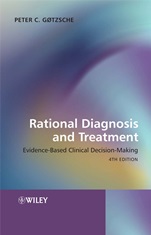
Rational Diagnosis and Treatment: Evidence–Based Clinical Decision–Making
ISBN 9780470515037
Autor: Peter Gøtzsche
Wydawca: Wiley
Dostępność: 3-6 tygodni
Cena: 452,55 zł
Przed złożeniem zamówienia prosimy o kontakt mailowy celem potwierdzenia ceny.
ISBN13: |
9780470515037 |
ISBN10: |
0470515031 |
Autor: |
Peter Gøtzsche |
Oprawa: |
Hardback |
Rok Wydania: |
2007-11-23 |
Numer Wydania: |
4th Edition |
Ilość stron: |
244 |
Wymiary: |
239x153 |
Tematy: |
MJ |
This fourth edition of Peter Gotzsche’s ‘Rational Diagnosis and Treatment’ argues that clinical decision–making should be built from first principles. By asking relevant questions, such as ‘how reliable are various sorts of data?’, ‘how has the disease classification evolved over time, and is it logical?’, fewer mistakes will be made by the practising physician and trainee.
This beautifully written book integrates the science and statistical approach of evidence–based medicine with the art and humanism of medical practice. It stresses that, whenever possible, clinical decisions must be based on the best evidence from clinical research; but also highlights the pitfalls of such research and the problems involved in applying evidence from groups of patients to the individual patient.
Such an intellectually challenging book is ideal for medical students, practitioners and doctors who require theoretical and practical clinical skills to help ensure that they apply theory to their practice, to achieve the best possible outcomes.
How does the diagnostic process narrow down options, and what are the pitfalls in diagnostic reasoning?
How do randomness, the spontaneous course of the disease, the placebo effect, luck and clinical trials come together?
What is the nature of reasoning?
What is the true value of the published literature?
How do commercial interests distort our perceptions about drugs?
Should people get screened for cancer and other diseases?
New edition contains:
Updated sections on placebo and meta–analysis
Sections on different research designs, focusing on advantages and limitations
Notes on increased medicalisation and the effects of cancer screening on healthy people
Updated section on alternative medicineGreater focus on insufficient reporting of harms of interventions
Additional text on academic freedom.
Spis treści:
Preface.
Introduction.
1 The Foundation of Clinical Decisions.
The clinical decision process.
Clinical data.
Scales of measurement.
Taking the history.
The physical examination.
Paraclinical findings.
Global assessments.
2 Reliability and relevance of clinical data.
Clinical data on an interval scale.
Clinical data on an ordinal scale.
Clinical data on a binary scale.
Descriptive paraclinical findings.
Descriptive physical signs.
The statistical concept of normality.
The concept of disease.
Interpretation and relevance.
Indicators.
3 The disease classification.
The historical perspective.
The seventeenth and eighteenth centuries.
The nineteenth and twentieth centuries.
The theoretical perspective.
The mechanical model of disease.
Molecular biology.
Disease and the environment.
The practical perspective.
Name of disease.
Definition.
Causes of disease (aetiology and pathogenesis).
The clinical picture.
Diagnosis and treatment.
4 Diagnosis.
The diagnostic universe.
Diagnosis of diseases with an accessible defining criterion.
The direct method for assessing the accuracy of test results.
The indirect method for assessing the accuracy of test results.
Terminological confusion.
Quantitative data.
Diagnosis of diseases with a concealed defining criterion.
Syndrome diagnosis.
Three patients.
Diagnosis in practice.
Frequential and subjective probabilities.
Diagnostic strategy.
5 Uncontrolled experience.
Uncontrolled experience in a pre–scientific era.
The numerical method.
The era of laboratory research.
The spontaneous course of the disease.
Regression towards the mean.
Run of luck.
B
ias.
The placebo effect.
The need for controlled experience.
Alternative medicine: pseudoscientific thinking.
6 The randomized clinical trial.
Selection of patients.
Randomization.
Choice of treatment in the control group.
Principles of blinding.
Cross–over trials.
Measures of benefits and harms.
Stopping rules.
Assessment of the results.
Statistical analysis.
Hypothesis testing.
Estimation.
Other statistical measures of effect.
Subgroup analyses.
Systematic reviews.
From trials to practice.
Evidence–based medicine and commercial pressures.
7 Medicine and the humanities.
The four components of clinical reasoning.
The empathic–hermeneutic component.
The ethical component.
Three kinds of norms.
The foundation of health care ethics.
The structure of ethical reasoning.
Assessment of the facts of the case.
Consequential considerations.
Deontological considerations.
The ethical decision.
Quality of life.
Autonomy and paternalism.
Clinical examples.
Clinical research ethics.
8 Critical reading of medical journals.
Logical analysis of medical papers.
Assets and limitations of cohort studies.
Assets and limitations of case–control studies.
Other designs.
Descriptive statistics.
Estimation.
Testing Hypotheses.
Psuedohypothetico–deductive logic.
Wrong sampling unit.
Sample size calculations.
Interpretation of P–values.
Statistical tests.
Examples.
Correlation analysis.
Life table analysis.
References.
Index.
Nota biograficzna:
Peter C. Gøtzsche, D. MSc. Director, Specialist in internal medicine, Director of the Nordic Cochrane Centre, Rigshospitalet, Copenhagen, Denmark.
Okładka tylna:
This fourth edition of Peter Gotzsche’s ‘Rational Diagnosis and Treatment’ argues that clinical de
cision–making should be built from first principles. By asking relevant questions, such as ‘how reliable are various sorts of data?’, ‘how has the disease classification evolved over time, and is it logical?’, fewer mistakes will be made by the practising physician and trainee.
This beautifully written book integrates the science and statistical approach of evidence–based medicine with the art and humanism of medical practice. It stresses that, whenever possible, clinical decisions must be based on the best evidence from clinical research; but also highlights the pitfalls of such research and the problems involved in applying evidence from groups of patients to the individual patient.
Such an intellectually challenging book is ideal for medical students, practitioners and doctors who require theoretical and practical clinical skills to help ensure that they apply theory to their practice, to achieve the best possible outcomes.
How does the diagnostic process narrow down options, and what are the pitfalls in diagnostic reasoning?
How do randomness, the spontaneous course of the disease, the placebo effect, luck and clinical trials come together?
What is the nature of reasoning?
What is the true value of the published literature?
How do commercial interests distort our perceptions about drugs?
Should people get screened for cancer and other diseases?
New edition contains:
Updated sections on placebo and meta–analysis
Sections on different research designs, focusing on advantages and limitations
Notes on increased medicalisation and the effects of cancer screening on healthy people
Updated section on alternative medicine
Greater focus on insufficient reporting of harms of interventions
Additional text on acade
mic freedom.
Koszyk
Książek w koszyku: 0 szt.
Wartość zakupów: 0,00 zł
Informacje


Kontakt
Gambit
Centrum Oprogramowania
i Szkoleń Sp. z o.o.
Al. Pokoju 29b/22-24
31-564 Kraków
Siedziba Księgarni
ul. Kordylewskiego 1
31-542 Kraków
+48 12 410 5991
+48 12 410 5987
+48 12 410 5989
Subskrypcje
Administratorem danych osobowych jest firma Gambit COiS Sp. z o.o. Na podany adres będzie wysyłany wyłącznie biuletyn informacyjny.
Autoryzacja płatności

Informacje na temat autoryzacji płatności poprzez PayU.

© Copyright 2012: GAMBIT COiS Sp. z o.o. Wszelkie prawa zastrzeżone.
Projekt i wykonanie: Alchemia Studio Reklamy