


Wydawcy
Katalog tematyczny
- Archeologia (109)
- Ekonomia, finanse, business (13704)
- Filozofia (1445)
- Historia (3040)
- Języki i językoznawstwo (2356)
- Lifestyle, hobby i rozrywka (475)
- Medycyna (9704)
- Nauki humanistyczne (4)
- Nauki o Ziemi i środowisku (2638)
- Nauki ścisłe (20412)
- Nauki społeczne (8486)
- Nauki techniczne (13450)
- Budownictwo lądowe (1045)
- Chemia przemysłowa (2258)
- Elektronika i telekomunikacja (3287)
- Energetyka (1122)
- Inne nauki stosowane (363)
- Inżynieria biochemiczna (507)
- Inżynieria transportu (232)
- Mechanika i materiały (3316)
- Nauka o środowisku (321)
- Rolnictwo (507)
- Technika, ogólnie (475)
- Prawo (1696)
- Publikacje informacyjne i interdyscyplinarne (1288)
- Religia i wierzenia (917)
- Technika komputerowa (4067)
- Zdrowie, relacje międzyludzkie i rozwój osobisty (657)





Informacje szczegółowe o książce
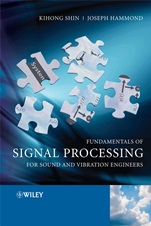
Fundamentals of Signal Processing for Sound and Vibration Engineers
ISBN 9780470511886
Autor: Kihong Shin, Joseph Hammond
Wydawca: Wiley
Dostępność: 3-6 tygodni
Cena: 502,95 zł
Przed złożeniem zamówienia prosimy o kontakt mailowy celem potwierdzenia ceny.
ISBN13: |
9780470511886 |
ISBN10: |
0470511885 |
Autor: |
Kihong Shin, Joseph Hammond |
Oprawa: |
Hardback |
Rok Wydania: |
2008-02-28 |
Ilość stron: |
416 |
Wymiary: |
244x170 |
Tematy: |
TG |
Fundamentals of Signal Processing for Sound and Vibration Engineers
Author: Kihong Shin and Joseph K. Hammond
Fundamentals of Signal Processing for Sound and Vibration Engineers is based on Joe Hammond’s many years of teaching experience at the Institute of Sound and Vibration Research, University of Southampton. Whilst the applications presented emphasise sound and vibration, the book focusses on the basic essentials of signal processing that ensures its appeal as a reference text to students and practitioners in all areas of mechanical, automotive, aerospace and civil engineering.
Offers an excellent introduction to signal processing for students and professionals in the sound and vibration engineering field.
Split into two parts, covering deterministic signals then random signals, and offering a clear explanation of their theory and application together with appropriate MATLAB examples.
Provides an excellent study tool for those new to the field of signal processing.
Integrates topics within continuous, discrete, deterministic and random signals to facilitate better understanding of the topic as a whole.
Illustrated with MATLAB examples, some using ‘real’ measured data, as well as fifty MATLAB codes on an accompanying website.
Spis treści:
Preface.
1. Introduction to Signal Processing.
1.1 Descriptions of Physical Data (Signals).
1.2 Classification of Data.
PART I: DETERMINISTIC SIGNALS.
2. Classification of Deterministic Data.
2.1 Periodic Signals.
2.2 Almost Periodic Signals.
2.3 Transient Signals.
2.4 Brief Summary and Concluding Remarks.
2.5 MATLAB Examples.
3. Fourier Series.
3.1 Periodic Signals and Fourier Series.
3.2 The Delta Function.
3.3 Fourier Series and the Delta Function.
3.4 The Complex Form of the Fourier Series.
3.5 Spectra.
3.6 Some Com
putational Considerations.
3.7 Brief Summary.
3.8 MATLAB Examples.
4. Fourier Integrals (Fourier Transform) and Continuous–Time Linear Systems.
4.1 The Fourier Integral.
4.2 Energy Spectra.
4.3 Some Examples of Fourier Transforms.
4.4 Properties of Fourier Transforms.
4.5 The Importance of Phase.
4.6 Echoes.
4.7 Continuous–Time Linear Time–Invariant Systems and Convolution.
4.8 Group Delay (Dispersion).
4.9 Minimum and Non–Minimum Phase Systems.
4.10 The Hilbert Transform.
4.11 The Effect of Data Truncation (Windowing).
4.12 Brief Summary.
4.13 MATLAB Examples.
5. Time Sampling and Aliasing.
5.1 The Fourier Transform of An Ideal Sampled Signal.
5.2 Aliasing and Anti–Aliasing Filters.
5.3 Analogue–to–Digital Conversion and Dynamic Range.
5.4 Some Other Considerations in Signal Acquisition.
5.5 Shannon’s Sampling Theorem (Signal Reconstruction).
5.6 Brief Summary.
5.7 MATLAB Examples.
6. The Discrete Fourier Transform.
6.1 Sequences and Linear Filters.
6.2 Frequency Domain Representation of Discrete Systems and Signals.
6.3 The Discrete Fourier Transform.
6.4 Properties of the DFT.
6.5 Convolution of Periodic Sequences.
6.6 The Fast Fourier Transform.
6.7 Brief Summary.
6.8 MATLAB Examples.
PART II: INTRODUCTION TO RANDOM PROCESSES.
7. Random Processes.
7.1 Basic Probability Theory.
7.2 Random Variables and Probability Distributions.
7.3 Expectations of Functions of a Random Variable.
7.4 Brief Summary.
7.5 MATLAB Examples.
8. Stochastic Processes; Correlation Functions and Spectra.
8.1 Probability Distribution Associated with a Stochastic Process.
8.2 Moments of a Stochastic Process.
8.3 Stationarity.
8.4 The Second Moments of a Stochastic Process; Covariance.
(Correlation) Functions.
8.5 Ergodicity and Time Averages.
8.6 Examples.
8
.7 Spectra.
8.8 Brief Summary.
8.9 MATLAB Examples.
9. Linear System Response to Random Inputs: System Identification.
9.1 Single–Input, Single–Output Systems.
9.2 The Ordinary Coherence Function.
9.3 System Identification.
9.4 Brief Summary.
9.5 MATLAB Examples.
10. Estimation Methods and Statistical Considerations.
10.1 Estimator Errors and Accuracy.
10.2 Mean Value and Mean Square Value.
10.3 Correlation and Covariance Functions.
10.4 Power Spectral Density Function.
10.5 Cross–spectral Density Function.
10.6 Coherence Function.
10.7 Frequency Response Function.
10.8 Brief Summary.
10.9 MATLAB Examples.
11. Multiple–Input/Response Systems.
11.1 Description of Multiple–Input, Multiple–Output (MIMO) Systems.
11.2 Residual Random Variables, Partial and Multiple Coherence Functions.
11.3 Principal Component Analysis.
Appendices.
References.
Index.
Nota biograficzna:
Joseph (Joe) Hammond graduated in Aeronautical Engineering in 1966 at the University of Southampton. He completed his PhD in the Institute of Sound and Vibration Research (ISVR) in 1972 whilst a lecturer in the Mathematics Department at Portsmouth Polytechnic. He returned to Southampton in 1978 as a lecturer in the ISVR, and was later Senior lecturer, Professor, Deputy Director and then Director of the ISVR from 1992–2001. In 2001 he became Dean of the Faculty of Engineering and Applied Science, and in 2003 Dean of the Faculty of Engineering, Science and Mathematics. he retired in July 2007 and is an Emeritus Professor at Southampton.
Kihong Shin graduated in Precision Mechanical Engineering from Hanyang University, Korea in 1989. After spending several years as an electric motor design and NVH engineer in Samsung Electro–Mechanics Co., he started an MSc at Cranfield University in 1992, on the design of rotating machines with ref
erence to noise and vibration. Following this, he joined the ISR and completed his PhD on nonlinear vibration and signal processing in 1996. In 2000, he moved back to Korea as a contract Professor of Hanyang University. In Mar. 2002, he joined Andong National University as an Assistant Professor, and is currently an Associate Professor.
Okładka tylna:
Fundamentals of Signal Processing for Sound and Vibration Engineers
Author: Kihong Shin and Joseph K. Hammond
Fundamentals of Signal Processing for Sound and Vibration Engineers is based on Joe Hammond’s many years of teaching experience at the Institute of Sound and Vibration Research, University of Southampton. Whilst the applications presented emphasise sound and vibration, the book focusses on the basic essentials of signal processing that ensures its appeal as a reference text to students and practitioners in all areas of mechanical, automotive, aerospace and civil engineering.
Offers an excellent introduction to signal processing for students and professionals in the sound and vibration engineering field.
Split into two parts, covering deterministic signals then random signals, and offering a clear explanation of their theory and application together with appropriate MATLAB examples.
Provides an excellent study tool for those new to the field of signal processing.
Integrates topics within continuous, discrete, deterministic and random signals to facilitate better understanding of the topic as a whole.
Illustrated with MATLAB examples, some using ‘real’ measured data, as well as fifty MATLAB codes on an accompanying website.
Koszyk
Książek w koszyku: 0 szt.
Wartość zakupów: 0,00 zł
Informacje


Kontakt
Gambit
Centrum Oprogramowania
i Szkoleń Sp. z o.o.
Al. Pokoju 29b/22-24
31-564 Kraków
Siedziba Księgarni
ul. Kordylewskiego 1
31-542 Kraków
+48 12 410 5991
+48 12 410 5987
+48 12 410 5989
Subskrypcje
Administratorem danych osobowych jest firma Gambit COiS Sp. z o.o. Na podany adres będzie wysyłany wyłącznie biuletyn informacyjny.
Autoryzacja płatności

Informacje na temat autoryzacji płatności poprzez PayU.

© Copyright 2012: GAMBIT COiS Sp. z o.o. Wszelkie prawa zastrzeżone.
Projekt i wykonanie: Alchemia Studio Reklamy