


Wydawcy
Katalog tematyczny
- Archeologia (109)
- Ekonomia, finanse, business (13704)
- Filozofia (1445)
- Historia (3040)
- Języki i językoznawstwo (2356)
- Lifestyle, hobby i rozrywka (475)
- Medycyna (9704)
- Nauki humanistyczne (4)
- Nauki o Ziemi i środowisku (2638)
- Nauki ścisłe (20412)
- Nauki społeczne (8486)
- Nauki techniczne (13450)
- Prawo (1696)
- Publikacje informacyjne i interdyscyplinarne (1288)
- Religia i wierzenia (917)
- Technika komputerowa (4067)
- Zdrowie, relacje międzyludzkie i rozwój osobisty (657)





Informacje szczegółowe o książce
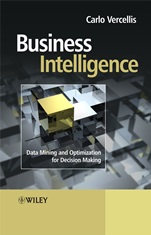
Business Intelligence: Data Mining and Optimization for Decision Making
ISBN 9780470511381
Autor: Carlo Vercellis
Wydawca: Wiley
Dostępność: 3-6 tygodni
Cena: 697,20 zł
Przed złożeniem zamówienia prosimy o kontakt mailowy celem potwierdzenia ceny.
ISBN13: |
9780470511381 |
ISBN10: |
0470511389 |
Autor: |
Carlo Vercellis |
Oprawa: |
Hardback |
Rok Wydania: |
2009-03-20 |
Ilość stron: |
436 |
Wymiary: |
235x162 |
Tematy: |
KM |
Business intelligence is a broad category of applications and technologies for gathering, providing access to, and analyzing data for the purpose of helping enterprise users make better business decisions. The term implies having a comprehensive knowledge of all factors that affect a business, such as customers, competitors, business partners, economic environment, and internal operations, therefore enabling optimal decisions to be made.
Business Intelligence provides readers with an introduction and practical guide to the mathematical models and analysis methodologies vital to business intelligence.
This book:Combines detailed coverage with a practical guide to the mathematical models and analysis methodologies of business intelligence.Covers all the hot topics such as data warehousing, data mining and its applications, machine learning, classification, supply optimization models, decision support systems, and analytical methods for performance evaluation.Is made accessible to readers through the careful definition and introduction of each concept, followed by the extensive use of examples and numerous real–life case studies.Explains how to utilise mathematical models and analysis models to make effective and good quality business decisions.
This book is aimed at postgraduate students following data analysis and data mining courses. Researchers looking for a systematic and broad coverage of topics in operations research and mathematical models for decision–making will find this an invaluable guide.
Spis treści:
Preface.
I Components of the decision–making process.
1 Business intelligence.
1.1 Effective and timely decisions.
1.2 Data, information and knowledge.
1.3 The role of mathematical models.
1.4 Business intelligence architectures.
1.5 Ethics and business intelligence.
1.6 Notes and readings.
2 Decision support systems.
2.1 Definition of system.
2.2 Representation of the decision–making process.
2.3 Evolution of information systems.
2.4 Definition of decision support system.
2.5 Development of a decision support system.
2.6 Notes and readings.
3 Data warehousing.
3.1 Definition of data warehouse.
3.2 Data warehouse architecture.
3.2.1 ETL tools.
3.3 Cubes and multidimensional analysis.
3.4 Notes and readings.
II Mathematical models and methods.
4 Mathematical models for decision making.
4.1 Structure of mathematical models.
4.2 Development of a model.
4.3 Classes of models.
4.4 Notes and readings.
5 Data mining.
5.1 Definition of data mining.
5.2 Representation of input data.
5.3 Data mining process.
5.4 Analysis methodologies.
5.5 Notes and readings.
6 Data preparation.
6.1 Data validation.
6.2 Data transformation.
6.3 Data reduction.
7 Data exploration.
7.1 Univariate analysis.
7.2 Bivariate analysis.
7.3 Multivariate analysis.
7.4 Notes and readings.
8 Regression.
8.1 Structure of regression models.
8.2 Simple linear regression.
8.3 Multiple linear regression.
8.4 Validation of regression models.
8.5 Selection of predictive variables.
8.6 Notes and readings.
9 Time series.
9.1 Definition of time series.
9.2 Evaluating time series models.
9.3 Analysis of the components of time series.
9.4 Exponential smoothing models.
9.5 Autoregressive models.
9.6 Combination of predictive models.
9.7 The forecasting process.
9.8 Notes and readings.
10 Classification.
10.1 Classification problems.
10.2 Evaluation of classification models.
10.3 Classification trees.
10.4 Bayesian methods.
10.5 Logistic regression.
10.6 Neural networks.
10.7 Support vector machines.
10.8 Notes and readings.
11 Association rules.
11.1 Motivation and structur
e of association rules.
11.2 Single–dimension association rules.
11.3 Apriori algorithm.
11.4 General association rules.
11.5 Notes and readings.
12 Clustering.
12.1 Clustering methods.
12.2 Partition methods.
12.3 Hierarchical methods.
12.4 Evaluation of clustering models.
12.5 Notes and readings.
III Business intelligence applications.
13 Marketing models.
13.1 Relational marketing.
13.2 Salesforce management.
13.3 Business case studies.
13.4 Notes and readings.
14 Logistic and production models.
14.1 Supply chain optimization.
14.2 Optimization models for logistics planning.
14.3 Revenue management systems.
14.4 Business case studies.
14.5 Notes and readings.
15 Data envelopment analysis.
15.1 Efficiency measures.
15.2 Efficient frontier.
15.3 The CCR model.
15.4 Identification of good operating practices.
15.5 Other models.
15.6 Notes and readings.
Appendix A Software tools.
Appendix B Dataset repositories.
References.
Index.
Nota biograficzna:
Carlo Vercellis – School of Management, Politecnico di Milano, Italy
As well as teaching courses in Operations Research and Business Intelligence, Professor Vercellis is director of the research group MOLD (Mathematical Modeling, Optimization, Learning from Data). He has written four book in Italian, contributed to numerous other books, and has had many papers published in a variety of international journals.
Okładka tylna:
Business intelligence is a broad category of applications and technologies for gathering, providing access to, and analyzing data for the purpose of helping enterprise users make better business decisions. The term implies having a comprehensive knowledge of all factors that affect a business, such as customers, competitors, business partners, economic environment, and internal oper
ations, therefore enabling optimal decisions to be made.
Business Intelligence provides readers with an introduction and practical guide to the mathematical models and analysis methodologies vital to business intelligence.
This book:Combines detailed coverage with a practical guide to the mathematical models and analysis methodologies of business intelligence.Covers all the hot topics such as data warehousing, data mining and its applications, machine learning, classification, supply optimization models, decision support systems, and analytical methods for performance evaluation.Is made accessible to readers through the careful definition and introduction of each concept, followed by the extensive use of examples and numerous real–life case studies.Explains how to utilise mathematical models and analysis models to make effective and good quality business decisions.
This book is aimed at postgraduate students following data analysis and data mining courses. Researchers looking for a systematic and broad coverage of topics in operations research and mathematical models for decision–making will find this an invaluable guide.
Koszyk
Książek w koszyku: 0 szt.
Wartość zakupów: 0,00 zł
Informacje


Kontakt
Gambit
Centrum Oprogramowania
i Szkoleń Sp. z o.o.
Al. Pokoju 29b/22-24
31-564 Kraków
Siedziba Księgarni
ul. Kordylewskiego 1
31-542 Kraków
+48 12 410 5991
+48 12 410 5987
+48 12 410 5989
Subskrypcje
Administratorem danych osobowych jest firma Gambit COiS Sp. z o.o. Na podany adres będzie wysyłany wyłącznie biuletyn informacyjny.
Autoryzacja płatności

Informacje na temat autoryzacji płatności poprzez PayU.

© Copyright 2012: GAMBIT COiS Sp. z o.o. Wszelkie prawa zastrzeżone.
Projekt i wykonanie: Alchemia Studio Reklamy