


Wydawcy
Katalog tematyczny
- Archeologia (109)
- Ekonomia, finanse, business (13704)
- Filozofia (1445)
- Historia (3040)
- Języki i językoznawstwo (2356)
- Lifestyle, hobby i rozrywka (475)
- Medycyna (9704)
- Nauki humanistyczne (4)
- Nauki o Ziemi i środowisku (2638)
- Nauki ścisłe (20412)
- Nauki społeczne (8486)
- Nauki techniczne (13450)
- Budownictwo lądowe (1045)
- Chemia przemysłowa (2258)
- Elektronika i telekomunikacja (3287)
- Energetyka (1122)
- Inne nauki stosowane (363)
- Inżynieria biochemiczna (507)
- Inżynieria transportu (232)
- Mechanika i materiały (3316)
- Nauka o środowisku (321)
- Rolnictwo (507)
- Technika, ogólnie (475)
- Prawo (1696)
- Publikacje informacyjne i interdyscyplinarne (1288)
- Religia i wierzenia (917)
- Technika komputerowa (4067)
- Zdrowie, relacje międzyludzkie i rozwój osobisty (657)





Informacje szczegółowe o książce
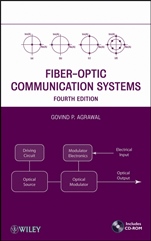
Fiber–Optic Communication Systems
ISBN 9780470505113
Autor: Govind P. Agrawal
Wydawca: Wiley
Dostępność: 3-6 tygodni
Cena: 707,70 zł
Przed złożeniem zamówienia prosimy o kontakt mailowy celem potwierdzenia ceny.
ISBN13: |
9780470505113 |
ISBN10: |
0470505117 |
Autor: |
Govind P. Agrawal |
Oprawa: |
Hardback |
Rok Wydania: |
2010-11-02 |
Numer Wydania: |
4th Edition |
Ilość stron: |
626 |
Wymiary: |
241x155 |
Tematy: |
TJ |
The definitive guide to fiber–optic communicationsystems, now fully up–to–date
since the release of the previous edition of this proven bestseller, fiber–optic communication systems (FOCS) have revolutionized the telecommunications industry and, due to advantages over electrical transmission, have largely replaced copper wire communications. Now, the Fourth Edition continues this trusted resource′s tradition of providing the most comprehensive FOCS coverage by incorporating the recent advances in the field, emphasizing both the physical understanding and engineering aspects.
Featured are two new chapters: one deals with the advanced modulation formats (such as DPSK, QPSK, and QAM) that are increasingly being used for improving spectral efficiency of WDM lightwave systems; the other focuses on new techniques such as all–optical regeneration that are under development and likely to be used in future communication systems. All other chapters have been updated, and material has been restructured to be better suited for a two–semester course on optical communications.
Students and researchers alike will benefit from the extensive pedagogical aids, including:
Extensive reference lists for each chapter
A survey of recent research material for each topic
Relevant end–of–chapter practice problems for instructors and students
A Solutions Manual available to instructors on request
State–of–the–art software on the enclosed CD, which students can use to design point–to–point optical links, as well as additional problems for each chapter
Used worldwide as a textbook in many universities, Fiber–Optic Communication Systems is intended primarily for graduate students of fiber–optic communications. It is also a valuable resource for undergraduate courses at the senior level, as well as an indispensable professional reference for engineers and technicians in the telecommunications industry and scientists working in the fields of fiber optics and optical communications.
Preface.
1 Introduction.
1.1 Historical Perspective.
1.2 Basic Concepts.
1.3 Optical Communication Systems.
1.4 Lightwave System Components.
Problems.
References.
2 Optical Fibers.
2.1 Geometrical–Optics Description.
2.2 Wave Propagation.
2.3 Dispersion in Single–Mode Fibers.
2.4 Dispersion–Induced Limitations.
2.5 Fiber Losses.
2.6 Nonlinear Optical Effects.
2.7 Fiber Design and Fabrication.
Problems.
References.
3 Optical Transmitters.
3.1 Semiconductor Laser Physics.
3.2 Single–Mode Semiconductor Lasers.
3.3 Laser Characteristics.
3.4 Optical Signal Generation.
3.5 Light–Emitting Diodes.
3.6 Transmitter Design.
Problems.
References.
4 Optical Receivers.
4.1 Basic Concepts.
4.2 Common Photodetectors.
4.3 Receiver Design.
4.4 Receiver Noise.
4.5 Coherent Detection.
4.6 Receiver Sensitivity.
4.7 Sensitivity Degradation.
4.8 Receiver Performance.
Problems.
References.
5 Lightwave Systems.
5.1 System Architectures.
5.2 Design Guidelines.
5.3 Long–Haul Systems.
5.4 Sources of Power Penalty.
5.5 Forward Error Correction.
5.6 Computer–Aided Design.
Problems.
References.
6 Multichannel Systems.
6.1 WDM Lightwave Systems.
6.2 WDM Components.
6.3 System Performance Issues.
6.4 Time–Division Multiplexing.
6.5 Subcarrier Multiplexing.
6.6 Code–Division Multiplexing.
Problems.
References.
7 Loss Management.
7.1 Compensation of Fiber Losses.
7.2 Erbium–Doped Fiber Amplifiers.
7.3 Raman Amplifiers.
7.4 Optical Signal–To–Noise Ratio.
7.5 Electrical Signal–To–Noise Ratio.
7.6 Receiver Sensitivity and Q Factor.
7.7 Role of Dispersive and Nonlinear Effects.
7.8 Periodically Amplified Lightwave Systems.
Problems.
References.
8 Dispersion Management.
8.1 Dispersion Problem and Its Solution.
8.2 Dispersion–Compensating Fibers.
8.3 Fiber Bragg Gratings.
8.4 Dispersion–Equalizing Filters.
8.5 Optical Phase Conjugation.
8.6 Channels at High Bit Rates.
8.7 Electronic Dispersion Compensation.
Problems.
References.
9 Control of Nonlinear Effects.
9.1 Impact of Fiber Nonlinearity.
9.2 Solitons in Optical Fibers.
9.3 Dispersion–Managed Solitons.
9.4 Pseudo–linear Lightwave Systems.
9.5 Control of Intrachannel Nonlinear Effects.
Problems.
References.
10 Advanced Lightwave Systems.
10.1 Advanced Modulation Formats.
10.2 Demodulation Schemes.
10.3 Shot Noise and Bit–Error Rate.
10.4 Sensitivity Degradation Mechanisms.
10.5 Impact of Nonlinear Effects.
10.6 Recent Progress.
10.7 Ultimate Channel Capacity.
Problems.
References.
11 Optical Signal Processing.
11.1 Nonlinear Techniques and Devices.
11.2 All–Optical Flip–Flops.
11.3 Wavelength Converters.
11.4 Ultrafast Optical Switching.
11.5 Optical Regenerators.
Problems.
References.
A System of Units.
B Acronyms.
C General Formula for Pulse Broadening.
D Software Package.
Govind P. Agrawal is a professor at the Institute of Optics at the University of Rochester and a Fellow of both the Optical Society of America and the Institute of Electrical and Electronics Engineering. He is also a Senior Scientist at the Laboratory for Laser Energetics. Dr. Agrawal is author or coauthor of more than 300 research papers, book chapters, and monographs.
"Despite the otherwise excellent quality of the book, there are also several typos, in the text as well as in the problems." (Optics and Photonics News, 13 May 2011)
Koszyk
Książek w koszyku: 0 szt.
Wartość zakupów: 0,00 zł
Informacje


Kontakt
Gambit
Centrum Oprogramowania
i Szkoleń Sp. z o.o.
Al. Pokoju 29b/22-24
31-564 Kraków
Siedziba Księgarni
ul. Kordylewskiego 1
31-542 Kraków
+48 12 410 5991
+48 12 410 5987
+48 12 410 5989
Subskrypcje
Administratorem danych osobowych jest firma Gambit COiS Sp. z o.o. Na podany adres będzie wysyłany wyłącznie biuletyn informacyjny.
Autoryzacja płatności

Informacje na temat autoryzacji płatności poprzez PayU.

© Copyright 2012: GAMBIT COiS Sp. z o.o. Wszelkie prawa zastrzeżone.
Projekt i wykonanie: Alchemia Studio Reklamy