


Wydawcy
Katalog tematyczny
- Archeologia (109)
- Ekonomia, finanse, business (13704)
- Filozofia (1445)
- Historia (3040)
- Języki i językoznawstwo (2356)
- Lifestyle, hobby i rozrywka (475)
- Medycyna (9704)
- Chirurgia (272)
- Inne gałęzie medycyny (1871)
- Medycyna kliniczna (4187)
- Medycyna niekonwencjonalna (14)
- Medycyna przedkliniczna (269)
- Medycyna, ogólnie (1740)
- Historia medycyny (3)
- Lekarze, sprawy zawodowe (8)
- Medycyna, aspekty prawne (10)
- Służba zdrowia (36)
- Wyposażenie medyczne (157)
- Zdrowie publiczne (460)
- Medyczne służby pomocnicze (745)
- Studia medyczne (16)
- Weterynaria (548)
- Nauki humanistyczne (4)
- Nauki o Ziemi i środowisku (2638)
- Nauki ścisłe (20412)
- Nauki społeczne (8486)
- Nauki techniczne (13450)
- Prawo (1696)
- Publikacje informacyjne i interdyscyplinarne (1288)
- Religia i wierzenia (917)
- Technika komputerowa (4067)
- Zdrowie, relacje międzyludzkie i rozwój osobisty (657)





Informacje szczegółowe o książce
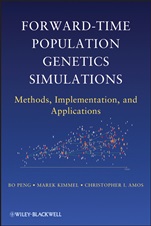
Forward–Time Population Genetics Simulations: Methods, Implementation, and Applications
ISBN 9780470503485
Autor: Bo Peng, Marek Kimmel, Christopher I. Amos
Wydawca: Wiley
Dostępność: 3-6 tygodni
Cena: 516,60 zł
Przed złożeniem zamówienia prosimy o kontakt mailowy celem potwierdzenia ceny.
ISBN13: |
9780470503485 |
ISBN10: |
0470503483 |
Autor: |
Bo Peng, Marek Kimmel, Christopher I. Amos |
Oprawa: |
Paperback |
Rok Wydania: |
2012-03-02 |
Ilość stron: |
256 |
Wymiary: |
228x161 |
Tematy: |
MBNS |
The only book available in the area of forward–time population genetics simulations applicable to both biomedical and evolutionary studies
The rapid increase of the power of personal computers has led to the use of serious forward–time simulation programs in genetic studies. Forward–Time Population Genetics Simulations presents both new and commonly used methods, and introduces simuPOP, a powerful and flexible new program that can be used to simulate arbitrary evolutionary processes with unique features like customized chromosome types, arbitrary nonrandom mating schemes, virtual subpopulations, information fields, and Python operators.
The book begins with an overview of important concepts and models, then goes on to show how simuPOP can simulate a number of standard population genetics models with the goal of demonstrating the impact of genetic factors such as mutation, selection, and recombination on standard Wright–Fisher models. The rest of the book is devoted to applications of forward–time simulations in various research topics.
Forward–Time Population Genetics Simulations includes:
An overview of currently available forward–time simulation methods, their advantages, and shortcomings
An overview and evaluation of currently available software
A simuPOP tutorial
Applications in population genetics
Applications in genetic epidemiology, statistical genetics, and mapping complex human diseases
The only book of its kind in the field today, Forward–Time Population Genetics Simulations will appeal to researchers and students of population and statistical genetics.
Preface ix
Acknowledgments xiii
List of examples xxiii
1. Basic concepts and models 1
1.1 Biological and genetic concepts 2
1.2 Population and evolutionary genetics 6
1.3 Statistical genetics and genetic epidemiology 17
2. Simulation of population genetics models 25
2.1 Random genetic drift 25
2.2 Demographic models 29
2.3 Mutation 31
2.4 Migration 34
2.5 Recombination and linkage disequilibrium 36
2.6 Natural selection 37
2.7 Genealogy of forward–time simulations 41
3. Ascertainment bias in population genetics 47
3.1 Introduction 47
3.2 Methods 49
3.3 Results 54
3.4 Discussion and Conclusions 58
4. Observing properties of evolving populations 63
4.1 Introduction 64
4.2 Simulation of the evolution of allele spectra 66
4.3 Extensions to the basic model 78
5. Simulating populations with complex human diseases 89
5.1 Introduction 89
5.2 Controlling disease allele frequencies at the present generation 91
5.3 Forward–time simulation of realistic samples 102
5.4 Discussion 119
6. Nonrandom mating and its applications 125
6.1 Assortative mating 126
6.2 More complex non–random mating schemes 132
6.3 Hetergeneous mating schemes 140
6.4 Simulation of age structured populations 145
Appendix: Forward–time simulations using stimulPOP 157
A.1 Introduction 157
A.2 Population 160
A.3 Operators 172
A.4 Evolve on or more populations 181
A.5 A complete stimuPOP script 185
Bo Peng, PHD, is an assistant professor in the Department of Genetics at The University of Texas MD Anderson Cancer Center. With his degrees in applied mathematics and biostatistics, he is applying advanced computational techniques such as parallel computation and large–scale simulations to research topics in population genetics, genetic epidemiology, and bioinformatics.
Marek Kimmel, PHD, is Director of the Doctoral Program in Bioinformatics and Statistical Genetics and head of the Bioinformatics Group at Rice University. He holds joint appointments as Professor of Statistics at Rice University, Professor of Biostatistics and Applied Mathematics at MD Anderson Cancer Center, and Professor of Biometry at The University of Texas School of Public Health.
Christopher I. Amos, PHD, is a professor in the Department of Genetics at The University of Texas MD Anderson Cancer Center. He also holds adjunct appointments at Rice University and in the Department of Epidemiology at The University of Texas School of Public Health.
Koszyk
Książek w koszyku: 0 szt.
Wartość zakupów: 0,00 zł
Informacje


Kontakt
Gambit
Centrum Oprogramowania
i Szkoleń Sp. z o.o.
Al. Pokoju 29b/22-24
31-564 Kraków
Siedziba Księgarni
ul. Kordylewskiego 1
31-542 Kraków
+48 12 410 5991
+48 12 410 5987
+48 12 410 5989
Subskrypcje
Administratorem danych osobowych jest firma Gambit COiS Sp. z o.o. Na podany adres będzie wysyłany wyłącznie biuletyn informacyjny.
Autoryzacja płatności

Informacje na temat autoryzacji płatności poprzez PayU.

© Copyright 2012: GAMBIT COiS Sp. z o.o. Wszelkie prawa zastrzeżone.
Projekt i wykonanie: Alchemia Studio Reklamy