


Wydawcy
Katalog tematyczny
- Archeologia (109)
- Ekonomia, finanse, business (13704)
- Filozofia (1445)
- Historia (3040)
- Języki i językoznawstwo (2356)
- Lifestyle, hobby i rozrywka (475)
- Medycyna (9704)
- Nauki humanistyczne (4)
- Nauki o Ziemi i środowisku (2638)
- Nauki ścisłe (20412)
- Nauki społeczne (8486)
- Nauki techniczne (13450)
- Budownictwo lądowe (1045)
- Chemia przemysłowa (2258)
- Elektronika i telekomunikacja (3287)
- Energetyka (1122)
- Inne nauki stosowane (363)
- Inżynieria biochemiczna (507)
- Inżynieria transportu (232)
- Mechanika i materiały (3316)
- Nauka o środowisku (321)
- Rolnictwo (507)
- Technika, ogólnie (475)
- Prawo (1696)
- Publikacje informacyjne i interdyscyplinarne (1288)
- Religia i wierzenia (917)
- Technika komputerowa (4067)
- Zdrowie, relacje międzyludzkie i rozwój osobisty (657)





Informacje szczegółowe o książce
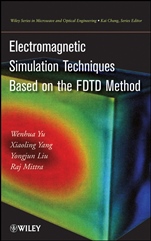
Electromagnetic Simulation Techniques Based on the FDTD Method
ISBN 9780470502037
Autor: W. Yu
Wydawca: Wiley
Dostępność: 3-6 tygodni
Cena: 643,65 zł
Przed złożeniem zamówienia prosimy o kontakt mailowy celem potwierdzenia ceny.
ISBN13: |
9780470502037 |
ISBN10: |
0470502037 |
Autor: |
W. Yu |
Oprawa: |
Hardback |
Rok Wydania: |
2009-10-06 |
Ilość stron: |
206 |
Wymiary: |
240x159 |
Tematy: |
TJ |
Bridges the gap between FDTD theory and the implementation of practical simulation techniques
This is the first publication that guides readers step by step through the implementation of electromagnetic simulation techniques based on FDTD methods. These simulation techniques serve as an essential bridge between FDTD methods and their applications. Moreover, the book helps readers better understand the underlying logic of FDTD methods so that they can design FDTD projects using either commercial electromagnetic software packages or their own codes in order to solve practical engineering problems.
The book begins with two chapters that introduce the basic concepts of the 3–D Cartesian FDTD method, followed by discussions of advanced FDTD methods such as conformal techniques, dispersive media, circuit elements, and near–to–far field transformation. Next, the book:
Presents basic concepts of parallel processing techniques and systems, including parallel FDTD techniques and systems
Explores simulation techniques based on FDTD methods
Illustrates practical simulation techniques using engineering applicationsIntroduces advanced simulation techniques
Each chapter concludes with references to help readers investigate particular topics in greater depth. Each chapter also includes problem sets that challenge readers to put their new FDTD and simulation skills into practice.
By bridging the gap between FDTD theory and practical simulation techniques, this publication is an invaluable guide for students and engineers who need to solve a wide range of design problems in RF, antenna, and microwave engineering.
Spis treści:
Preface.
1 Introduction to FDTD Method.
1.1 The FDTD Method.
1.2 Numerical Dispersion.
1.3 Stability Analysis.
1.4 Boundary Conditions.
References.
Exercises.
2 The Advanced FDTD Method.
2.1 Conformal Techniques for PEC Objects.<
br>2.2 Conformal Technique for Dielectric Objects.
2.3 Dispersive Media.
2.4 Circuit Parameters.
2.5 Power Analysis.
2.6 Near–to–Far Field Transformation.
References.
Exercises.
3 Parallel Computing Techniques.
3.1 Introduction to Parallel Processing Techniques.
3.2 Parallel FDTD Techniques.
3.3 Domain Decomposition Technique.
3.4 Parallel Processing Systems.
3.5 Excitation and Result Collection.
References.
Exercises.
4 Electromagnetic Simulation Techniques.
4.1 Introduction to Simulation Techniques.
4.2 Three–Dimensional Modeling Techniques.
4.3 Import CAD Models.
4.4 Mesh Design.
4.5 Excitation and Pulse Design.
4.6 Output Design.
4.7 Domain and Boundary Condition Setting.
4.8 Stability Characteristics of an Absorbing Boundary.
4.9 Project Preprocessing Technique.
4.10 Job Submission.
References.
Exercises.
5 Illustrative Engineering Applications.
5.1 Two–Dimensional Problem.
5.2 Dipole Antenna.
5.3 Rectangular Waveguide.
5.4 RCS of PEC and Dielectric Spheres.
5.5 Antennas.
5.6 Microwave Circuits.
5.7 Electromagnetic Interference.
5.8 Electronic Bandgap Structure.
5.9 RFID.
5.10 Standard SAR Test.
5.11 Bioelectromagnetic.
5.12 Helix Antennas.
5.13 Multiple–Port Scan Problems.
5.14 Antenna Array.
5.15 Multiscale Problem.
References.
Exercises.
6 Comprehensive Consideration for FDTD Simulation.
6.1 Compute Resource Estimation.
6.2 Mesh Design.
6.3 Excitation Design.
6.4 Simulation Termination.
6.5 Parallel Processing Design.
References.
Exercises.
Index.
About the Authors.
Nota biograficzna:
Wenhua Yu, PhD, is a Visiting Professor and the Group Leader of the Electromagnetic Communication Lab in the Electrical Engineering Department of Penn State University. Prior to joining the Penn State faculty, Dr. Yu
held teaching positions at the Communication University of China and the Beijing Institute of Technology. Dr. Yu, a Senior Member of the IEEE, founded Computer and Communication Unlimited in 2005, where he serves as President and CEO.
Xiaoling Yang, MS, is a Research Associate in the Electromagnetic Communication Lab at Penn State University. His research interests include numerical methods, visual languages, and software development.
Yongjun Liu, MS, worked at the Beijing Broadcasting Institute before joining the Electromagnetic Communication Lab at Penn State University in 2001.
Raj Mittra, PhD, is a Professor in the Electrical Engineering Department of Penn State University. He is Director of the Electromagnetic Communication Lab, which is affiliated with the Communication and Space Sciences Lab. Dr. Mittra, a Life Fellow of the IEEE, is a recipient of the Guggenheim Fellowship Award, IEEE Centennial Medal, IEEE Millennium Medal, IEEE Electromagnetics Award, and the IEEE/AP–S Distinguished Achievement Award. Dr. Mittra is President of RM Associates, a consulting organization that provides services to industrial and governmental organizations throughout the world.
Okładka tylna:
Bridges the gap between FDTD theory and the implementation of practical simulation techniques
This is the first publication that guides readers step by step through the implementation of electromagnetic simulation techniques based on FDTD methods. These simulation techniques serve as an essential bridge between FDTD methods and their applications. Moreover, the book helps readers better understand the underlying logic of FDTD methods so that they can design FDTD projects using either commercial electromagnetic software packages or their own codes in order to solve practical engineering problems.
The book begins with two chapters that introduce the basic concepts of the 3–D Cartesian FDTD method, followed by disc
ussions of advanced FDTD methods such as conformal techniques, dispersive media, circuit elements, and near–to–far field transformation. Next, the book:
Presents basic concepts of parallel processing techniques and systems, including parallel FDTD techniques and systems
Explores simulation techniques based on FDTD methods
Illustrates practical simulation techniques using engineering applicationsIntroduces advanced simulation techniques
Each chapter concludes with references to help readers investigate particular topics in greater depth. Each chapter also includes problem sets that challenge readers to put their new FDTD and simulation skills into practice.
By bridging the gap between FDTD theory and practical simulation techniques, this publication is an invaluable guide for students and engineers who need to solve a wide range of design problems in RF, antenna, and microwave engineering.
Koszyk
Książek w koszyku: 0 szt.
Wartość zakupów: 0,00 zł
Informacje


Kontakt
Gambit
Centrum Oprogramowania
i Szkoleń Sp. z o.o.
Al. Pokoju 29b/22-24
31-564 Kraków
Siedziba Księgarni
ul. Kordylewskiego 1
31-542 Kraków
+48 12 410 5991
+48 12 410 5987
+48 12 410 5989
Subskrypcje
Administratorem danych osobowych jest firma Gambit COiS Sp. z o.o. Na podany adres będzie wysyłany wyłącznie biuletyn informacyjny.
Autoryzacja płatności

Informacje na temat autoryzacji płatności poprzez PayU.

© Copyright 2012: GAMBIT COiS Sp. z o.o. Wszelkie prawa zastrzeżone.
Projekt i wykonanie: Alchemia Studio Reklamy