


Wydawcy
Katalog tematyczny
- Archeologia (109)
- Ekonomia, finanse, business (13704)
- Filozofia (1445)
- Historia (3040)
- Języki i językoznawstwo (2356)
- Lifestyle, hobby i rozrywka (475)
- Medycyna (9704)
- Nauki humanistyczne (4)
- Nauki o Ziemi i środowisku (2638)
- Nauki ścisłe (20412)
- Nauki społeczne (8486)
- Nauki techniczne (13450)
- Prawo (1696)
- Publikacje informacyjne i interdyscyplinarne (1288)
- Religia i wierzenia (917)
- Technika komputerowa (4067)
- Zdrowie, relacje międzyludzkie i rozwój osobisty (657)





Informacje szczegółowe o książce
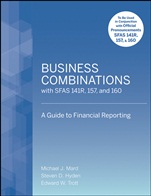
Business Combinations with SFAS 141 R, 157, and 160: A Guide to Financial Reporting
ISBN 9780470497555
Autor: Michael J. Mard, Steven D. Hyden, Edward W. Trott
Wydawca: Wiley
Dostępność: 3-6 tygodni
Cena: 909,30 zł
Przed złożeniem zamówienia prosimy o kontakt mailowy celem potwierdzenia ceny.
ISBN13: |
9780470497555 |
ISBN10: |
0470497556 |
Autor: |
Michael J. Mard, Steven D. Hyden, Edward W. Trott |
Oprawa: |
Paperback |
Rok Wydania: |
2009-04-03 |
Ilość stron: |
264 |
Wymiary: |
275x216 |
Tematy: |
KF |
Praise for Business Combinations with Sfas 141R, 157, and 160
"I am pleased to see this publication. Having known two of the authors for many years and employed their firm on many complex projects in the past, I am confident in their abilities. The intricacies of the topics mandate completeness of coverage in a succinct (impossible to be simple) manner if the reader is to grasp the true value. They′ve done that here."
–James A. McNulty, CPA, Chief Financial Officer, BioDelivery Sciences International, Inc.
"Through this Guide, valuation experts, auditors, and preparers of financial statements alike will acquire the necessary skills to meet the rigors of FASB′s new pronouncements on fair value and business combinations, specifically Sfas 141r, Sfas 160, And Sfas 157. The guide examines these ′principle–based′ pronouncements, their particular nuances, and their relationship to one another in a clear and concise manner. Finally, the Guide applies these principles learned to a business combination case study that encompasses the specialized valuation techniques for valuing tangible assets, intangible assets, and liabilities."
–Donald P. Wisehart, Asa, Cpa/Abv/Cff, Cva, Mst, Wisehart, Inc.
"This Guide will be of immense value to anyone who actually has to perform a Purchase Price Allocation for a business combination. The authors start with the FASB′s own statements. They then explain the language in the statements in a way that will allow the reader to meet the actual requirements. With this Guide, the mystery has been removed for preparers of company′s financial statements to comply with the applicable FASB statements. Recommended unreservedly."
–Alfred M. King, Cma, Cfm, Marshall–Stevens, Inc.
Spis treści:
About the Authors.
Michael J. Mard, CPA/ABV, ASA.
Steven D. Hyden, CPA/ABV, ASA.
Edward W. Trott.
Acknowledgments.
Preface.
Introduct
ion.
Philosophy of Fair Value.
SFAS 157.
Fair Value Philosophy.
Convergence with IFRS.
Norwalk Agreement.
The IASB.
Use of Valuation Specialists by Accountants and Auditors.
Fair Value and SFAS 157.
Scope.
Fair Value Definition.
Principal (or Most Advantageous) Market.
Transaction Costs.
Transportation Costs.
Market Participants.
Highest and Best Use and Valuation Premise.
Applicability to Liabilities.
Entry Price Versus Exit Price.
Valuation Techniques: Market, Income, and Cost Approaches.
Cost Approach.
Income Approach.
Examples of Present Value Techniques.
Market Approach.
Risk/Uncertainty Premiums.
Inputs: Observable and Unobservable.
Fair Value Hierarchy.
Inputs Based on Bid and Ask Prices.
Restrictions.
Stock.
Assets.
Events Subsequent to a Quoted Price.
Securities Owned as an Asset and Blockage Discounts.
Disclosures.
Subsequent Guidance about SFAS 157.
EITFs.
FSPs.
Preparer’s Guidance Flowchart of SFAS 157.
SFAS 141R.
Overview and Objective.
Statement 141R and IFRS 3 (as revised).
Statement of 141R Reduces the Volume of US GAAP.
Expanded Scope of Applying the Acquisition Method.
Transactions Not Covered by 141R.
The Acquisition Method.
Identifying the Acquirer.
Determining the Acquisition Date.
Recognition and Measurement.
Postcombination Expenses (Restructuring or Exit Activities).
Acquisition–Related Costs.
Determining What Is Part of a Business Combination.
Preexisting Relationships or Arrangement.
Compensation Arrangements.
Hidden Acquisition Costs.
Classifying or Designating Assets and Liabilities.
Examples of Acquired Assets and Assumed Liabilities Initially Recognized at Fair Value.
Assets.
Liabilities.
Recording Assets and Liabilities at SFAS 157 Fair Value Differs from Guidance in SFAS 141.
Exceptions to the Recognition or Measurement Principles.
Assets/Liabiliti
es Arising from Contingencies.
Acquirer Obtains a Reacquired Right.
Share–Based Payment Awards.
Assets Held for Sale.
Income Taxes, Tax Uncertainties, and Tax Valuation Allowance.
Employee Benefits.
Indemnification Assets.
Additional Specific Guidance.
Operating Leases.
Capital Leases.
Intangible Assets.
Intangible Assets Not Recognized by Acquiree.
Research and Development Assets.
Assets an Acquirer Does Not Plan to Use or Sell.
Recording the Consideration Transferred to Acquire the Acquiree, Including Contingent Consideration.
Contingent Consideration.
Calculation of Goodwill and Recording Noncontrolling Interest in the Acquiree.
Goodwill Calculation in a 100% Acquisition.
Goodwill Calculation in a Full Acquisition (Acquirer Has an Existing Investment).
Calculation of Goodwill in a Partial Acquisition and Recording Noncontrolling Interest.
Gain from a Bargain Purchase.
The Measurement Period for Recording a Business Combination.
Disclosures about a Business Combination.
Selected Disclosure Requirements.
Effective Date and Transition.
Other Guidance in Statement 141R.
Subsequent Guidance about SFAS 141R.
EITFs.
Statement 160 and Noncontrolling Interest.
Objective and Scope.
Definition.
Transactions that Change the Parent’s Ownership Interest in a Subsidiary.
Purchase of Noncontrolling Interest (Minority Interest).
Reduction in Parent Ownership Interest.
Deconsolidation of a Subsidiary.
Classification of Noncontrolling Interest.
Changes to the Balance Sheet.
Changes to the Income Statement.
Additional Points about Noncontrolling Interest.
Disclosures about Noncontrolling Interests.
Selected Disclosure Requirements.
Effective Date and Transition.
Subsequent Guidance about SFAS 160.
Comparing SFAS 141 with SFAS 141R.
(New) SFAS 141R.
(Old) SFAS 141.
141R Flowchart.
Case Study: Determining the Value of Goodwill and Ot
her Intangible Assets in a Business Combination.
Consideration and Calculation of the Total of Intangible Assets and Goodwill.
Identifying Intangible Assets.
Remaining Useful Life Analysis.
Business Enterprise Analysis.
Discounted Cash Flow Method.
Discount Rate.
Valuation of Tangible Assets.
General Discussion.
Marketable Securities.
Accounts Receivable.
Inventory.
Prepaid Expenses.
Land and Building.
Machinery and Equipment.
Organization Cost and Existing Goodwill.
Summary of Values.
Valuation of Intangible Assets.
Rates of Return.
Acquired Software.
Amortization Benefit.
Discount Rate for Amortization Benefit.
Assembled Workforce.
Trade Name.
Noncompete Agreement.
Technology (Existing and In–process) and Customer Relationships.
The Multiperiod Excess Earnings Method.
Existing Technology.
In–Process Research and Development.
Customer Relationships.
Valuation of Goodwill.
Weighted Average Return on Assets.
Case Study Accounting Entry.
Abbreviated Sample Worksheet.
Sample Balance Sheet.
Case Study Exhibits.
Other Discussion Issues.
FASB’s Valuation Resource Group.
Issue No. 2008–19 – Impact of Valuing Contingent Liabilities under FAS 141(R) – Gross Versus Net Analysis.
Issue No. 2008–18 – Fair Value of a Noncontrolling Interest and a Previously held Equity Interest.
Issue No. 2008–17 – Identification and Allocation of Market Participant Synergies.
Issue No. 2008–16 – Fair Value of Accounts Receivable, Account Payable, and Other Accrued Liabilities.
Issue No. 2008–15 – Allocation of In–use Valuation to Individual Unit of Account.
Issue No. 2008–14 – Fair Value Measurement of Liabilities Under FAS 157.
Issue No. 2008–13 – Observable Versus Unobservable Inputs.
Issue No. 2008–12 – Fair Value Disclosures.
Issu
Koszyk
Książek w koszyku: 0 szt.
Wartość zakupów: 0,00 zł
Informacje


Kontakt
Gambit
Centrum Oprogramowania
i Szkoleń Sp. z o.o.
Al. Pokoju 29b/22-24
31-564 Kraków
Siedziba Księgarni
ul. Kordylewskiego 1
31-542 Kraków
+48 12 410 5991
+48 12 410 5987
+48 12 410 5989
Subskrypcje
Administratorem danych osobowych jest firma Gambit COiS Sp. z o.o. Na podany adres będzie wysyłany wyłącznie biuletyn informacyjny.
Autoryzacja płatności

Informacje na temat autoryzacji płatności poprzez PayU.

© Copyright 2012: GAMBIT COiS Sp. z o.o. Wszelkie prawa zastrzeżone.
Projekt i wykonanie: Alchemia Studio Reklamy