


Wydawcy
Katalog tematyczny
- Archeologia (109)
- Ekonomia, finanse, business (13704)
- Filozofia (1445)
- Historia (3040)
- Języki i językoznawstwo (2356)
- Lifestyle, hobby i rozrywka (475)
- Medycyna (9704)
- Nauki humanistyczne (4)
- Nauki o Ziemi i środowisku (2638)
- Nauki ścisłe (20412)
- Astronomia (294)
- Biologia (5119)
- Chemia (6540)
- Chemia analityczna (361)
- Chemia fizyczna (346)
- Chemia nieorganiczna (137)
- Chemia organiczna (535)
- Krystalografia (27)
- Minerologia (46)
- Fizyka (3309)
- Matematyka (4574)
- Nauki ścisłe, ogólnie (503)
- Nauki społeczne (8486)
- Nauki techniczne (13450)
- Prawo (1696)
- Publikacje informacyjne i interdyscyplinarne (1288)
- Religia i wierzenia (917)
- Technika komputerowa (4067)
- Zdrowie, relacje międzyludzkie i rozwój osobisty (657)





Informacje szczegółowe o książce
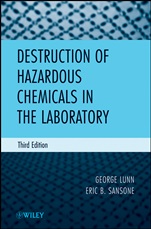
Destruction of Hazardous Chemicals in the Laboratory
ISBN 9780470487556
Autor: George Lunn, Eric B. Sansone
Wydawca: Wiley
Dostępność: 3-6 tygodni
Cena: 638,40 zł
Przed złożeniem zamówienia prosimy o kontakt mailowy celem potwierdzenia ceny.
ISBN13: |
9780470487556 |
ISBN10: |
0470487550 |
Autor: |
George Lunn, Eric B. Sansone |
Oprawa: |
Hardback |
Rok Wydania: |
2012-05-15 |
Numer Wydania: |
3rd Edition |
Ilość stron: |
800 |
Wymiary: |
234x156 |
Tematy: |
PN |
The fully updated reference on degrading and disposing ofhazardous chemicals in the laboratory
When it′s time for laboratory technicians to get rid ofhazardous materials, they can′t simply dump them in the trash.Detailed procedures need to be followed to safely degrade anddispose of hazardous chemicals from bulk quantities ofmaterial to accidental spills.
This new edition of Destruction of Hazardous Chemicals in theLaboratory includes validated methods for safely degrading specificcompounds, such as nitrosamines and aflatoxins, as well as generalstrategies that are applicable to all organic compounds. Inaddition, promising emerging technologies, such as advancedoxidation procedures, that are applicable to the destruction ofhazardous compounds in the laboratory are discussed. Practicaldetails are provided so these procedures can be readily implementedin the laboratory, often by technicians, without the use of exoticreagents or special equipment. Methods for the destruction ofpharmaceuticals have been placed in a new and greatly expandedsection, and many new monographs, including some on dealing withtoxins derived from biological agents, are included.
Destruction of Hazardous Chemicals in the Laboratory, ThirdEdition integrates all the available validated procedures for thesafe destruction of hazardous chemicals in the laboratory into onecomplete volume. No comparable text in this field provides such awealth of in–depth coverage on such an important topic. Togetherwith books on the hazardous properties of chemicals and generalprecautionary procedures, this practical guide should form thenucleus of any library concerned with chemical safety.
PREFACE xi
ACKNOWLEDGMENTS xiii
INTRODUCTION 1
SPECIFIC METHODS FOR THE DESTRUCTION OF HAZARDOUS CHEMICALSIN THE LABORATORY 17
Acetonitrile 19
Acid Halides and Anhydrides 23
Aflatoxins 29
Alkali and Alkaline Earth Metals 37
Alkali Metal Alkoxides 41
Anatoxin–A 43
Aromatic Amines 47
Arsenic 57
Azides 61
Azo and Azoxy Compounds and Tetrazenes 69
Boron Trifluoride and Inorganic Fluorides 77
Botulinum Toxins 81
Brevetoxins 85
Butyllithium 89
Calcium Carbide 93
Carbamic Acid Esters 95
Carbofuran 99
Chloromethylsilanes and Silicon Tetrachloride 101
N–Chlorosuccinimide and Chloramine–T 103
Chlorosulfonic Acid 105
Chromium(VI) 107
Citrinin 113
Complex Metal Hydrides 121
Cyanides and Cyanogen Bromide 129
Cylindrospermopsin 137
Diisopropyl Fluorophosphate 141
Dimethyl Sulfate and Related Compounds 151
Dyes and Biological Stains 163
Ethidium Bromide 201
Haloethers 211
Halogenated Compounds 217
Halogens 229
Heavy Metals 233
Hexamethylphosphoramide 241
Hydrazines 245
Hypochlorites 257
Mercury 261
2–Methylaziridine 267
1–Methyl–4–phenyl–1,2,3,6–tetrahydropyridine (MPTP) 271
Microcystins 277
4–Nitrobiphenyl 283
3–Nitrofluoranthene and 3–Aminofluoranthene 287
Nitrogen Tetroxide 291
N–Nitroso Compounds: Nitrosamides 293
N–Nitroso Compounds: Nitrosamines 307
Ochratoxin A 319
Organic Nitriles 327
Osmium Tetroxide 331
Palytoxin 335
Patulin 339
Peracids 347
Perchlorates 349
Peroxides and Hydroperoxides 355
Phenol 359
Phosgene 363
Phosphorus and Phosphorus Pentoxide 367
Picric Acid 371
Polycyclic Aromatic Hydrocarbons 375
Polycyclic Heterocyclic Hydrocarbons 387
Potassium Permanganate 405
b–Propiolactone 407
Protease Inhibitors 411
Ricin 417
Saxitoxin 421
Selenium Compounds 425
Sodium Amide 427
Sterigmatocystin 429
Sulfonyl Fluoride Enzyme Inhibitors 437
Sulfur–Containing Compounds 443
T–2 Toxin 449
Tetrodotoxin 455
Triacetone Triperoxide 459
Uranyl Compounds 463
METHODS FOR THE DESTRUCTION OF PHARMACEUTICALS IN THELABORATORY 467
Pharmaceuticals: General Considerations 469
A: Potassium Permanganate 549
B: Sodium Hypochlorite 567
C: Nickel–Aluminum Alloy Reduction 575
D: Fenton s Reagent 583
E: Photo–Fenton Reaction 587
F: Hydrogen Peroxide 591
G: Hydrogen Peroxide and Horseradish Peroxidase 593
H: Ozone 595
I: Hydroxylamine Degradation of b–Lactams 603
J: Miscellaneous Chemical Degradation Procedures 605
K: Photolytic Degradation Procedures 613
L: Decontamination of Aqueous Solutions 627
NONSPECIFIC METHODS FOR THE DESTRUCTION OF HAZARDOUSCHEMICALS IN THE LABORATORY 631
APPENDIXES 655
APPENDIX I: Procedures for Drying Organic Solvents 657
APPENDIX II: Safety Considerations with Potassium Permanganate661
MOLECULAR FORMULA INDEX 671
CAS REGISTRY NUMBER INDEX 681
CROSS INDEX OF PHARMACEUTICAL NAMES 693
CROSS–INDEX OF NAMES FOR DYES AND BIOLOGICAL STAINS 729
NAME INDEX 757
George Lunn, PhD, has been working as a review chemist for the FDA′s Office of New Drug Quality Assessment since 1996. Previously, he was a senior research scientist in the Environmental Control and Research Program at the NCI–Frederick Cancer Research and Development Center. He has written nine books and over sixty papers and review articles.
Eric B. Sansone, PhD, was the director of the Environmental Control and Research Program at the NCI–Frederick Cancer Research and Development Center until his retirement. He has also worked as a consultant in industrial hygiene and air pollution control for a widely diversified group of industries, law firms, universities, and governmental agencies. He has published many articles on the assessment of risk in cancer research.
The book provides a good survey on destruction methodssuitable for small and medium sized laboratories. Thewell–structured writing style provides an interesting textbook,helpful for every laboratory technician, and a reference book forsupervisors responsible for the laboratory work. (Materials and Corrosion, 1 August 2012)
The writing is clear and precise, molecular structuresand diagrams are clearly labelled, and procedures appear to beup–to–date, efficient, and adaptable . . . Summing Up:Essential. Graduate students throughprofessionals/practitioners in academic, commercial, or industrialchemical laboratories. (Choice, 1 November2012)
Koszyk
Książek w koszyku: 0 szt.
Wartość zakupów: 0,00 zł
Informacje


Kontakt
Gambit
Centrum Oprogramowania
i Szkoleń Sp. z o.o.
Al. Pokoju 29b/22-24
31-564 Kraków
Siedziba Księgarni
ul. Kordylewskiego 1
31-542 Kraków
+48 12 410 5991
+48 12 410 5987
+48 12 410 5989
Subskrypcje
Administratorem danych osobowych jest firma Gambit COiS Sp. z o.o. Na podany adres będzie wysyłany wyłącznie biuletyn informacyjny.
Autoryzacja płatności

Informacje na temat autoryzacji płatności poprzez PayU.

© Copyright 2012: GAMBIT COiS Sp. z o.o. Wszelkie prawa zastrzeżone.
Projekt i wykonanie: Alchemia Studio Reklamy