


Wydawcy
Katalog tematyczny
- Archeologia (109)
- Ekonomia, finanse, business (13704)
- Filozofia (1445)
- Historia (3040)
- Języki i językoznawstwo (2356)
- Lifestyle, hobby i rozrywka (475)
- Medycyna (9704)
- Nauki humanistyczne (4)
- Nauki o Ziemi i środowisku (2638)
- Nauki ścisłe (20412)
- Nauki społeczne (8486)
- Nauki techniczne (13450)
- Prawo (1696)
- Publikacje informacyjne i interdyscyplinarne (1288)
- Religia i wierzenia (917)
- Technika komputerowa (4067)
- Zdrowie, relacje międzyludzkie i rozwój osobisty (657)





Informacje szczegółowe o książce
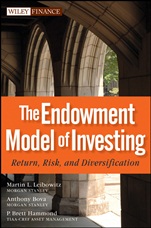
The Endowment Model of Investing: Return, Risk, and Diversification
ISBN 9780470481769
Autor: Martin L. Leibowitz, Anthony Bova, P. Brett Hammond
Wydawca: Wiley
Dostępność: 3-6 tygodni
Cena: 354,90 zł
Przed złożeniem zamówienia prosimy o kontakt mailowy celem potwierdzenia ceny.
ISBN13: |
9780470481769 |
ISBN10: |
0470481765 |
Autor: |
Martin L. Leibowitz, Anthony Bova, P. Brett Hammond |
Oprawa: |
Hardback |
Rok Wydania: |
2010-04-16 |
Ilość stron: |
352 |
Wymiary: |
235x161 |
Tematy: |
KF |
Praise for The Endowment Model of Investing
"This is a terrific book–required reading for any CIO responsible for the management of long–term investment portfolios."
—Lyn Hutton, Chief Investment Officer, Commonfund
"In my judgment—a must–read for every chief investment officer or strategist."
—Allan S. Bufferd, Treasurer Emeritus, MIT
"Shed(s) . . . light on . . . [endowment] portfolios during the financial crisis, and why their pain was predictable,inevitable, and . . . necessary for long–term success."
—Andrew K. Golden, President, Princeton University Investment Company
"This is a must–read for every institutional investor concerned with portfolio risk management. Full of important insights and robust analyses."
—Ian Kennedy, former global director of research, Cambridge Associates
"An elegant, rigorous, and articulate examination of . . . the endowment model . . . and why skillful
implementation is always crucial."
—Charles D. Ellis, author, Winning the Loser′s Game
"Is the endowment model broken? The answer, as provided . . . [in this] . . . appealing mix of analysis and common sense . . . is ′No′."
—Jack R. Meyer, Managing Partner and CEO, Convexity Capital
"A penetrating analysis of the trend towards allocating into multiple asset classes that shows when suchdiversification helps to control fund–level risk—and when it does not!"
—Jim Simons, Chairman, Renaissance Technologies LLC
"All–in–all . . . a balanced and exceptionally thoughtful study . . . that is sorely needed . . . a lot of great insight intobasic finance and investing. Heartily recommended."
—Clifford Asness, Chairman, AQR Investments
"A valuable new approach that probes more deeply into the various forms of diversification."
—Frank J. Fabozzi, Professor in the Practice of Finance, Yale School of Management, and
Editor, Journal of Portfolio Management
"A major advance in . . . investing for endowments . . . provides a way to incorporate . . . ′alphas′ into a risk/return framework . . . I think the book is great."
—David Booth, CEO, Dimensional Fund Advisors
"Many institutional funds may find this framework insightful for asset allocation and risk management purposes."
—Roger Clarke, Chairman, Analytic Investors, Inc.
"A compendium of insightful and actionable principles for the endowment space. . . an important . . . framework for
success for many institutional portfolios."
—H. Gifford Fong, President, Gifford Fong Associates
"A must–read for assessing . . . the future of this trusted model. This very readable book calls for maintaining the endowment model but adjusting our time horizons."
—Edgar Sullivan, Managing Director, Promark Global Advisors (formerly General Motors Asset Management)
Spis treści:
Preface.
Acknowledgments.
Part I: Alpha/Beta Building Blocks of Portfolio Management.
Chapter 1: The Modern Endowment Allocation Model.
Truly Long Term Orientation.
Novel Asset Classes and Special Access.
Remaking the Investment Manager Relationship.
More Market–Sensitive Allocations.
Asset Allocation.
Beta–Based Risk and Return: The Sigma and Beta Lines.
Notes.
References.
Chapter 2: Structural Betas and Alphas.
Finding the Beta in the Black Box.
The Structural Beta.
Return Components of Asset Classes.
Risk Components of Asset Classes.
Portfolio Beta Values.
“Modern” Allocations with Alternatives.
The Extreme Allocation.
Return Components at the Portfolio Level.
Comparison of Portfolios′ Risks and Returns.
Implications for Institutional Portfolios.
Beta as the Key Risk Factor.
Notes.
Part II: Beta–Based Asset Allocation.
Chapter 3: Beyond Dive
rsification: “Dragon Risk”.
The Nature of Diversification.
Dragon Risk.
A Diversification Model.
Diversification in Sources of Return.
Potential Diversification “Costs”.
Overdiversification versus Dragon Risk.
Chapter 4: Reverse Asset Allocation Using Alpha Cores.
Simplifying the Portfolio Optimization Process.
The Alpha Core.
The Swing Assets.
The Fixed Alpha Core Segment.
Generality of the Alpha Core Representation.
Varying the Core Parameters.
The Cash Line Segment.
The Bond Bridge.
The Equity Extension Segment.
The Three Segment Frontier.
The Frontier Slope.
The Uplifted Frontier.
Channel Risk.
Risk Mitigation and Asset Class Inclusion.
Conclusion.
Appendix.
Chapter 5: The Efficient Frontier with Bonds as the Risk–Free Base.
The Equity Risk Premium.
Bond–Relative Alphas and Betas.
Risk Analysis.
Portfolio Level Analysis.
The Alpha Core.
Efficient Frontier Analysis.
The Alpha Effect.
Appendix.
Chapter 6: Expanding the Alpha Core.
Inherent Constraints on Alternative Assets.
Building An Alpha Core.
Maximum–Return Alpha Cores.
The “Flower” Diagram.
Expanding the Alpha Core.
Moving Beyond Beta Domination.
Dual Active/Allocation Alphas.
Conclusion.
Chapter 7: Alpha–Driven Efficient Frontiers.
The Efficient Frontier in Alpha Space.
Increasing the Alpha Core Percentage.
Conclusion.
Chapter 8: The Societal Efficient Frontier.
Standard Efficient Frontiers.
The Swing Asset Frontier.
The Concept of a Societal Frontier.
Total Betas and the Diversification Paradox.
Dragon Risk Constraints and “Climbing the Alpha Wall”.
A “Societal Frontier” of Quantum Risk States.
Active Alphas and Other Return/Risk Tradeoffs.
Societal Gaps and Opportunities.
References.
Chapter 9: Equilibration.
Beta Domination and Constrained Alternatives.
Alpha Decay under Beta Domination.
Realized Returns versus Going–Forward Alphas.
Sharpe Ratio Decay.
Sequential Alpha Erosion.
Equilibration across the Societal Frontier.
References.
Chapter 10: Shortfall Risks and Efficient Frontiers.
Importance of Shortfall Risk in Portfolios.
Efficient Frontiers Using Fixed Alpha Cores.
Shortfall Probabilities.
Shortfall Regions in Return/Risk Space.
Shortfalls Relative to the Risk–Free Baseline.
Shortfall Probabilities along the Efficient Frontier.
Multiple Horizon Comparisons.
Appendix.
References.
Chapter 11: Convergence of Risks.
End–of–Period Shortfall Probabilities.
Within–Period “Stop–Loss” Probabilities.
High Watermark Shortfalls.
Changing the Thresholds and Horizons.
Shortfall Probabilities along the Efficient Frontier.
Acceptable Return/Risk Regions.
Conclusion.
References.
Chapter 12: Active Alphas: Bound, Portable, and Integrated.
Allocation Alphas.
Active Alphas.
Portable Alphas.
Bound–Active Alphas.
Integrated Alphas.
Risk Budgets.
Expanding the Active Universe.
Shifting Policy Portfolios.
Conclusion.
References.
Chapter 13: Beta–Based Performance Analysis.
Active versus Passive Alphas.
Decomposition of Benchmark Return.
Relative Return Analysis.
Actives Alphas without Reweighting.
Overweighting Active Alphas.
Adding a New Asset Class.
Beta Neutralization.
Analyzing Historical Performance.
Conclusion.
Chapter 14: Real Return “Tents” and Equity Durations.
P/E Ratios and Nominal Interest Rates.
P/E Ratios and Equity Duration.
Inflation vs. Real Rate Effects.
Spread–Driven DDM′s.
P/E Ratios vs. Inflation.
P/E Ratios vs. Real Rates.
Conclusion.
References.
Part III: Theoretical and Empiri
cal Stress Betas.
Chapter 15: Stress Betas and Correlation Tightening.
Portfolio Convexity Effects.
Stress Correlations of One.
Residual Volatility Constant.
Varying Residual Volatilities.
Conclusion.
Appendix.
References.
Chapter 16: Stress Risks within Asset and Surplus Frameworks.
Risk Life Cycles.
Stress Times as Determinant of Risk Tolerance.
Correlation Tightening Under Stress.
Divergence under Stress.
Short–Term Risk Reduction and Long–Term Returns.
Normal Correlation–Based Betas.
Beta Response Curves.
Stress Betas.
The Surplus Framework.
Surplus Beta Curves.
Partial Liability Hedge.
Full Liability Hedge.
De–Risking and Re–Risking.
Maintaining a Fund′s Return–Seeking Potential.
Diversification Alphas.
Active Alphas.
Double Alphas and Portability.
References.
Chapter 17: Stress Beta Pathways.
An Empirical Example.
A Minimum Residual Volatility Model.
Implied Asset Volatility.
Stress Betas at the Asset Level.
Short–Term Vulnerability of Diversified Portfolios.
Beta Pathways for Individual Asset Classes.
Appendix.
Chapter 18: The Endowment Model: Theory and Experience.
Theoretical Beta–Based Risks.
Historical Risk Characteristics.
Alpha and Beta Returns.
Conclusion.
Chapter 19: Diversification Performance: Under Stress (2008) and Over the Long Term (1993–2007).
A Semi–Diversified Portfolio.
Volatilities and Volatility Ratios.
Individual and Portfolio Correlations with US Equity.
Historical Betas.
Beta–Based and Alpha Returns.
Stress Beta Theory.
2008 Results and Stress Betas.
Conclusion.
Part IV: Asset Allocation and Return Thresholds.
Chapter 20: Asset Allocation and Return Thresholds in a Beta World.
Percentiles in Return/Beta Space.
The Percentile Fan.
Minimum and Maximum Beta
s for Return Targets.
The “Characteristic Probability” of Exceeding the Risk–Free Rate.
Multi–Year Horizons.
Beta Regimes.
Shortfall Lines.
Alpha Cores and Stress Betas.
Conclusion.
Appendix.
References.
Chapter 21: Key Takeaways.
About the Authors.
Index.
Nota biograficzna:
Martin L. Leibowitz is Managing Director in the U.S. Research Department at Morgan Stanley. Prior to working at Morgan Stanley, he was vice chairman and chief investment officer of TIAA–CREF. Leibowitz is a leading authority in the fields of security analysis and portfolio allocation. He is the author of four books, including Franchise Value, and 138 articles, eight of which have won the prestigious Graham and Dodd Award for excellence in financial writing.
Anthony Bova is a Vice President in the Morgan Stanley Research Department, focusing on institutional portfolio strategy. He recently won the ninth annual Bernstein Fabozzi/Jacobs Levy Award for coauthoring the article "Gathering Implicit Alphas in a Beta World," which ran in the Spring 2007 issue of the Journal of Portfolio Management.
P. Brett Hammond is a Managing Director and Chief Investment Strategist for TIAA–CREF Asset Management. His group is responsible for asset allocation modeling, institutional advising, economic and market commentary, and investment product and portfolio research. Within TIAA–CREF, Hammond has also published extensively on pension issues, developed new approaches to performance attribution, and played a key role in the creation of the company′s life–cycle inflation–linked bond funds.
Okładka tylna:
Praise for The Endowment Model of Investing
"This is a terrific book–required reading for any CIO responsible for the management of long–term investment portfolios."
—Lyn Hutton, Chief Investment Officer, Commonfund
"In my judgment—a mu
st–read for every chief investment officer or strategist."
—Allan S. Bufferd, Treasurer Emeritus, MIT
"Shed(s) . . . light on . . . [endowment] portfolios during the financial crisis, and why their pain was predictable,inevitable, and . . . necessary for long–term success."
—Andrew K. Golden, President, Princeton University Investment Company
"This is a must–read for every institutional investor concerned with portfolio risk management. Full of important insights and robust analyses."
—Ian Kennedy, former global director of research, Cambridge Associates
"An elegant, rigorous, and articulate examination of . . . the endowment model . . . and why skillful
implementation is always crucial."
—Charles D. Ellis, author, Winning the Loser′s Game
"Is the endowment model broken? The answer, as provided . . . [in this] . . . appealing mix of analysis and common sense . . . is ′No′."
—Jack R. Meyer, Managing Partner and CEO, Convexity Capital
"A penetrating analysis of the trend towards allocating into multiple asset classes that shows when suchdiversification helps to control fund–level risk—and when it does not!"
—Jim Simons, Chairman, Renaissance Technologies LLC
"All–in–all . . . a balanced and exceptionally thoughtful study . . . that is sorely needed . . . a lot of great insight intobasic finance and investing. Heartily recommended."
—Clifford Asness, Chairman, AQR Investments
"A valuable new approach that probes more deeply into the various forms of diversification."
—Frank J. Fabozzi, Professor in the Practice of Finance, Yale School of Management, and Editor, Journal of Portfolio Management
"A major advance in . . . investing for endowments . . . provides a way to incorporate . . . ′alphas′ into a risk/return framework . . . I think the book is great."
—David Booth, CEO, Dimensional Fund Advis
ors
"Many institutional funds may find this framework insightful for asset allocation and risk management purposes."
—Roger Clarke, Chairman, Analytic Investors, Inc.
"A compendium of insightful and actionable principles for the endowment space. . . an important . . . framework for
success for many institutional portfolios."
—H. Gifford Fong, President, Gifford Fong Associates
"A must–read for assessing . . . the future of this trusted model. This very readable book calls for maintaining the endowment model but adjusting our time horizons."
—Edgar Sullivan, Managing Director, Promark Global Advisors (formerly General Motors Asset Management)
Koszyk
Książek w koszyku: 0 szt.
Wartość zakupów: 0,00 zł
Informacje


Kontakt
Gambit
Centrum Oprogramowania
i Szkoleń Sp. z o.o.
Al. Pokoju 29b/22-24
31-564 Kraków
Siedziba Księgarni
ul. Kordylewskiego 1
31-542 Kraków
+48 12 410 5991
+48 12 410 5987
+48 12 410 5989
Subskrypcje
Administratorem danych osobowych jest firma Gambit COiS Sp. z o.o. Na podany adres będzie wysyłany wyłącznie biuletyn informacyjny.
Autoryzacja płatności

Informacje na temat autoryzacji płatności poprzez PayU.

© Copyright 2012: GAMBIT COiS Sp. z o.o. Wszelkie prawa zastrzeżone.
Projekt i wykonanie: Alchemia Studio Reklamy