


Wydawcy
Katalog tematyczny
- Archeologia (109)
- Ekonomia, finanse, business (13704)
- Filozofia (1445)
- Historia (3040)
- Języki i językoznawstwo (2356)
- Lifestyle, hobby i rozrywka (475)
- Medycyna (9704)
- Nauki humanistyczne (4)
- Nauki o Ziemi i środowisku (2638)
- Nauki ścisłe (20412)
- Nauki społeczne (8486)
- Nauki techniczne (13450)
- Prawo (1696)
- Publikacje informacyjne i interdyscyplinarne (1288)
- Religia i wierzenia (917)
- Technika komputerowa (4067)
- Zdrowie, relacje międzyludzkie i rozwój osobisty (657)





Informacje szczegółowe o książce
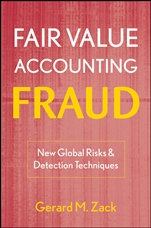
Fair Value Accounting Fraud: New Global Risks and Detection Techniques
ISBN 9780470478585
Autor: Gerard M. Zack
Wydawca: Wiley
Dostępność: 3-6 tygodni
Cena: 327,60 zł
Przed złożeniem zamówienia prosimy o kontakt mailowy celem potwierdzenia ceny.
ISBN13: |
9780470478585 |
ISBN10: |
0470478586 |
Autor: |
Gerard M. Zack |
Oprawa: |
Hardback |
Rok Wydania: |
2009-09-11 |
Ilość stron: |
272 |
Wymiary: |
237x156 |
Tematy: |
KF |
Fair Value Accounting
Fraud
In its December 2008 report on the use of fair value accounting in the United States, the Securities and Exchange Commission (SEC) soundly endorsed the use of fair value accounting, encouraging the expansion of fair value applications in financial statements, while also supporting clarification and simplification of fair value accounting standards.
Providing much–needed, practical guidance that simplifies an intimidating topic, Fair Value Accounting Fraud: New Global Risks and Detection Techniques is a nuts–and–bolts book dedicated to equipping fraud investigators and auditors to understand the many risks of fraud based on how fair value accounting is utilized in the preparation of financial statements.
Not designed as a how–to book on performing business or asset valuations, Fair Value Accounting Fraud instead familiarizes professionals with the ins–and–outs of fraud issues in fair value accounting with discussion of:
The Use of Fair Value Measurements in Financial Statements
Methods of Determining Fair Value
Recent Changes to Fair Value Accounting Standards
Asset–based Fraud Schemes Involving Fair Value
Investments in Debt and Equity Securities
Intangible Assets
Nonmonetary Transactions
Business Combinations
Liability–based Fraud Schemes
Comparison of U.S. GAAP and IFRS
Special Fair Value Issues of Not–for–Profit Organizations
Fair Value Disclosure Issues
Internal Controls for Fair Value Accounting
Detection of Fair Value Accounting Fraud
Author Gerard Zack, nationally recognized accounting, audit, and fraud expert, clearly demonstrates his experience in this subject, providing readers with an overview of the fair value applications, how those applications differ under U.S. and inte
rnational accounting standards, as well as some of the most commonly used methods, especially as these subjects relate to the primary focus—the risk of financial reporting fraud.
Conversational in tone with valuable insights, Fair Value Accounting Fraud lifts the veil of confusion from the substantial and growing requirements for understanding the various methodologies used in determining and detecting fair value accounting fraud.
Spis treści:
Preface.
Acknowledgments.
Part I: Introduction to Fair Value Accounting Fraud.
Chapter 1: Overview of Financial Statement Fraud and Fair Value Accounting.
Introduction to Financial Reporting Fraud.
What Makes It Fraud?
Why Financial Reporting Fraud Is Perpetrated.
Using One Fraud to Hide Another.
Chapter 2: The Use of Fair Value in Financial Statements.
Historical Cost versus Fair Value.
Sources of Accounting Principles.
U.S. GAAP versus IFRS.
Fair Value Option Added for U.S. GAAP.
Fair Value Defined.
International Convergence.
Some Principles of Financial Statement Presentation.
Effective Dates of Accounting Standards.
Impact of Fraud on Financial Statements.
Chapter 3: Methods of Determining Fair Value.
Introduction.
Market Approach.
Income Approach.
Cost Approach.
Internal versus Externally–Developed Valuations.
Inputs to Valuation Methods.
Fair Value Guidance under IFRS.
Availability of Market Evidence.
Part II: Asset–Based Schemes.
Chapter 4: Investments in Debt and Publicly Traded Equity Securities.
Scope of Investments Covered.
Sources of U.S. GAAP and IFRS.
Classification and Treatment – U.S. GAAP.
Classification and Treatment – IFRS.
Reclassifications in General.
Reclassifications from the Held–to–Maturity Category.
Determination of Fair Value.
Active versus Inactive Markets.
Temporary versus OtherR
11;Than–Temporary Impairments – U.S. GAAP.
Impairment Losses – IFRS.
Summary of Fraud Risks.
Chapter 5: Ownership Interests in Nonpublic Entities.
Sources of U.S. GAAP and IFRS.
Introduction.
Consolidated Financial Statements.
Jointly Controlled Entities versus Jointly Controlled Assets.
Equity Method Investments.
Proportionate Consolidation.
Chapter 6: Loans and Receivables.
Sources of GAAP and IFRS.
Recognition and Measurement – U.S. GAAP.
Recognition and Measurement – IFRS.
Chapter 7: Intangible Assets and Goodwill.
Sources of U.S. GAAP and IFRS.
Asset versus Expense.
Web Site Costs.
Measurement.
Finite Life Intangible Assets.
Residual Value.
Indefinite Life Intangible Assets.
Impairment Losses.
Concluding Remarks.
Chapter 8: Business Combinations.
Sources of U.S. GAAP and IFRS.
Business Combination versus Asset Acquisition.
Accounting for Business Combinations.
Identification of Intangible Assets.
Business Combinations Achieved in Stages.
Chapter 9: Asset Impairments.
Sources of U.S. GAAP and IFRS.
Definition of an Impairment Loss.
When to Test for Impairment.
Indicators of Impairment of Assets.
Extent of Impairment Loss.
Reversal of Previous Impairment Losses.
Chapter 10: Property and Equipment (Including Investment Properties).
Sources of U.S. GAAP and IFRS.
Initial Recognition.
Measurement after Initial Recognition.
Investment Property.
Impairment Losses.
Part III: Liability–Based Schemes.
Chapter 11: Debt Obligations.
Sources of U.S. GAAP and IFRS.
Measurement.
Fair Value Option.
Valuation of Debt.
Chapter 12: Deferred Revenue.
Sources of U.S. GAAP and IFRS.
Recognition – Customer Loyalty Programs.
Multiple Deliverable Arrangements.
Chapter 13: Asset Retirement Obligations.
Sources of U.S
. GAAP and IFRS.
Recognition – U.S. GAAP.
Recognition – IFRS.
Can a Reliable Estimate Be Determined?
Measuring and Recording an Asset Retirement Obligation.
Summary – Comparison of U.S. GAAP and IFRS.
Chapter 14: Guarantees.
Sources of U.S. GAAP and IFRS.
Recognition – U.S. GAAP.
Measurement.
Recognition – IFRS.
Part IV: Other Fair Value Accounting Fraud Issues.
Chapter 15: Derivatives and Hedging.
Sources of U.S. GAAP and IFRS.
Definitions and Treatment – U.S. GAAP.
Definitions and Treatment – IFRS.
Measurement.
Embedded Derivatives.
Chapter 16: Assets or Liabilities of Sponsors of Employee Benefit Plans.
Sources of U.S. GAAP and IFRS.
Recognition and Measurement – U.S. GAAP.
Recognition and Measurement – IFRS.
Chapter 17: Contingencies and Provisions.
Sources of U.S. GAAP and IFRS.
Recognition – U.S. GAAP.
Amount of Loss to Be Recognized.
Recognition – IFRS.
Measurement.
Comparison of U.S. GAAP and IFRS.
Chapter 18: Share–Based Transactions.
Sources of U.S. GAAP and IFRS.
Recognition – U.S. GAAP.
Measurement – U.S. GAAP.
Recognition – IFRS.
Measurement – IFRS.
Chapter 19: Nonmonetary Transactions.
Sources of U.S. GAAP and IFRS.
Recognition and Measurement – U.S. GAAP.
Recognition and Measurement – IFRS.
Advertising Barter Transactions – U.S. GAAP.
Advertising Barter Transactions – IFRS.
Chapter 20: Special Fair Value Issues of Not–for–Profit Organizations.
Introduction.
Non–Cash Contributions of Assets.
Contributed Use of Assets.
Promises to Give.
Contributed Services.
Matching Requirements.
Chapter 21: Fair Value Disclosure Issues.
Introduction.
Sources of Disclosure Requirements.
Financial Instruments.
I
Koszyk
Książek w koszyku: 0 szt.
Wartość zakupów: 0,00 zł
Informacje


Kontakt
Gambit
Centrum Oprogramowania
i Szkoleń Sp. z o.o.
Al. Pokoju 29b/22-24
31-564 Kraków
Siedziba Księgarni
ul. Kordylewskiego 1
31-542 Kraków
+48 12 410 5991
+48 12 410 5987
+48 12 410 5989
Subskrypcje
Administratorem danych osobowych jest firma Gambit COiS Sp. z o.o. Na podany adres będzie wysyłany wyłącznie biuletyn informacyjny.
Autoryzacja płatności

Informacje na temat autoryzacji płatności poprzez PayU.

© Copyright 2012: GAMBIT COiS Sp. z o.o. Wszelkie prawa zastrzeżone.
Projekt i wykonanie: Alchemia Studio Reklamy