


Wydawcy
Katalog tematyczny
- Archeologia (109)
- Ekonomia, finanse, business (13704)
- Filozofia (1445)
- Historia (3040)
- Języki i językoznawstwo (2356)
- Lifestyle, hobby i rozrywka (475)
- Medycyna (9704)
- Nauki humanistyczne (4)
- Nauki o Ziemi i środowisku (2638)
- Nauki ścisłe (20412)
- Astronomia (294)
- Biologia (5119)
- Chemia (6540)
- Chemia analityczna (361)
- Chemia fizyczna (346)
- Chemia nieorganiczna (137)
- Chemia organiczna (535)
- Krystalografia (27)
- Minerologia (46)
- Fizyka (3309)
- Matematyka (4574)
- Nauki ścisłe, ogólnie (503)
- Nauki społeczne (8486)
- Nauki techniczne (13450)
- Prawo (1696)
- Publikacje informacyjne i interdyscyplinarne (1288)
- Religia i wierzenia (917)
- Technika komputerowa (4067)
- Zdrowie, relacje międzyludzkie i rozwój osobisty (657)





Informacje szczegółowe o książce
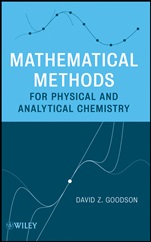
Mathematical Methods for Physical and Analytical Chemistry
ISBN 9780470473542
Autor: David Z. Goodson
Wydawca: Wiley
Dostępność: 3-6 tygodni
Cena: 538,65 zł
Przed złożeniem zamówienia prosimy o kontakt mailowy celem potwierdzenia ceny.
ISBN13: |
9780470473542 |
ISBN10: |
0470473541 |
Autor: |
David Z. Goodson |
Oprawa: |
Hardback |
Rok Wydania: |
2011-11-15 |
Ilość stron: |
408 |
Wymiary: |
242x161 |
Tematy: |
PN |
Bridging the gap between undergraduate calculus and the mathematics of chemistry
A focused presentation of statistical and advanced mathematical methods likely to be encountered by chemists, Mathematical Methods for Physical and Analytical Chemistry can serve as a text for a one–semester course at the undergraduate or graduate level, or as a resource for independent study by students and professionals in all areas of chemistry and in related fields such as environmental science, geochemistry, and chemical engineering.
Mathematical Methods for Physical and Analytical Chemistry covers:
CALCULUS—review of the basics, coordinate systems, degrees of freedom, special functions, numerical methods, complex numbers, singular points, improper integrals, Taylor series
STATISTICS—probability theory, distribution functions, confidence intervals, propagation of error, significance of difference, ANOVA, method of least squares, calibration, model testing, fits with error in both variables, experiment design, randomization, optimization
DIFFERENTIAL EQUATIONS—chemical reaction rate equations, Lagrangian and Hamiltonian mechanics, transport equations, the superposition principle, separation of variables, methods for exact, approximate, and numerical solutions
LINEAR ALGEBRA—groups, Hilbert spaces, basis sets, matrices, determinants, orthogonal polynomials, spherical harmonics, Fourier series, eigenvalue equations, diagonalization, Fourier transform, spectral lineshapes, convolution, principles of quantum mechanics, Schrödinger′s equation, hydrogen orbitals, hybrid orbitals, molecular orbitals
Mathematical Methods for Physical and Analytical Chemistry features:
Modern topics such as Monte Carlo simulation, robust estimation, and discrete Fourier transform, which are otherwise available only in more specialized texts
Numerous figures and worked out e
xamples and more than 200 exercises, many of which take advantage of computer algebra
An annotated bibliography of references for further study
Spis treści:
Preface xiii
List of Examples xv
Greek Alphabet xix
Part I. Calculus
1 Functions: General Properties 3
1.1 Mappings 3
1.2 Differentials and Derivatives 4
1.3 Partial Derivatives 7
1.4 Integrals 9
1.5 Critical Points 14
2 Functions: Examples 19
2.1 Algebraic Functions 19
2.2 Transcendental Functions 21
2.3 Functional 31
3 Coordinate Systems 33
3.1 Points in Space 33
3.2 Coordinate Systems for Molecules 35
3.3 Abstract Coordinates 37
3.4 Constraints 39
3.5 Differential Operators in Polar Coordinates 43
4 Integration 47
4.1 Change of Variables in Integrands 47
4.2 Gaussian Integrals 51
4.3 Improper Integrals 53
4.4 Dirac Delta Function 56
4.5 Line Integrals 57
5 Numerical Methods 61
5.1 Interpolation 61
5.2 Numerical Differentiation 63
5.3 Numerical Integration 65
5.4 Random Numbers 70
5.5 Root Finding 71
5.6 Minimization∗ 74
6 Complex Numbers 79
6.1 Complex Arithmetic 79
6.2 Fundamental Theorem of Algebra 81
6.3 The Argand Diagram 83
6.4 Functions of a Complex Variable∗ 87
6.5 Branch Cuts∗ 89
7 Extrapolation 93
7.1 Taylor Series 93
7.2 Partial Sums 97
7.3 Applications of Taylor Series 99
7.4 Convergence 102
7.5 Summation Approximants∗ 104
Part II. Statistics
8 Estimation 111
8.1 Error and Estimation Ill
8.2 Probability Distributions 113
8.3 Outliers 124
8.4 Robust Estimation 126
9 Analysis of Significance 131
9.1 Confidence Intervals 131
9.2 Propagation of Error 136
9.3 Monte Carlo Simulation of Error 139
9.4 Significance of Difference 140
9.5 Distribution Testing∗ 144
10 Fitting 151
10.1 Method of Least Squares 151
10.2 Fitting with Error in Both Variables 157
10.3 Nonlinear Fitting 162
11 Quality of Fit 165
11.1 Confidence Intervals for Parameters 165
11.2 Confidence Band for a Calibration Line 168
11.3 Outliers and Leverage Points ′ 171
11.4 Robust Fitting∗ 173
11.5 Model Testing 176
12 Experiment Design 181
12.1 Risk Assessment 181
12.2 Randomization 185
12.3 Multiple Comparisons 188
12.4 Optimization∗ 195
Part III. Differential Equations
13 Examples of Differential Equations 203
13.1 Chemical Reaction Rates 203
13.2 Classical Mechanics 205
13.3 Differentials in Thermodynamics 212
13.4 Transport Equations 213
14 Solving Differential Equations, I 217
14.1 Basic Concepts 217
14.2 The Superposition Principle 220
14.3 First–Order ODE′s 222
14.4 Higher–Order ODE′s 225
14.5 Partial Differential Equations 228
15 Solving Differential Equations, II 231
15.1 Numerical Solution 231
15.2 Chemical Reaction Mechanisms 236
15.3 Approximation Methods 239
Part IV. Linear Algebra
16 Vector Spaces 247
16.1 Cartesian Coordinate Vectors 247
16.2 Sets 248
16.3 Groups 249
16.4 Vector Spaces 251
16.5 Functions as Vectors 252
16.6 Hilbert Spaces 253
16.7 Basis Sets 256
17 Spaces of Functions 261
17.1 Orthogonal Polynomials 261
17.2 Function Resolution 267
17.3 Fourier Series 270
17.4 Spherical Harmonics 275
18 Matrices 279
18.1 Matrix Representation of Operators 279
18.2 Matrix Algebra 282
18.3 Matrix Operations 284
18.4 Pseudoinverse∗ 286
18.5 Determinants 288
18.6 Orthogonal and Unitary Matrices 290
18.7 Simultaneous Linear Equations 292
19 Eigenvalue Equations 297
19.1 Matrix Eigenvalue Equations 297
19.2 Matrix Diagonalization 301
19.3 Differential Eig
envalue Equations 305
19.4 Hermitian Operators 306
19.5 The Variational Principle∗ 309
20 Schrödinger′s Equation 313
20.1 Quantum Mechanics 313
20.2 Atoms and Molecules 319
20.3 The One–Electron Atom 321
20.4 Hybrid Orbitals 325
20.5 Antisymmetry∗ 327
20.6 Molecular Orbitals∗ 329
21 Fourier Analysis 333
21.1 The Fourier Transform 333
21.2 Spectral Line Shapes∗ 336
21.3 Discrete Fourier Transform∗ 339
21.4 Signal Processing 342
A Computer Programs 351
A.l Robust Estimators 351
A.2 FREML 352
A.3 Neider–Mead Simplex Optimization 352
B Answers to Selected Exercises 355
C Bibliography 367
Index 373
Nota biograficzna:
David Z. Goodson, Associate Professor of Chemistry at the University of Massachusetts Dartmouth, has a BA in chemistry from Pomona College and a PhD in chemical physics from Harvard University. An interdisciplinary scientist, he is author of numerous articles on a wide range of topics including quantum chemistry, molecular spectroscopy, reaction rate theory, atomic physics, and applied mathematics.
Okładka tylna:
Bridging the gap between undergraduate calculus and the mathematics of chemistry
A focused presentation of statistical and advanced mathematical methods likely to be encountered by chemists, Mathematical Methods for Physical and Analytical Chemistry can serve as a text for a one–semester course at the undergraduate or graduate level, or as a resource for independent study by students and professionals in all areas of chemistry and in related fields such as environmental science, geochemistry, and chemical engineering.
Mathematical Methods for Physical and Analytical Chemistry covers:
CALCULUS—review of the basics, coordinate systems, degrees of freedom, special functions, numerical methods, complex n
umbers, singular points, improper integrals, Taylor series
STATISTICS—probability theory, distribution functions, confidence intervals, propagation of error, significance of difference, ANOVA, method of least squares, calibration, model testing, fits with error in both variables, experiment design, randomization, optimization
DIFFERENTIAL EQUATIONS—chemical reaction rate equations, Lagrangian and Hamiltonian mechanics, transport equations, the superposition principle, separation of variables, methods for exact, approximate, and numerical solutions
LINEAR ALGEBRA—groups, Hilbert spaces, basis sets, matrices, determinants, orthogonal polynomials, spherical harmonics, Fourier series, eigenvalue equations, diagonalization, Fourier transform, spectral lineshapes, convolution, principles of quantum mechanics, Schrödinger′s equation, hydrogen orbitals, hybrid orbitals, molecular orbitals
Mathematical Methods for Physical and Analytical Chemistry features:
Modern topics such as Monte Carlo simulation, robust estimation, and discrete Fourier transform, which are otherwise available only in more specialized texts
Numerous figures and worked out examples and more than 200 exercises, many of which take advantage of computer algebra
An annotated bibliography of references for further study
Koszyk
Książek w koszyku: 0 szt.
Wartość zakupów: 0,00 zł
Informacje


Kontakt
Gambit
Centrum Oprogramowania
i Szkoleń Sp. z o.o.
Al. Pokoju 29b/22-24
31-564 Kraków
Siedziba Księgarni
ul. Kordylewskiego 1
31-542 Kraków
+48 12 410 5991
+48 12 410 5987
+48 12 410 5989
Subskrypcje
Administratorem danych osobowych jest firma Gambit COiS Sp. z o.o. Na podany adres będzie wysyłany wyłącznie biuletyn informacyjny.
Autoryzacja płatności

Informacje na temat autoryzacji płatności poprzez PayU.

© Copyright 2012: GAMBIT COiS Sp. z o.o. Wszelkie prawa zastrzeżone.
Projekt i wykonanie: Alchemia Studio Reklamy