


Wydawcy
Katalog tematyczny
- Archeologia (109)
- Ekonomia, finanse, business (13704)
- Filozofia (1445)
- Historia (3040)
- Języki i językoznawstwo (2356)
- Lifestyle, hobby i rozrywka (475)
- Medycyna (9704)
- Nauki humanistyczne (4)
- Nauki o Ziemi i środowisku (2638)
- Nauki ścisłe (20412)
- Nauki społeczne (8486)
- Nauki techniczne (13450)
- Budownictwo lądowe (1045)
- Chemia przemysłowa (2258)
- Elektronika i telekomunikacja (3287)
- Energetyka (1122)
- Inne nauki stosowane (363)
- Inżynieria biochemiczna (507)
- Inżynieria transportu (232)
- Mechanika i materiały (3316)
- Nauka o środowisku (321)
- Rolnictwo (507)
- Technika, ogólnie (475)
- Prawo (1696)
- Publikacje informacyjne i interdyscyplinarne (1288)
- Religia i wierzenia (917)
- Technika komputerowa (4067)
- Zdrowie, relacje międzyludzkie i rozwój osobisty (657)





Informacje szczegółowe o książce
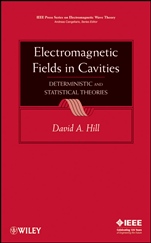
Electromagnetic Fields in Cavities: Deterministic and Statistical Theories
ISBN 9780470465905
Autor: David A. Hill
Wydawca: Wiley
Dostępność: 3-6 tygodni
Cena: 730,80 zł
Przed złożeniem zamówienia prosimy o kontakt mailowy celem potwierdzenia ceny.
ISBN13: |
9780470465905 |
ISBN10: |
0470465905 |
Autor: |
David A. Hill |
Oprawa: |
Hardback |
Rok Wydania: |
2009-10-27 |
Ilość stron: |
296 |
Wymiary: |
235x169 |
Tematy: |
TJ |
A thorough and rigorous analysis of electromagnetic fields in cavities
This book offers a comprehensive analysis of electromagnetic fields in cavities of general shapes and properties.
Part One covers classical deterministic methods to conclude resonant frequencies, modal fields, and cavity losses; quality factor; mode bandwidth; and the excitation of cavity fields from arbitrary current distributions for metal–wall cavities of simple shape.
Part Two covers modern statistical methods to analyze electrically large cavities of complex shapes and properties.
Electromagnetic Fields in Cavities combines rigorous solutions to Maxwell′s equations with conservation of energy to solve for the statistics of many quantities of interest: penetration into cavities (and shielding effectiveness), field strengths far from and close to cavity walls, and power received by antennas within cavities. It includes all modes and shows you how to utilize fairly simple statistical formulae to apply to your particular problem, whether it′s interference calculations, electromagnetic compatibility testing in reverberation chambers, measurement of shielding materials using multiple cavities, or efficiency of test antennas. Electromagnetic Fields in Cavities is a valuable resource for researchers, engineers, professors, and graduate students in electrical engineering.
Spis treści:
PREFACE.
PART I. DETERMINISTIC THEORY.
1. Introduction.
1.1 Maxwell’s Equations.
1.2 Empty Cavity Modes.
1.3 Wall Losses.
1.4 Cavity Excitation.
1.5 Perturbation Theories.
Problems.
2. Rectangular Cavity.
2.1 Resonant Modes.
2.2 Wall Losses and Cavity Q.
2.3 Dyadic Green’s Functions.
Problems.
3. Circular Cylindrical Cavity.
3.1 Resonant Modes.
3.2 Wall Losses and Cavity Q.
3.3 Dyadic Green’s Functions.
Problems.
4. Spherical Cav
ity.
4.1 Resonant Modes.
4.2 Wall Losses and Cavity Q.
4.3 Dyadic Green’s Functions.
4.4 Schumann Resonances in the Earth–Ionosphere Cavity.
Problems.
PART II. STATISTICAL THEORIES FOR ELECTRICALLY LARGE CAVITIES.
5. Motivation for Statistical Approaches.
5.1 Lack of Detailed Information.
5.2 Sensitivity of Fields to Cavity Geometry and Excitation.
5.3 Interpretation of Results.
Problems.
6. Probability Fundamentals.
6.1 Introduction.
6.2 Probability Density Function.
6.3 Common Probability Density Functions.
6.4 Cumulative Distribution Function.
6.5 Methods for Determining Probability Density Functions.
Problems.
7. Reverberation Chambers.
7.1 Plane–Wave Integral Representation of Fields.
7.2 Ideal Statistical Properties of Electric and Magnetic Fields.
7.3 Probability Density Functions for the Fields.
7.4 Spatial Correlation Functions of Fields and Energy Density.
7.5 Antenna or Test–Object Response.
7.6 Loss Mechanisms and Chamber Q.
7.7 Reciprocity and Radiated Emissions.
7.8 Boundary Fields.
7.9 Enhanced Backscatter at the Transmitting Antenna.
Problems.
8. Aperture Excitation of Electrically Large, Lossy Cavities.
8.1 Aperture Excitation.
8.2 Power Balance.
8.3 Experimental Results for SE.
Problems.
9. Extensions to the Uniform–Field Model.
9.1 Frequency Stirring.
9.2 Unstirred Energy.
9.3 Alternative Probability Density Function.
Problems.
10. Further Applications of Reverberation Chambers.
10.1 Nested Chambers for Shielding Effectiveness Measurements.
10.2 Evaluation of Shielded Enclosures.
10.3 Measurement of Antenna Efficiency.
10.4 Measurement of Absorption Cross Section.
Problems.
11. Indoor Wireless Propagation.
11.1 General Considerations.
11.2 Path Loss Models.
11.3 Temporal Characteristics.
11.4 Angle of Arrival.<
br>11.5 Reverberation Chamber Simulation.
Problems.
APPENDIX A. VECTOR ANALYSIS.
APPENDIX B. ASSOCIATED LEGENDRE FUNCTIONS.
APPENDIX C. SPHERICAL BESSEL FUNCTIONS.
APPENDIX D. THE ROLE OF CHAOS IN CAVITY FIELDS.
APPENDIX E. SHORT ELECTRIC DIPOLE RESPONSE.
APPENDIX F. SMALL LOOP ANTENNA RESPONSE.
APPENDIX G. RAY THEORY FOR CHAMBER ANALYSIS.
APPENDIX H. ABSORPTION BY A HOMOGENEOUS SPHERE.
APPENDIX I. TRANSMISSION CROSS SECTION OF A SMALL CIRCULAR APERTURE.
APPENDIX J. SCALING.
REFERENCES.
INDEX.
Nota biograficzna:
David A. Hill is a Guest Researcher at the National Institute of Standards and Technology (NIST) specializing in cavity theory and reverberation chamber applications. Previously, he held project leader positions with the Institute for Telecommunication Sciences and NIST. Since 1980, he has been an Adjunct Professor in the Department of Electrical and Computer Engineering at the University of Colorado at Boulder, where he teaches graduate courses in electromagnetics and advises graduate students on master′s and PhD theses. Dr. Hill is an IEEE Life Fellow and a member of URSI Commissions A, B, E, and F. He has won IEEE EMC Society Prize Paper Awards for "Out–of–Band Response of Antenna Arrays" in 1987 and "On Determining the Maximum Emissions from Electrically Large Sources" in 2002.
Okładka tylna:
A thorough and rigorous analysis of electromagnetic fields in cavities
This book offers a comprehensive analysis of electromagnetic fields in cavities of general shapes and properties.
Part One covers classical deterministic methods to conclude resonant frequencies, modal fields, and cavity losses; quality factor; mode bandwidth; and the excitation of cavity fields from arbitrary current distributions for metal–wall cavities of simple shape.
Part Two covers modern statistical methods to analyze electrically large cavities of com
plex shapes and properties.
Electromagnetic Fields in Cavities combines rigorous solutions to Maxwell′s equations with conservation of energy to solve for the statistics of many quantities of interest: penetration into cavities (and shielding effectiveness), field strengths far from and close to cavity walls, and power received by antennas within cavities. It includes all modes and shows you how to utilize fairly simple statistical formulae to apply to your particular problem, whether it′s interference calculations, electromagnetic compatibility testing in reverberation chambers, measurement of shielding materials using multiple cavities, or efficiency of test antennas. Electromagnetic Fields in Cavities is a valuable resource for researchers, engineers, professors, and graduate students in electrical engineering.
Koszyk
Książek w koszyku: 0 szt.
Wartość zakupów: 0,00 zł
Informacje


Kontakt
Gambit
Centrum Oprogramowania
i Szkoleń Sp. z o.o.
Al. Pokoju 29b/22-24
31-564 Kraków
Siedziba Księgarni
ul. Kordylewskiego 1
31-542 Kraków
+48 12 410 5991
+48 12 410 5987
+48 12 410 5989
Subskrypcje
Administratorem danych osobowych jest firma Gambit COiS Sp. z o.o. Na podany adres będzie wysyłany wyłącznie biuletyn informacyjny.
Autoryzacja płatności

Informacje na temat autoryzacji płatności poprzez PayU.

© Copyright 2012: GAMBIT COiS Sp. z o.o. Wszelkie prawa zastrzeżone.
Projekt i wykonanie: Alchemia Studio Reklamy