


Wydawcy
Katalog tematyczny
- Archeologia (109)
- Ekonomia, finanse, business (13704)
- Filozofia (1445)
- Historia (3040)
- Języki i językoznawstwo (2356)
- Lifestyle, hobby i rozrywka (475)
- Medycyna (9704)
- Nauki humanistyczne (4)
- Nauki o Ziemi i środowisku (2638)
- Nauki ścisłe (20412)
- Nauki społeczne (8486)
- Nauki techniczne (13450)
- Prawo (1696)
- Publikacje informacyjne i interdyscyplinarne (1288)
- Religia i wierzenia (917)
- Technika komputerowa (4067)
- Zdrowie, relacje międzyludzkie i rozwój osobisty (657)





Informacje szczegółowe o książce
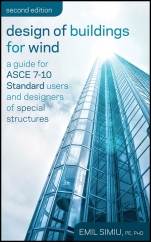
Design of Buildings for Wind: A Guide for ASCE 7–10 Standard Users and Designers of Special Structures
ISBN 9780470464922
Autor: Emil Simiu
Wydawca: Wiley
Dostępność: 3-6 tygodni
Cena: 693,00 zł
Przed złożeniem zamówienia prosimy o kontakt mailowy celem potwierdzenia ceny.
ISBN13: |
9780470464922 |
ISBN10: |
0470464925 |
Autor: |
Emil Simiu |
Oprawa: |
Hardback |
Rok Wydania: |
2011-10-28 |
Numer Wydania: |
2nd Edition |
Ilość stron: |
352 |
Wymiary: |
244x164 |
Tematy: |
AM |
The updated practical guide to the design for wind of low– and medium–rise buildings, tall buildings, and special structures
Design of Buildings for Wind, Second Edition is a practical guide that uses physical and intuitive approaches as well as practical examples to demonstrate how to interpret and use provisions of the ASCE 7–10 Standard and design structures for strength and serviceability. Written by one of the world′s foremost wind engineering experts, Emil Simiu, this unique text is written specifically for designers and structural engineers.
Covering routine buildings, tall buildings, and other structures, Design of Buildings for Wind, Second Edition contains a wealth of step–by–step numerical examples, as well as links to publicly available software, to assist structural engineers in understanding and using the elements of wind and structural engineering required for design. Thoroughly revised and updated to conform to current practice and research, the Second Edition includes:
New coverage of ASCE 7–10 Standard design methods, guiding designers to clearly understand the spirit, letter, and limitations of the provisions and use the design methods with confidence and ease
New focus on tall buildings to help make the analysis and design easier and more transparent
New material on structural reliability and estimation of wind–induced losses
PREFACE xi
PART I INTRODUCTION 1
1 OVERVIEW 3
PART II GUIDE TO THE ASCE 7–10 STANDARD PROVISIONS ON WIND LOADS 7
2 ASCE 7–10 WIND LOADING PROVISIONS 9
2.1 Introduction / 9
2.2 ASCE 7–10 Standard: An Overview / 10
2.3 Organization of the Guide: Chapters 3 to 9 / 19
3 REGULAR AND SIMPLIFIED APPROACH: RISK CATEGORY, BASIC WIND SPEED, ENCLOSURE, EXPOSURE, TOPOGRAPHIC FACTOR 21
3.1 Risk Category (ASCE Table 1.5–1) / 21
3.2 Basic Wind Speed V (ASCE Sect. 26.5, ASCE Figs. 26.5.–1a, b, c) / 22
3.3 Enclosure Classification (ASCE Sects. 26.2 and 26.10) / 23
3.4 Exposure Category (ASCE Sect. 26.7) / 24
3.5 Topographic Factor Kzt (ASCE Sect. 26.8, ASCE Fig. 26.8–1) / 27
4 REGULAR APPROACH: STEPS COMMON TO ALL BUILDINGS/OTHER STRUCTURES (MWFRS AND C&C) 31
4.1 Introduction / 31
4.2 Regular Approach: Steps Common to All Buildings and Other Structures (MWFRS and C&C) / 32
5 REGULAR APPROACH: BUILDINGS, PARAPETS, OVERHANGS ( DIRECTIONAL PROCEDURE), MWFRS 37
5.1 Introduction / 37
5.2 Regular Approach: Enclosed or Partially Enclosed Buildings of All Heights, MWFRS / 37
5.3 Regular Approach: Roof Overhangs and Parapets, MWFRS / 53
5.4 Regular Approach: Open Buildings with Monoslope, Pitched, or Troughed Free Roofs, MWFRS / 55
6 REGULAR APPROACH: LOW–RISE BUILDINGS, PARAPETS, OVERHANGS ( ENVELOPE PROCEDURE), MWFRS 57
6.1 Net Pressures on Walls and Roof / 57
6.2 Comparison Between Results Based on ASCE Sects. 27.4.1 and 28.4.1 / 62
6.3 Regular Approach: Parapets and Roof Overhangs, MWFRS / 63
7 REGULAR APPROACH: STRUCTURES OTHER THAN BUILDINGS, MWFRS 65
7.1 Solid Freestanding Walls and Solid Signs / 65
7.2 Open Signs, Lattice Frameworks, Trussed Towers / 69
7.3 Chimneys, Tanks, Rooftop Equipment, and Similar Structures / 74
7.4 Solid Attached Signs / 75
7.5 Rooftop Structures and Equipment on Buildings / 77
8 SIMPLIFIED APPROACH: ENCLOSED SIMPLE DIAPHRAGM BUILDINGS, PARAPETS, OVERHANGS (MWFRS) 81
8.1 Simplified Approach: Class 1 Buildings, Walls and Roof, MWFRS / 81
8.2 Simplified Approach: Parapets, MWFRS / 85
8.3 Simplified Approach: Roof Overhangs, MWFRS / 85
8.4 Simplified Approach: Class 2 Buildings, Walls and Roof, MWFRS / 86
8.5 Simplified Approach: Simple Diaphragm Low–Rise Buildings, MWFRS / 90
9 REGULAR AND SIMPLIFIED APPROACHES: C&C 95
9.1 Introduction / 95
9.2 Regular Approach / 95
9.3 Simplified Approaches / 105
PART III WIND ENGINEERING FUNDAMENTALS 107
10 ATMOSPHERIC CIRCULATIONS 109
10.1 Atmospheric Hydrodynamics / 109
10.2 Windstorms / 113
11 THE ATMOSPHERIC BOUNDARY LAYER 117
11.1 Wind Speeds and Averaging Times / 118
11.2 Wind Speed Profiles / 121
11.3 Atmospheric Turbulence / 130
12 EXTREME WIND SPEEDS AND WIND–INDUCED EFFECTS 137
12.1 Wind Speed Data / 138
12.2 Cumulative Distributions, Exceedance Probabilities, Mean Recurrence Intervals / 141
12.3 Parametric Estimates of N–Year Wind Speeds; Closed Form Estimators; Software / 143
12.4 Probabilistic Estimates of Wind Effects Based on Nondirectional and Directional Wind Speed Data / 149
12.5 Development of Directional Databases of Hurricane Wind Speeds / 153
12.6 Development of Directional Databases of Non–Hurricane Wind Speeds / 155
12.7 Non–Parametric Statistics, Application to One–Dimensional Time Series / 157
12.8 Error Estimates / 159
13 BLUFF BODY AERODYNAMICS BASICS; AERODYNAMIC TESTING 163
13.1 Introduction / 163
13.2 Bluff Body Aerodynamics / 163
13.3 Aerodynamic Testing / 173
13.4 Low–Frequency Turbulence and Aerodynamic Pressures on Residential Homes / 183
14 STRUCTURAL DYNAMICS 185
14.1 Introduction / 185
14.2 The Single–Degree–of Freedom Linear System / 186
14.3 Continuously Distributed Linear Systems / 190
14.4 Time Domain Solutions for Three–Dimensional Dynamic Response / 199
15 AEROELASTICITY 203
15.1 Introduction / 203
15.2 Vortex–Induced Oscillations / 205
15.3 Galloping / 206
15.4 Flutter / 210
16 STRUCTURAL RELIABILITY UNDER WIND LOADING 217
16.1 Introduction / 217
16.2 First–Order Second–Moment Approach, Load and Resistance Factors / 220
16.3 Dependence of Wind Effects on Wind Directionality / 225
16.4 Structural Strength Reserve / 226
16.5 Design Criteria for Multi–Hazard Regions / 228
16.6 Individual Uncertainties and Overall Uncertainty in the Estimation of Wind Effects / 229
16.7 Calibration of Design MRIs in the Presence of Dynamic Effects or of Large Knowledge Uncertainties / 232
17 LOSS ESTIMATION 237
17.1 Introduction / 237
17.2 Elements of Damage Estimation Procedures / 238
17.3 Loss Estimation / 245
PART IV WIND EFFECTS ON BUILDINGS 247
18 RIGID BUILDINGS 249
18.1 Introduction / 249
18.2 Database–Assisted Design (DAD) / 252
18.3 Wind Directionality Effects / 258
18.4 Uncertainties in the Estimation of Wind Effects / 259
19 TALL BUILDINGS 261
19.1 Introduction / 261
19.2 High–Frequency Force Balance Approach (HFFB) / 263
19.3 Aeroelastic Effects. Testing Based on Strain Measurements / 265
19.4 Database–Assisted Design / 269
19.5 Serviceability Requirements / 278
19.6 Preliminary Estimates of Flexible Building Response / 279
PART V APPENDICES 287
APPENDIXA1 RANDOM PROCESSES 289
A1.1 Fourier Series and Fourier Integrals / 290
A1.2 Parseval s Equality / 291
A1.3 Spectral Density Function of a Random Stationary Signal / 292
A1.4 Autocorrelation Function of a Random Stationary Signal / 293
A1.5 Cross–Covariance Function, Co–Spectrum, Quadrature Spectrum, Coherence / 295
A1.6 Mean Upcrossing and Outcrossing Rate for a Gaussian Process / 296
A1.7 Probability Distribution of the Peak Value of a Normally Distributed Random Signal / 297
A1.8 Probability Distribution of the Peak Value of a Non–Gaussian Random Signal / 298
APPENDIXA2 MEAN WIND PROFILES AND ATMOSPHERIC BOUNDARY LAYER DEPTH 301
A2.1 Equations of Balance of Momenta within the Atmospheric Boundary Layer / 301
A2.2 The Turbulent Ekman Layer / 302
APPENDIXA3 SPECTRA OF TURBULENT VELOCITY FLUCTUATIONS, KOLMOGOROV HYPOTHESES 307
APPENDIXA4 WIND DIRECTIONALITY EFFECTS, OUTCROSSING AND SECTOR–BY–SECTOR APPROACHES 311
A4.1 Approach Based on the Outcrossing of the Limit–State Boundary / 311
A4.2 The Sector–By–Sector Approach [18–10] / 313
APPENDIXA5 REPORT ON ESTIMATION OF WIND EFFECTS ON THE WORLD TRADE CENTER TOWERS 315
REFERENCES 323
INDEX 333
Emil Simiu, PE, PhD, is a NIST Fellow and a Fellow at the American Society of Civil Engineers. He served as chairman of its Committee on Wind Effects, Committee on Dynamic Effects, and Committee on the Reliability of Offshore Structures; as senior structural engineer with Severud Associates and Ammann & Whitney, Inc.; and as distinguished research professor at Florida International University′s International Hurricane Research Center. Also a distinguished member of the ASCE Standard Committee on Loads, he was a recipient of the Federal Engineer of the Year award from the National Society of Professional Engineers, and of the 2006 Japan Association for Wind Engineering Prize, given to the outstanding wind engineering publication of the year, for the first edition of Design of Buildings and Bridges for Wind. In addition, Dr. Simiu is the coauthor of Wind Effects on Structures, Third Edition (Wiley).
Koszyk
Książek w koszyku: 0 szt.
Wartość zakupów: 0,00 zł
Informacje


Kontakt
Gambit
Centrum Oprogramowania
i Szkoleń Sp. z o.o.
Al. Pokoju 29b/22-24
31-564 Kraków
Siedziba Księgarni
ul. Kordylewskiego 1
31-542 Kraków
+48 12 410 5991
+48 12 410 5987
+48 12 410 5989
Subskrypcje
Administratorem danych osobowych jest firma Gambit COiS Sp. z o.o. Na podany adres będzie wysyłany wyłącznie biuletyn informacyjny.
Autoryzacja płatności

Informacje na temat autoryzacji płatności poprzez PayU.

© Copyright 2012: GAMBIT COiS Sp. z o.o. Wszelkie prawa zastrzeżone.
Projekt i wykonanie: Alchemia Studio Reklamy