


Wydawcy
Katalog tematyczny
- Archeologia (109)
- Ekonomia, finanse, business (13704)
- Filozofia (1445)
- Historia (3040)
- Języki i językoznawstwo (2356)
- Lifestyle, hobby i rozrywka (475)
- Medycyna (9704)
- Nauki humanistyczne (4)
- Nauki o Ziemi i środowisku (2638)
- Nauki ścisłe (20412)
- Nauki społeczne (8486)
- Nauki techniczne (13450)
- Prawo (1696)
- Publikacje informacyjne i interdyscyplinarne (1288)
- Religia i wierzenia (917)
- Technika komputerowa (4067)
- Zdrowie, relacje międzyludzkie i rozwój osobisty (657)





Informacje szczegółowe o książce
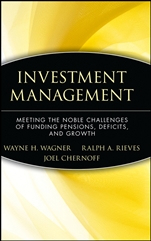
Investment Management: Meeting the Noble Challenges of Funding Pensions, Deficits, and Growth
ISBN 9780470455944
Autor: Wayne H. Wagner, Ralph A. Rieves, Joel Chernoff
Wydawca: Wiley
Dostępność: 3-6 tygodni
Cena: 638,40 zł
Przed złożeniem zamówienia prosimy o kontakt mailowy celem potwierdzenia ceny.
ISBN13: |
9780470455944 |
ISBN10: |
0470455942 |
Autor: |
Wayne H. Wagner, Ralph A. Rieves, Joel Chernoff |
Oprawa: |
Hardback |
Rok Wydania: |
2009-09-04 |
Ilość stron: |
480 |
Wymiary: |
235x153 |
Tematy: |
KF |
Praise for Investment Management
"A compelling analysis of the challenges of investment management, and why investment management firms require innovation to succeed."
—Blake Grossman, CEO, Barclays Global Investors
"Great investment managers understand that positioning portfolios for clients should not be an act of conformity, but rather a constant journey of shifting fundamentals and opinion. Wayne and Ralph bring this fact to life by addressing some of the key challenges to serious investment thinking, using top–level researchers in their respective fields. For those investment managers and clients who want to go beyond the ordinary."
—Jeff Diermeier, former CEO of CFA Institute and retired CIO of UBS Global Asset Management
"The essays in this book provide an invaluable reference point of serious readings for money managers. The works provide the analyst with the most recent scholarship in a single book, presenting ideas and philosophy that will lead me back to its various sections time and time again."
—Kenneth S. Hackel, CFA, President, CT Capital LLC
"The crash of 2007–2009 brought a harsh conclusion to a quarter of a century of unprecedented growth and prosperity for the investment management industry, which faces no less a task than reinventing itself. Rieves′ and Wagner′s contribution to the way forward couldn′t be timelier."
—Richard Ennis, Principal, Ennis Knupp + Associates
"This book uniformly focuses on the best practices to which investment management professionals should commit. I highly recommend this book to investment managers, sales people, and trustees of pensions, endowments, trusts, and mutual funds."
—Jack Clark Francis, PhD, Professor of Economics and Finance, Bernard Baruch College
Spis treści:
Foreword.
Preface.
Acknowledgments.
Editorial Advisory Board.
Introduction: A Sea of Changes and Waves of Opportun
ity (Jacqueline Charnley and Christine Røstvold).
The 2008–2009 credit crisis roiled the already–turbulent environment in which asset managers confronted their stewardship challenges. The authors cite seven major elements of the “pre–crisis” turbulence, and remind readers of Darwin′s dictum of survival. Proactive relationships with all the players are the key.
PART ONE: The Challenges of Changes and Crises.
Chapter 1 The Discontinuity Challenge (Wayne H. Wagner).
The twists and tangles of the 2008–2009 credit crunch will long be remembered. This chapter does not address that specific discontinuity, but discusses discontinuities in general. From a longer time perspective, we see that these discontinuities occur frequently, suggesting that in addition to applying our experience and running our models in “normal” times, we need to prepare to face the inevitable discontinuity environments. This is the first chapter of several in which we reflect on Taleb′s Black Swan.
Chapter 2 The Sub–Prime Crisis as a “Predictable Surprise” Strategic Lessons to Be Learned (Keith Ambachtsheer).
The fallout from the events of 2008–2009 has engendered several million words of criticism, constructive and otherwise. Yet, very little relevant appraisal has come from the investment management industry. An enduring champion of pension reform describes the collective actions that can be effectively marshaled when confronted with another threat of asset erosion. Why, in this care, Bazerman and Watkins are more relevant than Taleb.
Chapter 3 The Solidarity Challenge (David G. Tittsworth, Esq.).
Compared to many other laws, the statutory framework of the Investment Advisors Act of 1940 is relatively simple and straightforward. The fiduciary culture it has fostered distinguishes
the advisory profession from other financial services. Now, the basic legal and regulatory structure that has governed investment advisors for decades is being debated. Well–organized and well–financed groups seek to change the laws based on the 1940 Act., charging that they are “outdated” and “losing relevance”. The author suggests three actions to ensure that investment advisers work together to preserve what is good about how the advisory profession is governed.
PART TWO: Keeping the Challenges in Perspective.
Chapter 4 The Failure of Invariance (Peter L. Bernstein).
When published in 1996, Against the Gods: The Remarkable Story of Risk took its place as one of the seminal history books written in the twentieth century. Here is chapter 16 from that remarkable work. Many readers encountered for the first time Kahneman’s and Tversky′s “Prospect Theory”. Investment managers who have not read Against the Gods are at a competitive disadvantage—big time.
Chapter 5 Inverted Reasoning and Its Consequences (G.C. Seldon).
Not for the first time, we anthologize this excerpt from Psychology of the Stock Market, first published in 1912. Sage observations from which the author observes “Historical parallels are likely to be misleading.”
Chapter 6 Fatal Attractions for Money Managers (Arnold S. Wood).
An experienced and innovative investment manager reflects on “the triumph of temptation over reason”, and offers a “list of ten causes of irrational, and occasionally bizarre, behavior” by professional investors.
Chapter 7 Renzo Gracie′s Brazilian Jiu Jitsu Academy (Richard Bookstaber, PhD).
An elegant analogy illustrating how innovation, endogenous risks, and regulation should be contemplated so as t
o assure a market “that is more robust and survivable”. Excerpted from the best–selling A Demon of Our Own Design Hoboken: (Wiley, 2007).
Chapter 8 Managing Outside the Box (Robert A. Jaeger, Ph.D.).
This reflection on fads and fashion in the investment business provides an appropriate departure for studying Part three of this book: The Challenges Under Transformation.
PART THREE: The Challenges Under Transformation.
Chapter 9 The Evolving Challenges of Quantitative Investing (Robert L. Hagin, PhD and Kathleen T. DeRose).
The authors suggest that the rapid pace of technological change affects both fundamental and quantitative investors. Despite their similarities, quantitative investors, particularly those who acknowledge the limits of technology, are better equipped to deliver on their clients′ performance expectations. As investment approaches begin to incorporate insights from beyond computer science, drawing from biology and other disciplines, the debate becomes a philosophical one about the frontier between the computer and the intellect.
Chapter 10 EMH and the Matter at Hand (Wayne H. Wagner and Ralph A. Rieves).
Do nanosecond changes in “publicly available information” and the behavioral school′s challenge require a reappraisal of a fundamental postulate of investment theory? Why is Taleb relevant?
Chapter 11 The Attribution Challenge (Ron Surz).
Performance standards focus on accurate measurements and reporting. But the most accurate measurements can be misinterpreted when compared to faulty benchmarks. Here is an extensive discussion about accurate benchmarking and rigorous attribution analysis. Tiger Wood′s bowling scores are not relevant to his achievements.
Chapter 12 The Academic Challenge An Interview with Professor Stephen Brown on Developments in Modern Finance (
Koszyk
Książek w koszyku: 0 szt.
Wartość zakupów: 0,00 zł
Informacje


Kontakt
Gambit
Centrum Oprogramowania
i Szkoleń Sp. z o.o.
Al. Pokoju 29b/22-24
31-564 Kraków
Siedziba Księgarni
ul. Kordylewskiego 1
31-542 Kraków
+48 12 410 5991
+48 12 410 5987
+48 12 410 5989
Subskrypcje
Administratorem danych osobowych jest firma Gambit COiS Sp. z o.o. Na podany adres będzie wysyłany wyłącznie biuletyn informacyjny.
Autoryzacja płatności

Informacje na temat autoryzacji płatności poprzez PayU.

© Copyright 2012: GAMBIT COiS Sp. z o.o. Wszelkie prawa zastrzeżone.
Projekt i wykonanie: Alchemia Studio Reklamy