


Wydawcy
Katalog tematyczny
- Archeologia (109)
- Ekonomia, finanse, business (13704)
- Filozofia (1445)
- Historia (3040)
- Języki i językoznawstwo (2356)
- Lifestyle, hobby i rozrywka (475)
- Medycyna (9704)
- Nauki humanistyczne (4)
- Nauki o Ziemi i środowisku (2638)
- Nauki ścisłe (20412)
- Nauki społeczne (8486)
- Nauki techniczne (13450)
- Prawo (1696)
- Publikacje informacyjne i interdyscyplinarne (1288)
- Religia i wierzenia (917)
- Technika komputerowa (4067)
- Zdrowie, relacje międzyludzkie i rozwój osobisty (657)





Informacje szczegółowe o książce
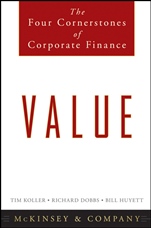
Value: The Four Cornerstones of Corporate Finance
ISBN 9780470424605
Autor: McKinsey & Company Inc., Tim Koller, Richard Dobbs, Bill Huyett
Wydawca: Wiley
Dostępność: 3-6 tygodni
Cena: 170,10 zł
Przed złożeniem zamówienia prosimy o kontakt mailowy celem potwierdzenia ceny.
ISBN13: |
9780470424605 |
ISBN10: |
0470424605 |
Autor: |
McKinsey & Company Inc., Tim Koller, Richard Dobbs, Bill Huyett |
Oprawa: |
Hardback |
Rok Wydania: |
2010-11-24 |
Ilość stron: |
272 |
Wymiary: |
237x166 |
Tematy: |
KF |
Praise for VALUE
"Value will help senior leaders and their boards act on bold ideas for creating value in the businesses they lead. The four principles of value creation are a concise guide to growing and shaping companies."
Ed Breen, Chairman and Chief Executive Officer, Tyco International Ltd.
"In a complex business world, we shouldn′t overlook the relatively simple financial principles that underlie the creation of long–term shareholder value. This book gives corporate leaders a clear base of knowledge for creating and sustaining value under any economic, industry, or company circumstances."
Dominic J. Caruso, Chief Financial Officer, Johnson & Johnson
"More than a handbook, this is the bible of value creation. It should be read by corporate leaders across the entire spectrum. It also reminds us not to ignore the abiding financial principles that guide companies to long–term value creation."
Stefan Krause, Chief Financial Officer, Member of the Management Board, Deutsche Bank AG
"A valuable source of guidance for business leaders who are focused on creating real, lasting value."
Mark Loughridge, Senior Vice President and Chief Financial Officer, Finance and Enterprise Transformation, IBM Corporation
"A very useful, no–nonsense guide for creating shareholder value. Competition, capital structure, acquisitions, buybacks, dividends, and more it′s all here with straightforward principles and examples."
Keith S. Sherin, Vice Chairman and Chief Financial Officer, General Electric Company
"If more owners and executives had the overriding objective of long–term value creation and enough knowledge about how to create it then our financial world would be a more stable one."
Rajiv Singh, Vice Chairman, DLF Limited
"Value cuts through clutter and myopia to provide a sound foundation for leaders who are building enterprises that thrive and serve society."
Daniel Vasella, MD, Chairman, Novartis AG
About the Authors ix
Preface xi
Acknowledgments xv
Part One The Four Cornerstones
1 Why Value Value? 3
Many companies make decisions that compromise value in the name of creating value. But with courage and independence, executives can apply the four cornerstones of finance to make sound decisions that lead to lasting value creation.
2 The Core of Value 15
Return on capital and growth are the twin drivers of value creation, but they rarely matter equally. Sometimes raising returns matters more, whereas other times accelerating growth matters more.
3 The Conservation of Value 29
You can create the illusion of value or you can create real value. Sometimes acquisitions and financial engineering schemes create value, and sometimes they don t. No matter how you slice the financial pie, only improving cash flow creates value.
4 The Expectations Treadmill 41
No company can perpetually outperform the stock market s expectations. When a company outperforms, expectations rise, forcing it to do better just to keep up. The treadmill explains why the share prices of high performing companies sometimes falter, and vice versa.
5 The Best Owner 51
No company has an objective, inherent value. A target business is worth one amount to one owner and other amounts to other potential owners depending on their relative abilities to generate cash flow from the business.
Part Two The Stock Market
6 Who Is the Stock Market? 63
Conventional wisdom segments investors into pigeonholes like growth and value, but these distinctions are erroneous. There s a more insightful way to classify investors, and doing so culls out those who matter most to the value–minded executive.
7 The Stock Market and the Real Economy 73
The performance of stock markets and real economies are typically aligned, hardly ever perfectly aligned, and rarely very misaligned. Executives and investors who understand this are better able to make value–creating decisions.
8 Stock Market Bubbles 89
Stock market bubbles are rare and usually confined to specific industry sectors and companies. Knowing why and when bubbles occur can keep management focused on making sound strategic decisions based on a company s intrinsic value.
9 Earnings Management 103
Trying to smooth earnings is a fool s game that can backfire and, in some cases, destroy value. Creating value in the longer run sometimes necessitates decisions that reduce earnings in the shorter run.
Part Three Managing Value Creation
10 Return on Capital 119
A company can t sustain a high return on capital in the absence of an attractive industry structure and a clear competitive advantage. Yet it s surprising how few executives can pinpoint the competitive advantages that drive their companies returns.
11 Growth 139
It s difficult to create value without growing, but growth alone doesn t necessarily create value. It all depends on what type of growth a company achieves and what the returns on that growth are.
12 The Business Portfolio 153
A company s destiny is largely synonymous with the businesses it owns, and actively managed portfolios outperform passively managed portfolios. Sometimes companies can create value by selling even high performing businesses.
13 Mergers and Acquisitions 169
Most acquisitions create value, but typically the acquirer s shareholders only get a small portion of that value, while the lion s share goes to the target s shareholders. But there are archetypal ways that acquirers can create value.
14 Risk 183
Nothing in business is more clear yet complex than the imperative to manage risk. Clear because risk matters greatly to the company, its board, its investors, and its decision makers. Complex because each of these groups has a different perspective.
15 Capital Structure 197
Getting capital structure right is important but doesn t necessarily create value while getting capital structure wrong can destroy tremendous value. When it comes to financial structures, companies are best to keep them as simple as possible.
16 Investor Communications 209
Good investor communications can ensure that a company s share price doesn t become misaligned with its intrinsic value. And communication isn t just one way: executives should listen selectively to the right investors as much as they tell investors about the company.
17 Managing for Value 223
It s not easy to strike the right balance between shorter–term financial results and longer–term value creation especially in large, complex corporations. The trick is to cut through the clutter by making your management processes more granular and transparent.
Appendix A The Math of Value 237
Appendix B The Use of Earnings Multiples 241
Index 245
McKINSEY & COMPANY is a global management consulting firm that helps leading private, public, and social–sector organizations make distinctive, lasting, and substantial performance improvements. With consultants deployed from more than ninety offices in over fifty countries, McKinsey advises companies on strategic, operational, organizational, financial, and technological issues.
TIM KOLLER leads the firm′s research activities in valuation and capital market issues. He advises clients globally on corporate strategy, capital markets, M&A, and value–based management. Tim is a coauthor of Valuation: Measuring and Managing the Value of Companies.
RICHARD DOBBS is a director of the McKinsey Global Institute, the firm′s business and economics research arm. He advises Korean and other Asian companies and governments on strategy, economics, and M&A issues. Richard is an associate fellow of University of Oxford′s Saïd Business School.
BILL HUYETT advises clients in healthcare and other technology–intensive industries on corporate strategy, M&A, product development and commercialization, and corporate leadership. Bill is active on several not–for–profit boards in basic life sciences research.
Koszyk
Książek w koszyku: 0 szt.
Wartość zakupów: 0,00 zł
Informacje


Kontakt
Gambit
Centrum Oprogramowania
i Szkoleń Sp. z o.o.
Al. Pokoju 29b/22-24
31-564 Kraków
Siedziba Księgarni
ul. Kordylewskiego 1
31-542 Kraków
+48 12 410 5991
+48 12 410 5987
+48 12 410 5989
Subskrypcje
Administratorem danych osobowych jest firma Gambit COiS Sp. z o.o. Na podany adres będzie wysyłany wyłącznie biuletyn informacyjny.
Autoryzacja płatności

Informacje na temat autoryzacji płatności poprzez PayU.

© Copyright 2012: GAMBIT COiS Sp. z o.o. Wszelkie prawa zastrzeżone.
Projekt i wykonanie: Alchemia Studio Reklamy