


Wydawcy
Katalog tematyczny
- Archeologia (109)
- Ekonomia, finanse, business (13704)
- Filozofia (1445)
- Historia (3040)
- Języki i językoznawstwo (2356)
- Lifestyle, hobby i rozrywka (475)
- Medycyna (9704)
- Nauki humanistyczne (4)
- Nauki o Ziemi i środowisku (2638)
- Nauki ścisłe (20412)
- Nauki społeczne (8486)
- Nauki techniczne (13450)
- Budownictwo lądowe (1045)
- Chemia przemysłowa (2258)
- Elektronika i telekomunikacja (3287)
- Energetyka (1122)
- Inne nauki stosowane (363)
- Inżynieria biochemiczna (507)
- Inżynieria transportu (232)
- Mechanika i materiały (3316)
- Nauka o środowisku (321)
- Rolnictwo (507)
- Technika, ogólnie (475)
- Prawo (1696)
- Publikacje informacyjne i interdyscyplinarne (1288)
- Religia i wierzenia (917)
- Technika komputerowa (4067)
- Zdrowie, relacje międzyludzkie i rozwój osobisty (657)





Informacje szczegółowe o książce
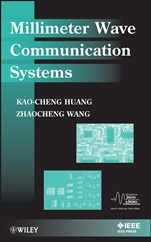
Millimeter Wave Communication Systems
ISBN 9780470404621
Autor: Kao–Cheng Huang, Zhaocheng Wang
Wydawca: Wiley
Dostępność: 3-6 tygodni
Cena: 565,95 zł
Przed złożeniem zamówienia prosimy o kontakt mailowy celem potwierdzenia ceny.
ISBN13: |
9780470404621 |
ISBN10: |
0470404620 |
Autor: |
Kao–Cheng Huang, Zhaocheng Wang |
Oprawa: |
Hardback |
Rok Wydania: |
2011-03-18 |
Ilość stron: |
304 |
Wymiary: |
241x156 |
Tematy: |
TJ |
Millimeter wave communication systems are poised to play key roles in modern gigabit wireless communication; millimeter wave industrial standards from IEEE, Wireless Gigabit Alliance, European Computer Manufacturers Association, and Wireless High Definition Group are about to emerge. This is the first book to address complete and modern millimeter wave communication systems, covering their key components and explaining the critical issues that influence their performance. The authors, experts in the field of millimeter wave communications, provide powerful techniques for analyzing real millimeter wave systems, with an emphasis on new transceivers, new antennas, multiple–input multiple–output (MIMO), modulations, beam steering, beam forming, and frequency domain equalization.
Covering the whole system from millimeter wave front–end to digital signal processing, the book reviews up–to–date research results and numerous design methods and analysis for an entire high–speed wireless system. Major topics addressed are:
Millimeter wave characteristics
Modulations for millimeter wave communications
Millimeter wave transceivers
Millimeter wave antennas
Millimeter wave MIMO
Advanced diversity over MIMO channels
Beam steering and beam forming
Single–carrier frequency domain equalization
The authors emphasize the importance and the requirements of high–gain antennas, low–power transceivers, MIMO, modulation, frequency domain equalization, beam steering, and beam forming for gigabit wireless communications. In addition, they discuss new research and patents in transceivers, antennas, MIMO, channel capacity, equalizers, modems, beam steering, and beam forming. The application of these systems is explained in light of different forthcoming wireless standards for V–band and E–band use. Example designs a
re presented and the analysis of their performance is detailed.
Linking academic research with commercial applications, this practical resource gives wireless communication system professionals, millimeter wave professionals, and project managers the insights they need to reduce design and production costs when integrating these systems. This book is also written for graduate students who are interested in becoming familiar with the modern communication system concept at millimeter wave range.
Spis treści:
Preface.
List of Abbreviations.
Chapter1 Millimeter wave Characteristics.
1.1 Millimeter wave characterizations.
1.2 Channel performance at 60 GHz.
1.3 Gigabit wireless communications.
1.4 Development of millimeter wave standards.
1.5 Co–existence with wireless backhaul.
Chapter2 Review of modulations for mm–wave communications.
2.1 On/Off Keying (OOK).
2.2 Phase shift keying (PSK).
2.3 Frequency shift keying (FSK).
2.4 Quadrature amplitude modulation (QAM).
2.5 Orthogonal frequency division multiplexing (OFDM).
Chapter3 Millimeter wave Transceivers.
3.1 Millimeter wave link budget.
3.2 Transceiver architecture.
3.3 Transceiver without mixer.
3.4 Receiver without local oscillator.
3.5 Millimeter wave calibration.
3.6 Research trend: transceiver siliconization.
Chapter4 Millimeter wave Antennas.
4.1 Path loss and antenna directivity.
4.2 Antenna beamwidth.
4.3 Maximum possible Gain–to–Q.
4.4 Polarization.
4.5 Beam steering antenna.
4.6 Millimeter wave design consideration.
4.7 Production and manufacture.
Chapter5 Millimeter wave MIMO.
5.1 Spatial diversity of antenna arrays.
5.2 Multiple antennas.
5.3 Multiple transceivers.
5.4 Noise coupling in a MIMO system.
Chapter6 Advanced Diversity over MIMO Channels.
6.1 Potential benefits for millimeter wave systems.
6.2 Spatial and temporal diversity.
6.3 Spatial a
nd frequency diversity.
6.4 Dynamic spatial, frequency and modulation allocation.
Chapter7 Advanced Beam Steering and Beam Forming.
7.1 The need for beam steering/beam forming.
7.2 Adaptive frame structure.
7.3 Advanced beam steering technology.
7.4 Advanced antenna ID technology.
7.5 Advanced beam forming technology.
Chapter8 Single Carrier Frequency Domain Equalization.
8.1 Advantages of SC–FDE over ODSM for millimeter wave systems.
8.2 Preamble design.
8.3 Adaptive channel estimation.
8.4 Frequency domain equalization.
8.5 Decision feedback equalization.
References.
Appendix: Simulation Tools.
Index.
Nota biograficzna:
Kao–Cheng Huang, PhD, is Vice President at the Dharma Academy in Taiwan and an IEEE Senior Member. Dr. Huang formerly worked as the MSc program leader at the University of Greenwich (UK), and senior research engineer at Sony Technology Centre, Germany. He received his PhD degree from University of Oxford (UK), and is the author of a previous book, Millimetre Wave Antennas for Gigabit Wireless Communications (Wiley). He holds several world and international patents in the area of millimeter wave communications.
Zhaocheng Wang, PhD, is Professor at the Department of Electronic Engineering, Tsinghua University, China. He has more than ten years of industry R&D experience in the areas of wireless and millimeter wave communications. He holds eighteen U.S./EU patents, some of which have been adopted by a plurality of international standards.
Okładka tylna:
Millimeter wave communication systems are poised to play key roles in modern gigabit wireless communication; millimeter wave industrial standards from IEEE, Wireless Gigabit Alliance, European Computer Manufacturers Association, and Wireless High Definition Group are about to emerge. This is the first book to address complete and modern millimeter wave communication systems, covering their
key components and explaining the critical issues that influence their performance. The authors, experts in the field of millimeter wave communications, provide powerful techniques for analyzing real millimeter wave systems, with an emphasis on new transceivers, new antennas, multiple–input multiple–output (MIMO), modulations, beam steering, beam forming, and frequency domain equalization.
Covering the whole system from millimeter wave front–end to digital signal processing, the book reviews up–to–date research results and numerous design methods and analysis for an entire high–speed wireless system. Major topics addressed are:
Millimeter wave characteristics
Modulations for millimeter wave communications
Millimeter wave transceivers
Millimeter wave antennas
Millimeter wave MIMO
Advanced diversity over MIMO channels
Beam steering and beam forming
Single–carrier frequency domain equalization
The authors emphasize the importance and the requirements of high–gain antennas, low–power transceivers, MIMO, modulation, frequency domain equalization, beam steering, and beam forming for gigabit wireless communications. In addition, they discuss new research and patents in transceivers, antennas, MIMO, channel capacity, equalizers, modems, beam steering, and beam forming. The application of these systems is explained in light of different forthcoming wireless standards for V–band and E–band use. Example designs are presented and the analysis of their performance is detailed.
Linking academic research with commercial applications, this practical resource gives wireless communication system professionals, millimeter wave professionals, and project managers the insights they need to reduce design and production costs when integrating these systems. This book is also written for graduate students who a
re interested in becoming familiar with the modern communication system concept at millimeter wave range.
Koszyk
Książek w koszyku: 0 szt.
Wartość zakupów: 0,00 zł
Informacje


Kontakt
Gambit
Centrum Oprogramowania
i Szkoleń Sp. z o.o.
Al. Pokoju 29b/22-24
31-564 Kraków
Siedziba Księgarni
ul. Kordylewskiego 1
31-542 Kraków
+48 12 410 5991
+48 12 410 5987
+48 12 410 5989
Subskrypcje
Administratorem danych osobowych jest firma Gambit COiS Sp. z o.o. Na podany adres będzie wysyłany wyłącznie biuletyn informacyjny.
Autoryzacja płatności

Informacje na temat autoryzacji płatności poprzez PayU.

© Copyright 2012: GAMBIT COiS Sp. z o.o. Wszelkie prawa zastrzeżone.
Projekt i wykonanie: Alchemia Studio Reklamy