


Wydawcy
Katalog tematyczny
- Archeologia (109)
- Ekonomia, finanse, business (13704)
- Filozofia (1445)
- Historia (3040)
- Języki i językoznawstwo (2356)
- Lifestyle, hobby i rozrywka (475)
- Medycyna (9704)
- Nauki humanistyczne (4)
- Nauki o Ziemi i środowisku (2638)
- Nauki ścisłe (20412)
- Nauki społeczne (8486)
- Nauki techniczne (13450)
- Budownictwo lądowe (1045)
- Chemia przemysłowa (2258)
- Elektronika i telekomunikacja (3287)
- Energetyka (1122)
- Inne nauki stosowane (363)
- Inżynieria biochemiczna (507)
- Inżynieria transportu (232)
- Mechanika i materiały (3316)
- Nauka o środowisku (321)
- Rolnictwo (507)
- Technika, ogólnie (475)
- Prawo (1696)
- Publikacje informacyjne i interdyscyplinarne (1288)
- Religia i wierzenia (917)
- Technika komputerowa (4067)
- Zdrowie, relacje międzyludzkie i rozwój osobisty (657)





Informacje szczegółowe o książce
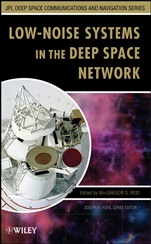
Low–Noise Systems in the Deep Space Network
ISBN 9780470402283
Autor: Macgregor S. Reid
Wydawca: Wiley
Dostępność: 3-6 tygodni
Cena: 1 014,30 zł
Przed złożeniem zamówienia prosimy o kontakt mailowy celem potwierdzenia ceny.
ISBN13: |
9780470402283 |
ISBN10: |
0470402288 |
Autor: |
Macgregor S. Reid |
Oprawa: |
Hardback |
Rok Wydania: |
2008-10-17 |
Ilość stron: |
416 |
Wymiary: |
245x164 |
Tematy: |
TJ |
DETAILED COVERAGE OF LOW–NOISE SYSTEMS IN THE DEEP SPACE NETWORK
This book explores the low–noise microwave systems that form the front end of all DSN ground receiving stations. It explains why the front end of each antenna is key to establishing the sensitivity, polarization, frequency diversity, and capabilities of the receiving chain and, therefore, the entire ground station. The book uses precise definitions, measurements, and calibrations of system noise temperature for the calculations based on IEEE standards—an approach that is not generally used in industry and research—which facilitates clarity, understanding, and cross–referencing throughout the book.
With the guidance of this book, readers will gain unprecedented insight into all of the major topics needed to understand how to improve a ground station′s receiving capability. Low–Noise Systems in the Deep Space Network provides:
A description of all internal and external noise elements
A complete analysis of ruby maser microwave preamplifiers and closed–cycle refrigerators
A comprehensive discussion of high electron mobility transistors (HEMT), including theory, operation, calibration, noise modeling, and characterization
A look at external noise and changing atmospheric conditions
An overview of antenna gain
All noise contributions in the front end are detailed in their measurement and calibration, with an emphasis on achieving maximum accuracy and precision. Each step is analyzed with mathematical rigor, so that the logic trail can be followed throughout. Conversely, the author also provides the overall summary of measurements, error analyses, and statistical results. The book is complemented with copious photographs, diagrams, graphs, and tables; an extensive list of acronyms and abbreviations; cross–references; and an extended list of equations brought together compactly for easy reference
. It is an invaluable resource for designers and operators of communications systems, radio– and radar–astronomy stations, space–research facilities, and interferometry observatories. It is also suitable for a range of scientists, engineers, and management personnel, and advanced undergraduate and graduate students in engineering and mathematics.
Spis treści:
Foreword.
Preface.
Acknowledgments.
Contributors.
Chapter 1: Introduction (Macgregor S. Reid).
References.
Chapter 2: System Noise Concepts with DSN Applications (Charles T. Stelzried, Arthur J. Freiley, and Macgregor S. Reid).
2.1 Introduction.
2.2 Noise Temperature Concepts.
2.3 Antennas.
2.4 Low–Noise Amplifiers.
2.5 Receiving Systems.
2.6 Measurements.
2.7 Radiometers in the DSN.
2.8 Status and Future.
Notation and Terms.
References.
Chapter 3: Ruby Masers (Robert C. Clauss and James S. Shell).
3.1 Introduction.
3.2 Ruby Properties.
3.3 Spin Resonance, the Applied Magnetic Field, Ruby Orientation, the Low–Temperature Requirement, and Excitation.
3.4 Spin–Lattice Relaxation Time, Inversion Ratios, Transition Probabilities, the Filling Factor, and Magnetic.
3.5 Ruby Maser Noise Temperatures.
3.6 Ruby Masers as Noise Temperature Standards.
3.7 Immunity from Radio Frequency Interference (RFI).
3.8 Early DSN Cavity Masers.
3.9 Comb–Type Traveling–Wave Masers.
3.10 Reflected–Wave Masers.
3.11 Ka–Band and the Return to Cavity.
3.12 Analysis of Maser Designs.
References.
Chapter 4: Cryogenic Refrigeration Systems (Robert C. Clauss).
4.1 Introduction.
4.2 Advantages of Using Cryogenic Cooling.
4.3 Open–Cycle Refrigeration.
4.4 Heat Transfer.
4.5 Antenna–Mounted Operation.
4.6 Closed–Cycle Helium Refrigerators.
4.7 Conclusion.
References.
Chapter 5: HEMT Low–Noise
Amplifiers (J. Javier Bautista).
5.1 Introduction–Semiconductor Conductivity.
5.2 The Many Acronym–ed Device (MAD)––A Brief HEMT History.
5.3 HEMT Growth Technology.
5.4 HEMT Materials Evolution––From GaAs to InAs.
5.5 Device Fabrication.
5.6 HEMT Noise Modeling.
5.7 LNA Development.
5.8 LNA Modeling and Characterization.
5.9 Subsystem Measurements.
5.10 Conclusion.
References.
Chapter 6: Atmosphere Attenuation and Noise Temperature at Microwave Frequencies (Shervin Shambayati).
6.1 Introduction.
6.2 Surface Weather.
6.3 Water Vapor Radiometer Data.
6.4 Weather Forecasting.
6.5 Concluding Remarks/Future Directions.
References.
Chapter 7: Antenna Calibration (David J. Rochblatt).
7.1 Introduction.
7.2 Calibration System Requirements.
7.3 Conventional Approach to Aperture Efficiency and Pointing Measurements.
7.4 The Raster–Scan Method.
7.5 Blind–Pointing Calibration.
7.6 Cassini–Jupiter Microwave Observation Campaign (Cassini JMOC).
7.7 Operational Antenna Calibration & Measurement Equipment (ACME) for the DSN.
7.8 Conclusions.
References.
Chapter 8: Microwave Antenna Holography (David J. Rochblatt).
8.1 Introduction.
8.2 Holography System Simulation.
8.3 Holography Receiver Signal Analysis.
8.4 Mathematical Formulation Data Processing.
8.5 Applications.
8.6 Conclusion.
References.
Acronyms And Abbreviations.
Nota biograficzna:
MacGregor S. Reid, PhD, worked at the Jet Propulsion Laboratory (JPL) from 1969 until his retirement in 1998. For the last ten years of his career, he was technical executive assistant to the director. He served a three–year term as vice president of the American Institute of Aeronautics and Astronautics (AIAA), Washington, D.C. Dr. Reid was formation chairman of the International Organization for Standardizati
on (ISO) Subcommittee on Space Systems and Operations for nine years, and he represented the United States on ISO′s Committee on Aircraft and Space Operations for twelve years. He has served on many advisory committees, both nationally and internationally, and he is the author of more than eighty publications in the technical literature, three of which have won awards. In recognition of his international work, an asteroid was named after Dr. Reid in 1998 (6894 MacReid). He was awarded medals from AIAA and NASA, and six monetary awards from NASA for the invention of new technology.
Okładka tylna:
DETAILED COVERAGE OF LOW–NOISE SYSTEMS IN THE DEEP SPACE NETWORK
This book explores the low–noise microwave systems that form the front end of all DSN ground receiving stations. It explains why the front end of each antenna is key to establishing the sensitivity, polarization, frequency diversity, and capabilities of the receiving chain and, therefore, the entire ground station. The book uses precise definitions, measurements, and calibrations of system noise temperature for the calculations based on IEEE standards—an approach that is not generally used in industry and research—which facilitates clarity, understanding, and cross–referencing throughout the book.
With the guidance of this book, readers will gain unprecedented insight into all of the major topics needed to understand how to improve a ground station′s receiving capability. Low–Noise Systems in the Deep Space Network provides:
A description of all internal and external noise elements
A complete analysis of ruby maser microwave preamplifiers and closed–cycle refrigerators
A comprehensive discussion of high electron mobility transistors (HEMT), including theory, operation, calibration, noise modeling, and characterization
A look at external noise and changing atmospheric conditions
An ove
Koszyk
Książek w koszyku: 0 szt.
Wartość zakupów: 0,00 zł
Informacje


Kontakt
Gambit
Centrum Oprogramowania
i Szkoleń Sp. z o.o.
Al. Pokoju 29b/22-24
31-564 Kraków
Siedziba Księgarni
ul. Kordylewskiego 1
31-542 Kraków
+48 12 410 5991
+48 12 410 5987
+48 12 410 5989
Subskrypcje
Administratorem danych osobowych jest firma Gambit COiS Sp. z o.o. Na podany adres będzie wysyłany wyłącznie biuletyn informacyjny.
Autoryzacja płatności

Informacje na temat autoryzacji płatności poprzez PayU.

© Copyright 2012: GAMBIT COiS Sp. z o.o. Wszelkie prawa zastrzeżone.
Projekt i wykonanie: Alchemia Studio Reklamy