


Wydawcy
Katalog tematyczny
- Archeologia (109)
- Ekonomia, finanse, business (13704)
- Filozofia (1445)
- Historia (3040)
- Języki i językoznawstwo (2356)
- Lifestyle, hobby i rozrywka (475)
- Medycyna (9704)
- Nauki humanistyczne (4)
- Nauki o Ziemi i środowisku (2638)
- Nauki ścisłe (20412)
- Nauki społeczne (8486)
- Edukacja (229)
- Kryminologia, opieka spełeczna (284)
- Obronność (10)
- Polityka (1389)
- Psychologia (777)
- Socjologia (410)
- Społeczeństwo i kultura (187)
- Nauki techniczne (13450)
- Prawo (1696)
- Publikacje informacyjne i interdyscyplinarne (1288)
- Religia i wierzenia (917)
- Technika komputerowa (4067)
- Zdrowie, relacje międzyludzkie i rozwój osobisty (657)





Informacje szczegółowe o książce
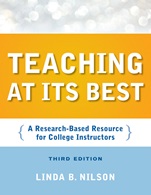
Teaching at Its Best: A Research–Based Resource for College Instructors
ISBN 9780470401040
Autor: Linda B. Nilson
Wydawca: Wiley
Dostępność: 3-6 tygodni
Cena: 211,05 zł
Przed złożeniem zamówienia prosimy o kontakt mailowy celem potwierdzenia ceny.
ISBN13: |
9780470401040 |
ISBN10: |
0470401044 |
Autor: |
Linda B. Nilson |
Oprawa: |
Paperback |
Rok Wydania: |
2010-06-11 |
Numer Wydania: |
3rd Edition |
Ilość stron: |
400 |
Wymiary: |
275x216 |
Tematy: |
JD |
Teaching at Its Best
This third edition of the best–selling handbook offers faculty at all levels an essential toolbox of hundreds of practical teaching techniques, formats, classroom activities, and exercises, all of which can be implemented immediately. This thoroughly revised edition includes the newest portrait of the Millennial student; current research from cognitive psychology; a focus on outcomes maps; the latest legal options on copyright issues; and how to best use new technology including wikis, blogs, podcasts, vodcasts, and clickers. Entirely new chapters include subjects such as matching teaching methods with learning outcomes, inquiry–guided learning, and using visuals to teach, and new sections address Felder and Silverman′s Index of Learning Styles, SCALE–UP classrooms, multiple true–false test items, and much more.
Praise for the Third Edition of Teaching at Its BestEveryone—veterans as well as novices—will profit from reading Teaching at Its Best, for it provides both theory and practical suggestions for handling all of the problems one encounters in teaching classes varying in size, ability, and motivation."—Wilbert McKeachie, Department of Psychology, University of Michigan, and coauthor, McKeachie′s Teaching TipsThis new edition of Dr. Nilson′s book, with its completely updated material and several new topics, is an even more powerful collection of ideas and tools than the last. What a great resource, especially for beginning teachers but also for us veterans!"—L. Dee Fink, author, Creating Significant Learning ExperiencesThis third edition of Teaching at Its Best is successful at weaving the latest research on teaching and learning into what was already a thorough exploration of each topic. New information on how we learn, how students develop, and innovations in instructional strategies complement the solid foundation established in the first two editions."—Marilla
D. Svinicki, Department of Psychology, The University of Texas, Austin, and coauthor, McKeachie′s Teaching Tips
Spis treści:
The Author.
Preface.
Part I. Laying the Groundwork for Student Learning.
1 Understanding Your Students and How They Learn.
Your Undergraduate Student Body Profile.
How People Learn.
How Structure Increases Learning.
The Cognitive Development of Undergraduates.
Encouraging Cognitive Growth.
Teaching the Millennial Generation.
The Adult Learner.
Inclusive Instructing.
The Challenge.
2 Outcomes–Centered Course Design.
Why Outcomes–Centered Course Design?
Writing Outcomes.
Types of Learning Outcomes.
Types of Cognitive Outcomes.
Designing the Learning Process.
Helpful Frameworks for Designing a Course.
Showing Students Their Learning Process.
Outcomes–Centered Course Development.
3 The Complete Syllabus.
Appropriate Syllabus Items.
The Graphic Syllabus.
The Online "Living Syllabus".
Getting Students to Read Your Syllabus.
The Evolving Syllabus.
4 Your First Day of Class.
Before the First Class.
First Impressions.
Exchanging Information.
Social Icebreakers: Getting to Know You.
Subject–Matter Icebreakers.
Drawing Class to a Close.
5 Motivating Your Students.
What We Know About Motivation in Learning.
Credible Theories of Motivation.
Strategies for Motivating Students.
Equity in the Classroom.
Part II. Managing Your Courses.
6 Copyright Guidelines for Instructors.
Where Copyright Does and Does Not Apply.
Common Copyright Misconceptions.
Free Use: Fair Use, Facts, and Public Domain.
Printed Text.
Visual Materials.
In–Class Performances.
Recording Broadcast Programming.
Online/Electronic Materials and Distance Learning.
Obtaining Permission or a License.
How Copyright Violations Are Actua
lly Handled.
For Further and Future Reference.
7 Preventing and Responding to Classroom Incivility.
What Is Incivility?
Why the Increase?
Preventing Incivility: Your Classroom Persona.
Responding to Incivility.
Seek Assistance.
8 Preserving Academic Honesty.
How Prevalent Is Cheating?
Who Cheats and Why?
Detecting Cheating.
Preventing Cheating.
Honor Codes.
Changing Student Values.
9 Making the Most of Office Hours.
Getting Students to See You.
Making the Time Productive.
Student–Active Tutoring.
Students in Academic or Emotional Trouble.
10 Course Coordination Between Faculty and TAs.
Before the Term: Course Review and Role Specifications.
During the Term: Regular Meetings and Teaching Feedback.
Extending Managing to Mentoring.
Part III. Choosing and Using the Right Tools for Teaching and Learning.
11 Matching Teaching Methods with Learning Outcomes.
Types of Tools.
Dangerous Knowledge?
12 Making the Lecture a Learning Experience.
Purpose: To Lecture or Not to Lecture?
Preparing an Effective Lecture.
Delivering an Effective Lecture.
Incorporating Student–Active Breaks: The Interactive Lecture.
Teaching Students to Take Good Notes.
Making the Lecture Effective for Everyone.
13 Leading Effective Discussions.
When to Choose Discussion.
How to Set the Stage for Discussion.
How to Maximize Participation through Skillful Discussion Management.
14 Questioning Techniques for Discussion and Assessment.
Questioning as a Process of Inquiry.
Typologies of Good Discussion Questions.
Poor Questions for Discussion Purposes.
Turning the Tables.
15 Experiential Learning Activities.
Student Presentation Formats.
Role–Playing.
Simulations and Games.
Service–Learning: The Real Thing.
16 Learning in Groups.
A Group by Any Other Name . . .
The Case for Group Work.
Changing Methods, Changing Roles.
The Setup and Management of Student Groups.
Management Tips.
Tried and True Group Learning Strategies.
Preparing Students for Life.
17 Writing–to–Learn Activities and Assignments.
Free Writes.
The One–Minute Paper.
Journals.
One–Sentence Summaries.
Learning Logs.
Dialectical Notes.
Directed Paraphrasing.
Letters, Memos, Notes, and Electronic Posts.
Mock Tests.
Drafts for Peer Feedback.
Multiple Purposes.
Part IV. More Tools: Teaching Real–World Problem Solving.
18 Inquiry–Guided Learning.
Definitions of Inquiry–Guided Learning.
The Effectiveness of Inquiry–Guided Learning.
Objects and Modes of Inquiry.
Variations of Inquiry–Based Learning.
19 The Case Method.
The Effectiveness of the Case Method.
The Appropriate Subject Matter.
What Makes a Good Case.
Types of Cases.
Debriefing Cases.
A Postscript for Pioneers.
20 Problem–Based Learning (PBL).
How PBL Works.
Good PBL Problems and Where to Find Them.
The Effectiveness of PBL.
What Students Think.
Kudos for Creativity.
21 Quantitative Reasoning and Problem Solving.
Understanding Students′ Problems with Problems.
Modeling Expert Reasoning.
Teaching the Steps of Problem Solving.
Tutoring Students out of Bad Habits.
Routinizing Peer Feedback.
Making Problems More Real and Challenging.
Using the Power of Group Learning.
Accommodating New Methods to Traditional Settings.
22 Problem Solving in the Sciences.
Where Science Education Falls Short.
How to Help Students Learn Science: General Advice.
How the Lecture Can Be Made into a Meaningful Learning Experience.
How the Lab Can Be Made into a Meaningful Learning Experience.
The Essentials of Lab Safety and Management.
Why Science Education Is so I
mportant.
Part V. Making Learning Easier.
23 Getting Students to Do the Readings.
Why Students Don′t Do the Readings.
How We Can Equip and Induce Students to Do the Readings.
Specific Tools for Holding Students Accountable.
Managing Your Workload.
24 Teaching Your Students to Think and Write in Your Discipline.
Crossdisciplinary Commonalities.
Teaching Critical Thinking Through the Discipline′s Metacognitive Model.
Metacognitive Differences Among Disciplines.
Making Students Better Thinkers and Writers.
Teaching Students to Write for Their Futures.
The Many Worlds of Writing.
25 Accommodating Different Learning Styles.
Kolb′s Learning Styles Model and Experiential Learning Theory (ELT).
Teaching to Kolb′s Types.
Fleming and Mills′ Sensory–Based Learning Style Typology.
Feldman and Silverman′s Index of Learning Styles (ILS).
Parallels Across Learning Style Models.
Multi–Sensory, Multi–Method Teaching: Most Effective for All.
26 Using Visuals to Teach.
Ways That Visuals Enhance Learning.
Types of Visuals for Learning.
The Future of Visuals in Teaching and Learning.
27 Using Instructional Technology Wisely.
Reliable Low–Tech Tools for the Classroom.
The Choice of High–Tech Alternatives.
Learning Management Systems.
Lecture–Related Software.
Web Resources.
Laptops in the Wireless Classroom.
Web 2.0 Tools.
Looking Ahead.
Part VI. Assessing Learning Outcomes.
28 Assessing Student Learning in Progress.
Classroom Assessment Techniques (CATs).
Formative Feedback.
Student Portfolios.
Extending Classroom Assessment to Classroom Research and the Scholarship of.
Teaching and Learning.
29 Constructing Summative Assessments.
General Testing Guidelines.
Objective Test Items.
Constructed Response Instruments: Essay Ques
tions and Writing Assignments.
Tests and Assignments: The Ultimate Teaching Evaluations.
30 Preparing Students for Tests.
Test Preparation Measures.
Anxiety Reduction Measures.
What the Effort Is Worth.
31 Grading Summative Assessments.
The Meaning of Grades.
Summative Assessments and Grading Systems.
The Qualities of a Sound Grading System.
Grading Constructed Responses and Papers.
Grading Lab Reports.
How to Grade Mechanics Quickly While Ensuring Students Learn Them.
Contract Grading.
Returning Students′ Work.
Helping Students Use Your Feedback to Improve.
The Real Meaning and Limits of Grades.
32 Evaluating and Documenting Teaching Effectiveness.
Defining and Measuring Teaching Effectiveness.
Student Evaluations.
Peer, Administrative, and Self–Evaluations.
Documenting Your Effectiveness.
Comprehensive Approaches to Faculty Evaluation.
Complex Beyond Measure.
Appendix: Instructional Support and Resources at Your Institution.
References.
Index.
Nota biograficzna:
The Author
Linda B. Nilson is the founding director of the Office of Teaching Effectiveness and Innovation at Clemson University. She is the author of The Graphic Syllabus and the Outcomes Map: Communicating Your Course from Jossey–Bass.
Okładka tylna:
Teaching at Its Best
This third edition of the best–selling handbook offers faculty at all levels an essential toolbox of hundreds of practical teaching techniques, formats, classroom activities, and exercises, all of which can be implemented immediately. This thoroughly revised edition includes the newest portrait of the Millennial student; current research from cognitive psychology; a focus on outcomes maps; the latest legal options on copyright issues; and how to best use new technology including wikis, blogs, podcasts, vodcasts, and clickers. Entirely new chapters include subjects
such as matching teaching methods with learning outcomes, inquiry–guided learning, and using visuals to teach, and new sections address Felder and Silverman′s Index of Learning Styles, SCALE–UP classrooms, multiple true–false test items, and much more.
Praise for the Third Edition of Teaching at Its BestEveryone—veterans as well as novices—will profit from reading Teaching at Its Best, for it provides both theory and practical suggestions for handling all of the problems one encounters in teaching classes varying in size, ability, and motivation."—Wilbert McKeachie, Department of Psychology, University of Michigan, and coauthor, McKeachie′s Teaching TipsThis new edition of Dr. Nilson′s book, with its completely updated material and several new topics, is an even more powerful collection of ideas and tools than the last. What a great resource, especially for beginning teachers but also for us veterans!"—L. Dee Fink, author, Creating Significant Learning ExperiencesThis third edition of Teaching at Its Best is successful at weaving the latest research on teaching and learning into what was already a thorough exploration of each topic. New information on how we learn, how students develop, and innovations in instructional strategies complement the solid foundation established in the first two editions."—Marilla D. Svinicki, Department of Psychology, The University of Texas, Austin, and coauthor, McKeachie′s Teaching Tips
Koszyk
Książek w koszyku: 0 szt.
Wartość zakupów: 0,00 zł
Informacje


Kontakt
Gambit
Centrum Oprogramowania
i Szkoleń Sp. z o.o.
Al. Pokoju 29b/22-24
31-564 Kraków
Siedziba Księgarni
ul. Kordylewskiego 1
31-542 Kraków
+48 12 410 5991
+48 12 410 5987
+48 12 410 5989
Subskrypcje
Administratorem danych osobowych jest firma Gambit COiS Sp. z o.o. Na podany adres będzie wysyłany wyłącznie biuletyn informacyjny.
Autoryzacja płatności

Informacje na temat autoryzacji płatności poprzez PayU.

© Copyright 2012: GAMBIT COiS Sp. z o.o. Wszelkie prawa zastrzeżone.
Projekt i wykonanie: Alchemia Studio Reklamy