


Wydawcy
Katalog tematyczny
- Archeologia (109)
- Ekonomia, finanse, business (13704)
- Filozofia (1445)
- Historia (3040)
- Języki i językoznawstwo (2356)
- Lifestyle, hobby i rozrywka (475)
- Medycyna (9704)
- Nauki humanistyczne (4)
- Nauki o Ziemi i środowisku (2638)
- Nauki ścisłe (20412)
- Nauki społeczne (8486)
- Nauki techniczne (13450)
- Prawo (1696)
- Publikacje informacyjne i interdyscyplinarne (1288)
- Religia i wierzenia (917)
- Technika komputerowa (4067)
- Zdrowie, relacje międzyludzkie i rozwój osobisty (657)





Informacje szczegółowe o książce
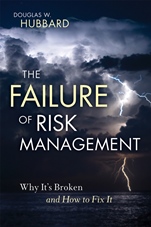
The Failure of Risk Management: Why Its Broken and How to Fix It
ISBN 9780470387955
Autor: Douglas W. Hubbard
Wydawca: Wiley
Dostępność: 3-6 tygodni
Cena: 248,85 zł
Przed złożeniem zamówienia prosimy o kontakt mailowy celem potwierdzenia ceny.
ISBN13: |
9780470387955 |
ISBN10: |
0470387955 |
Autor: |
Douglas W. Hubbard |
Oprawa: |
Hardback |
Rok Wydania: |
2009-05-15 |
Ilość stron: |
304 |
Wymiary: |
231x159 |
Tematy: |
KJ |
The Failure of Risk Management explains which risk analysis methods work, which don′t, and how to tell the difference. The Failure of Risk Management discusses topics relevant to the management of any risk including: Financial Risks, Natural Disasters, Industrial Accidents, Product Safety, Technology Risks, Project Failures, Engineering Disasters, Pandemic Viruses, Computer Security, Fraud, Loss of Reputation, Litigation
Companion Web site www.howtofixriskmgt.com
YOUR BIGGEST RISK IS THAT YOUR RISK MANAGEMENT METHODS PROBABLY DON′T WORK.
THE FAILURE OF RISK MANAGEMENT
"Doug Hubbard, a recognized expert among experts in the field of risk management, covers the entire spectrum of risk management in this invaluable guide. There are specific value–added take aways in each chapter that are sure to enrich all readers including IT, business management, students, and academic alike."
—Peter Julian, former chief information officer of the New York Metro Transit Authority, President of The Alliance Group Consulting
"In his, trademark style, Doug asks the tough questions on risk management. A must–read not only for analysts, but also for the executive who is making critical business decisions."
—Jim Franklin, VP Enterprise Performance Management and General Manager, Crystal Ball Global Business Unit, Oracle Corporation
"Doug Hubbard′s book should be required reading for managers and practitioners responsible for mitigating risk. If corporations and government are to regain the public trust, effective and broad–based risk management must be as natural as breathing."
—Ron Miller, FEMA CIO 2001–2002; former senior advisor, White House Homeland Security Transition Planning Office; Chairman, TeamRonMiller.com
"A seminal and timely book. The Failure of Risk Management challenges conventional wisdom and provides priceless sup
port to decision makers navigating their company in these turbulent times."
—Dr. John F.A. Spangenberg, CEO, SeaQuation (an ING spin–off)
"Doug Hubbard really knows his stuff. He is not just an author who has learned enough about a current popular topic to write a book, but instead is a talented consultant in this area, who has learned how to write, and write well. He displays a deep real–world understanding that ranges from mathematics to everyday human behavior, a trait that is all too rare in this age of specialization."
—Prof. Sam Savage, Fellow, Judge Business School, Cambridge University; Consulting Professor, Stanford University School of Engineering
Spis treści:
Preface.
Acknowledgments.
PART ONE AN INTRODUCTION TO THE CRISIS.
CHAPTER 1 Healthy Skepticism for Risk Management.
Common Mode Failure.
What Counts as Risk Management.
Anecdote: The Risk of Outsourcing Drug Manufacturing.
What Failure Means.
Scope and Objectives of This Book.
CHAPTER 2 Risk Management: A Very Short Introduction to Where We’ve Been and Where (We Think) We Are.
The Entire History of Risk Management (in 800 Words or Less).
Methods of Assessing Risks.
Risk Mitigation.
The State of Risk Management According to Surveys.
CHAPTER 3 How Do We Know What Works?
An Assessment of Self–Assessments.
Potential Objective Evaluations of Risk Management.
What We May Find.
PART TWO WHY IT’S BROKEN.
CHAPTER 4 The "Four Horsemen" of Risk Management: Some (Mostly) Sincere Attempts to Prevent an Apocalypse.
Actuaries.
War Quants: How World War II Changed Risk Analysis Forever.
Economists.
Management Consulting: How a Power Tie and a Good Pitch Changed Risk Management.
Comparing the Horsemen.
Major Risk Management Problems to Be Addressed.
CHAPTER 5 An
Ivory Tower of Babel: Fixing the Confusion about Risk.
The Frank Knight Definition.
Risk as Volatility.
A Construction Engineering Definition.
Risk as Expected Loss.
Risk as a Good Thing.
Risk Analysis and Risk Management versus Decision Analysis.
Enriching the Lexicon.
CHAPTER 6 The Limits of Expert Knowledge: Why We Don’t Know What We Think We Know about Uncertainty.
The Right Stuff: How a Group of Psychologists Saved Risk Analysis.
Mental Math: Why We Shouldn’t Trust the Numbers in Our Heads.
"Catastrophic" Overconfidence.
The Mind of "Aces": Possible Causes and Consequences of Overconfidence.
Inconsistencies and Artifacts: What Shouldn’t Matter Does.
Answers to Calibration Tests.
CHAPTER 7 Worse Than Useless: The Most Popular Risk Assessment Method and Why It Doesn’t Work.
A Basic Course in Scoring Methods (Actually, It’s the Advanced Course, Too—There’s Not Much to Know).
Does That Come in ‘‘Medium’’?: Why Ambiguity Does Not Offset Uncertainty.
Unintended Effects of Scales: What You Don’t Know Can Hurt You.
Clarification of Scores and Preferences: Different but Similar–Sounding Methods and Similar but Different–Sounding Methods.
CHAPTER 8 Black Swans, Red Herrings, and Invisible Dragons: Overcoming Conceptual Obstacles to Improved Risk Management.
Risk and Righteous Indignation: The Belief that Quantitative Risk Analysis Is Impossible.
A Note about Black Swans.
Frequentist versus Subjectivist.
We’re Special: The Belief that Risk Analysis Might Work, But Not Here.
CHAPTER 9 Where Even the Quants Go Wrong: Common and Fundamental Errors in Quantitative Models.
Introduction to Monte Carlo Concepts.
Survey of Monte Carlo Users.
The Risk Paradox.
The Measurement Inversion.
Where’s the Science? The Lack of Empiricism in Risk
Models.
Financial Models and the Shape of Disaster: Why Normal Isn’t so Normal.
Following Your Inner Cow: The Problem with Correlations.
"That’s Too Uncertain": How Modelers Justify Excluding the Biggest Risks.
Is Monte Carlo Too Complicated?
PART THREE HOW TO FIX IT.
CHAPTER 10 The Language of Uncertain Systems: The First Step Toward Improved Risk Management.
Getting Your Probabilities Calibrated.
The Model of Uncertainty: Decomposing Risk with Monte Carlos.
Decomposing Probabilities: Thinking about Chance the Way You Think about a Budget.
A Few Modeling Principles.
Modeling the Mechanism.
CHAPTER 11 The Outward–Looking Modeler: Adding Empirical Science to Risk.
Why Your Model Won’t Behave.
Empirical Inputs.
Introduction to Bayes: One Way to Get around that "Limited Data for Disasters" Problem.
Self–Examinations for Modelers Who Care about Quality.
CHAPTER 12 The Risk Community: Intra– and Extraorganizational Issues of Risk Management.
Getting Organized.
Managing the Global Probability Model.
Incentives for a Calibrated Culture.
Extraorganizational Issues: Solutions beyond Your Office Building.
Miscellaneous Topics.
Final Thoughts on Quantitative Models and Better Decisions.
Appendix Calibration Tests and Answers.
Index.
Nota biograficzna:
Douglas W. Hubbard is the inventor of Applied Information Economics (AIE). He is an internationally recognized expert in the field of measuring intangibles, risks, and value, especially in IT value, and is a popular speaker at numerous conferences. He has written articles for InformationWeek, CIO Enterprise, and DBMS magazine. His AIE method has been applied to dozens of large Fortune 500 IT investments, military logistics, venture capital, aerospace, and environmental issues. Doug is the author of How to Measure Any
thing: Finding the Value of Intangibles in Business (Wiley).
Okładka tylna:
The Failure of Risk Management explains which risk analysis methods work, which don′t, and how to tell the difference. The Failure of Risk Management discusses topics relevant to the management of any risk including: Financial Risks, Natural Disasters, Industrial Accidents, Product Safety, Technology Risks, Project Failures, Engineering Disasters, Pandemic Viruses, Computer Security, Fraud, Loss of Reputation, Litigation
Companion Web site www.howtofixriskmgt.com
YOUR BIGGEST RISK IS THAT YOUR RISK MANAGEMENT METHODS PROBABLY DON′T WORK.
THE FAILURE OF RISK MANAGEMENT
"Doug Hubbard, a recognized expert among experts in the field of risk management, covers the entire spectrum of risk management in this invaluable guide. There are specific value–added take aways in each chapter that are sure to enrich all readers including IT, business management, students, and academic alike."
—Peter Julian, former chief information officer of the New York Metro Transit Authority, President of The Alliance Group Consulting
"In his, trademark style, Doug asks the tough questions on risk management. A must–read not only for analysts, but also for the executive who is making critical business decisions."
—Jim Franklin, VP Enterprise Performance Management and General Manager, Crystal Ball Global Business Unit, Oracle Corporation
"Doug Hubbard′s book should be required reading for managers and practitioners responsible for mitigating risk. If corporations and government are to regain the public trust, effective and broad–based risk management must be as natural as breathing."
—Ron Miller, FEMA CIO 2001–2002; former senior advisor, White House Homeland Security Transition Planning Office; Chairman, TeamRonMiller.com
"A seminal and timely
book. The Failure of Risk Management challenges conventional wisdom and provides priceless support to decision makers navigating their company in these turbulent times."
—Dr. John F.A. Spangenberg, CEO, SeaQuation (an ING spin–off)
"Doug Hubbard really knows his stuff. He is not just an author who has learned enough about a current popular topic to write a book, but instead is a talented consultant in this area, who has learned how to write, and write well. He displays a deep real–world understanding that ranges from mathematics to everyday human behavior, a trait that is all too rare in this age of specialization."
—Prof. Sam Savage, Fellow, Judge Business School, Cambridge University; Consulting Professor, Stanford University School of Engineering
Koszyk
Książek w koszyku: 0 szt.
Wartość zakupów: 0,00 zł
Informacje


Kontakt
Gambit
Centrum Oprogramowania
i Szkoleń Sp. z o.o.
Al. Pokoju 29b/22-24
31-564 Kraków
Siedziba Księgarni
ul. Kordylewskiego 1
31-542 Kraków
+48 12 410 5991
+48 12 410 5987
+48 12 410 5989
Subskrypcje
Administratorem danych osobowych jest firma Gambit COiS Sp. z o.o. Na podany adres będzie wysyłany wyłącznie biuletyn informacyjny.
Autoryzacja płatności

Informacje na temat autoryzacji płatności poprzez PayU.

© Copyright 2012: GAMBIT COiS Sp. z o.o. Wszelkie prawa zastrzeżone.
Projekt i wykonanie: Alchemia Studio Reklamy