


Wydawcy
Katalog tematyczny
- Archeologia (109)
- Ekonomia, finanse, business (13704)
- Filozofia (1445)
- Historia (3040)
- Języki i językoznawstwo (2356)
- Lifestyle, hobby i rozrywka (475)
- Medycyna (9704)
- Nauki humanistyczne (4)
- Nauki o Ziemi i środowisku (2638)
- Nauki ścisłe (20412)
- Astronomia (294)
- Biologia (5119)
- Chemia (6540)
- Chemia analityczna (361)
- Chemia fizyczna (346)
- Chemia nieorganiczna (137)
- Chemia organiczna (535)
- Krystalografia (27)
- Minerologia (46)
- Fizyka (3309)
- Matematyka (4574)
- Nauki ścisłe, ogólnie (503)
- Nauki społeczne (8486)
- Nauki techniczne (13450)
- Prawo (1696)
- Publikacje informacyjne i interdyscyplinarne (1288)
- Religia i wierzenia (917)
- Technika komputerowa (4067)
- Zdrowie, relacje międzyludzkie i rozwój osobisty (657)





Informacje szczegółowe o książce
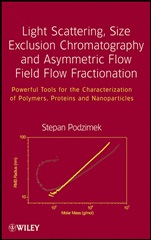
Light Scattering, Size Exclusion Chromatography and Asymmetric Flow Field Flow Fractionation: Powerful Tools for the Characterization of Polymers, Proteins and Nanoparticles
ISBN 9780470386170
Autor: Stepan Podzimek
Wydawca: Wiley
Dostępność: 3-6 tygodni
Cena: 565,95 zł
Przed złożeniem zamówienia prosimy o kontakt mailowy celem potwierdzenia ceny.
ISBN13: |
9780470386170 |
ISBN10: |
0470386177 |
Autor: |
Stepan Podzimek |
Oprawa: |
Hardback |
Rok Wydania: |
2011-02-15 |
Ilość stron: |
372 |
Wymiary: |
249x169 |
Tematy: |
PN |
A comprehensive, practical approach to three powerful methods of polymer analysis and characterization
This book serves as a complete compendium of three important methods widely used for the characterization of synthetic and natural polymers—light scattering, size exclusion chromatography (SEC), and asymmetric flow field flow fractionation (A4F). Featuring numerous up–to–date examples of experimental results obtained by light scattering, SEC, and A4F measurements, Light Scattering, Size Exclusion Chromatography and Asymmetric Flow Field Flow Fractionation takes an all–in–one approach to deliver a complete and thorough explanation of the principles, theories, and instrumentation needed to characterize polymers from the viewpoint of their molar mass distribution, size, branching, and aggregation. This comprehensive resource:
Is the only book gathering light scattering, size exclusion chromatography, and asymmetric flow field flow fractionation into a single text
Systematically compares results of size exclusion chromatography with results of asymmetric flow field flow fractionation, and how these two methods complement each other
Provides in–depth guidelines for reproducible and correct determination of molar mass and molecular size of polymers using SEC or A4F coupled with a multi–angle light scattering detector
Offers a detailed overview of the methodology, detection, and characterization of polymer branching
Light Scattering, Size Exclusion Chromatography and Asymmetric Flow Field Flow Fractionation should be of great interest to all those engaged in the polymer analysis and characterization in industrial and university research, as well as in manufacturing quality control laboratories. Both beginners and experienced can confidently rely on this volume to confirm their own understanding or to help interpret their results.
Spis treści:
Preface.
1 Polymers.
1.1 Introduction.
1.2 Molecular Structure of Polymers.
1.2.1 Macromolecules in Dilute Solution.
1.3 Molar Mass Distribution.
1.3.1 Description of Molar Mass Distribution.
1.3.1.1 Distribution Functions.
1.3.1.2 Molar Mass Averages.
1.4 Methods for the Determination of Molar Mass.
1.4.1 Method of End Groups.
1.4.2 Osmometry.
1.4.2.1 Vapor Pressure Osmometry.
1.4.2.2 Membrane osmometry.
1.4.3 Dilute Solution Viscometry.
1.4.3.1 Properties of Mark–Houwink Exponent.
1.4.3.2 Molecular Size from Intrinsic Viscosity.
1.4.3.3 Dependence of Intrinsic Viscosity on Polymer Structure, Temperature and Solvent.
1.4.4 Matrix Assisted Laser Desorption Ionization Time–of–Flight Mass Spectrometry.
1.4.5 Analytical Ultracentrifugation.
1.5 Keynotes.
1.6 References.
2 Light Scattering.
2.1 Theory and Basic Principles.
2.2 Types of Light Scattering.
2.2.1 Static Light Scattering.
2.2.1.1 Particle Scattering Functions.
2.2.1.2 Light Scattering Formalisms.
2.2.1.3 Processing the Experimental Data.
2.2.2 Dynamic Light Scattering.
2.3 Light Scattering Instrumentation.
2.4 Specific Refractive Index Increment.
2.5 Light Scattering in Batch and Chromatography Mode.
2.6 Parameters Affecting Accuracy of Molar Mass Determined by Light Scattering.
2.7 Examples of Light Scattering Measurement in Batch Mode.
2.8 Keynotes.
2.9 References.
3 3 Size Exclusion Chromatography.
3.1 Introduction.
3.2 Separation Mechanisms.
3.2.1 Steric Exclusion.
3.2.2 Restricted Diffusion.
3.2.3 Separation by Flow.
3.2.4 Peak Broadening and Separation Efficiency.
3.2.5 Secondary Separation Mechanisms.
3.3 Instrumentation.
3.3.1 Solvents.
3.3.2 Columns and Column Packing.
3.3.3 Detectors.
3.3.3.1 UV Detector.
3.3.3.2 Refractive Index Detector.
3.3.3.3 Infrared Detector.
3.3.3.4 Evaporative Light Scattering Detector.
3.3.3.5 Vi
scosity Detector.
3.3.3.6 Light Scattering Detector.
3.3.3.7 Other Types of Detectors.
3.4 Column Calibration.
3.4.1 Universal Calibration.
3.4.2 Flow Marker.
3.5 SEC Measurements and Data Processing.
3.5.1 Sample Preparation.
3.5.1.1 Sample Derivatization.
3.5.2 Determination of Molar Mass and Molar Mass Distribution.
3.5.3 Reporting Results.
3.5.4 Characterization of Chemical Composition of Copolymers and Polymer Blends.
3.5.5 Characterization of Oligomers.
3.5.6 Influence of Separation Conditions.
3.5.7 Accuracy, Repeatability and Reproducibility of SEC Measurements.
3.6 Applications of SEC.
3.7 Keynotes.
3.8 References.
4 Combination of SEC and Light Scattering.
4.1 Introduction.
4.2 Data Collection and Processing.
4.2.1 Processing MALS Data.
4.2.1.1 Debye Fit Method.
4.2.1.2 Zimm Fit Method.
4.2.1.3 Berry fit Method.
4.2.1.4 Random Coil Fit Method.
4.2.1.5 Influence of Light Scattering Formalism on Molar Mass and RMS Radius.
4.2.2 Determination of Molar Mass and RMS Radius Averages and Distributions.
4.2.3 Chromatogram Processing.
4.2.4 Influence of Concentration and Second Virial Coefficient.
4.2.5 Repeatability and Reproducibility.
4.2.6 Accuracy of Results.
4.3 Applications of SEC–MALS.
4.3.1 Determination of Molar Mass Distribution.
4.3.2 Fast Determination of Molar Mass.
4.3.3 Characterization of Complex Polymers.
4.3.3.1 Branched Polymers.
4.3.3.2 Copolymers and Polymer Blends.
4.3.4 Conformation Plots.
4.3.5 Mark–Houwink Plots.
4.4 Keynotes.
4.5 References.
5 Asymmetric Flow Field Flow Fractionation.
5.1 Introduction.
5.2 Theory and Basic Principles.
5.2.1 Separation Mechanisms.
5.2.2 Resolution and Band Broadening.
5.3 Instrumentation.
5.4 Measurements and Data Processing.
5.4.1 Influence of Separation Conditions.
5.4.1.1 Isocratic and Gradient Experiments.
5.4.1.2 Overloading.
5.4.2 Pra
ctical Measurements.
5.5 A4F Applications.
5.6 Keynotes.
5.7 References.
6 Characterization of Branched Polymers.
6.1 Introduction.
6.2 Detection and Characterization of Branching.
6.2.1 SEC Elution Behavior of Branched Polymers.
6.2.2 Distribution of Branching.
6.2.3 Average Branching Ratios.
6.2.4 Other Methods for the Identification and Characterization of Branching.
6.3 Examples of Characterization of Branching.
6.4 Keynotes.
6.5 References.
Symbols.
Abbreviations.
Index.
Nota biograficzna:
Stepan Podzimek, an author or coauthor of forty scientific papers, works as a head of the Department of Analytical and Physical Chemistry at SYNPO, a Czech R&D company, and as a professor at the Institute of Chemistry and Technology of Macromolecular Materials at the University of Pardubice. He has been working in the field of polymer analysis and characterization for twenty–five years. His research interests include characterization of molecular and chemical structure of synthetic and natural polymers using size exclusion chromatography, liquid chromatography, asymmetric flow field flow fractionation, light scattering, viscometry, mass spectroscopy, and study of structure–property relationships. In particular, he has focused on the characterization of branched polymers.
Okładka tylna:
A comprehensive, practical approach to three powerful methods of polymer analysis and characterization
This book serves as a complete compendium of three important methods widely used for the characterization of synthetic and natural polymers—light scattering, size exclusion chromatography (SEC), and asymmetric flow field flow fractionation (A4F). Featuring numerous up–to–date examples of experimental results obtained by light scattering, SEC, and A4F measurements, Light Scattering, Size Exclusion Chromatography and Asymmetric Flow Field Flow Fractionation takes an
all–in–one approach to deliver a complete and thorough explanation of the principles, theories, and instrumentation needed to characterize polymers from the viewpoint of their molar mass distribution, size, branching, and aggregation. This comprehensive resource:
Is the only book gathering light scattering, size exclusion chromatography, and asymmetric flow field flow fractionation into a single text
Systematically compares results of size exclusion chromatography with results of asymmetric flow field flow fractionation, and how these two methods complement each other
Provides in–depth guidelines for reproducible and correct determination of molar mass and molecular size of polymers using SEC or A4F coupled with a multi–angle light scattering detector
Offers a detailed overview of the methodology, detection, and characterization of polymer branching
Light Scattering, Size Exclusion Chromatography and Asymmetric Flow Field Flow Fractionation should be of great interest to all those engaged in the polymer analysis and characterization in industrial and university research, as well as in manufacturing quality control laboratories. Both beginners and experienced can confidently rely on this volume to confirm their own understanding or to help interpret their results.
Koszyk
Książek w koszyku: 0 szt.
Wartość zakupów: 0,00 zł
Informacje


Kontakt
Gambit
Centrum Oprogramowania
i Szkoleń Sp. z o.o.
Al. Pokoju 29b/22-24
31-564 Kraków
Siedziba Księgarni
ul. Kordylewskiego 1
31-542 Kraków
+48 12 410 5991
+48 12 410 5987
+48 12 410 5989
Subskrypcje
Administratorem danych osobowych jest firma Gambit COiS Sp. z o.o. Na podany adres będzie wysyłany wyłącznie biuletyn informacyjny.
Autoryzacja płatności

Informacje na temat autoryzacji płatności poprzez PayU.

© Copyright 2012: GAMBIT COiS Sp. z o.o. Wszelkie prawa zastrzeżone.
Projekt i wykonanie: Alchemia Studio Reklamy