


Wydawcy
Katalog tematyczny
- Archeologia (109)
- Ekonomia, finanse, business (13704)
- Filozofia (1445)
- Historia (3040)
- Języki i językoznawstwo (2356)
- Lifestyle, hobby i rozrywka (475)
- Medycyna (9704)
- Nauki humanistyczne (4)
- Nauki o Ziemi i środowisku (2638)
- Nauki ścisłe (20412)
- Nauki społeczne (8486)
- Nauki techniczne (13450)
- Prawo (1696)
- Publikacje informacyjne i interdyscyplinarne (1288)
- Religia i wierzenia (917)
- Technika komputerowa (4067)
- Zdrowie, relacje międzyludzkie i rozwój osobisty (657)





Informacje szczegółowe o książce
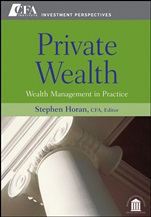
Private Wealth: Wealth Management In Practice
ISBN 9780470381137
Autor: Stephen M. Horan
Wydawca: Wiley
Dostępność: 3-6 tygodni
Cena: 449,40 zł
Przed złożeniem zamówienia prosimy o kontakt mailowy celem potwierdzenia ceny.
ISBN13: |
9780470381137 |
ISBN10: |
0470381132 |
Autor: |
Stephen M. Horan |
Oprawa: |
Hardback |
Rok Wydania: |
2009-01-29 |
Ilość stron: |
576 |
Wymiary: |
262x186 |
Tematy: |
KF |
Praise for Private Wealth
"The collection of material in Stephen Horan′s Private Wealth assembles in one, organized tome a critical core treatment of ideas upon which most aspects of modern private wealth management are founded. It is sure to be a useful reference for those who deal with the challenging task of balancing the myriad needs and preferences of individuals and families alike in the single or multigenerational management of their wealth. I am confident that advisors will find Private Wealth as useful in their practices as we will in wealth management coursework at Wharton."
–Professor Christopher C. Geczy, PhD, Academic Director, Wharton Wealth Management Initiative, The Wharton School
"Private Wealth is an excellent compilation of the best research in private wealth management published by the CFA Institute. Stephen Horan has done a superb job not only at selecting articles that reflect the most forward thinking about the theory and practice of private wealth management, but also at organizing them around the topics that matter the most to today′s wealth managers. Private wealth management is undoubtedly one of the most complex areas in investment management for the many dimensions involved in the process of selecting and implementing the appropriate asset allocation for private taxable investors. Wealth managers can find in Private Wealth a helpful reference when confronting today′s complex challenges."
–Luis M. Viceira, PhD, Professor of Business Administration, Harvard Business School
Spis treści:
Foreword.
Introduction.
PART I: LIFE–CYCLE INVESTING CHAPTER.
The Future of Retirement Planning (Robert C. Merton).
Reprinted from The Future of Life–Cycle Saving and Investing, The Research Foundation of CFA Institute (October 2007):5–18.
CHAPTER 2: Is Personal Finance a
Science? (Paul A. Samuelson).
Reprinted from The Future of Life–Cycle Saving and Investing, The Research Foundation of CFA Institute (October 2007):1–4.
CHAPTER 3: Lifetime Financial Advice: Human Capital, Asset Allocation, and Insurance (Roger G. Ibbotson; Moshe A. Milevsky; Peng Chen, CFA; and Kevin X. Zhu Reprinted from The Research Foundation of CFA Institute (April 2007).
CHAPTER 4: The Theory of Optimal Life–Cycle Saving and Investing (Zvi Bodie, Jonathan Treussard, and Paul Willen).
Reprinted from The Future of Life–Cycle Saving and Investing, The Research Foundation of CFA Institute (October 2007):19–37.
CHAPTER 5: Is Conventional Financial Planning Good for Your Financial Health? (Laurence J. Kotlikoff).
Reprinted from The Future of Life–Cycle Saving and Investing, The Research Foundation of CFA Institute (October 2007):55–71.
CHAPTER 6: The Life Care Annuity (Mark J. Warshawsky).
Reprinted from The Future of Life–Cycle Saving and Investing, The Research Foundation of CFA Institute (October 2007):103–106.
CHAPTER 7: The Longevity Annuity: An Annuity for Everyone? (Jason S. Scott).
Reprinted from the Financial Analysts Journal (January/February 2008):40–48.
CHAPTER 8: A Sustainable Spending Rate without Simulation (Moshe A. Milevsky and Chris Robinson).
Reprinted from the Financial Analysts Journal (November/December 2005): 89–100.
CHAPTER 9: Asset Allocation without Unobservable Parameters (Michael Stutzer).
Reprinted from the Financial Analysts Journal (September/October 2004):38–51.
PART II: INVESTMENT MANAGEMENT FOR TAXABLE PRIVATE CLIENTS.
CHAPTER 10: Investment Management for Taxable Private Investors (Jarrod Wilcox, CF
A; Jeffrey E. Horvitz; and Dan diBartolomeo).
Reprinted from The Research Foundation of CFA Institute (January 2006).
CHAPTER 11: Core/Satellite Strategies for the High–Net–Worth Investor (Clifford H. Quisenberry, CFA).,
Reprinted from CFA Institute Conference Proceedings Quarterly (December 2006):38–45.
CHAPTER 12: The Higher Equity Risk Premium Created by Taxation (Martin L. Leibowitz).
Modifi ed from the Financial Analysts Journal (September/October 2003):28–31.
CHAPTER 13: Tax Deferral and Tax–Loss Harvesting (Jeffrey E. Horvitz).
Reprinted from CFA Institute Conference Proceedings: Wealth Management (October 2005):24–30.
CHAPTER 14: Tax Management, Loss Harvesting, and HIFO Accounting (Andrew L. Berkin and Jia Ye).
Reprinted from the Financial Analysts Journal (July/August 2003):91–102.
CHAPTER 15: Investing with a Tax–Effi cient Eye (Robert N. Gordon).
Reprinted from CFA Institute Conference Proceedings: Wealth Management (October 2005):31–40.
CHAPTER 16: Diversifying Concentrated Holdings (Scott D. Welch).
Reprinted from AIMR Conference Proceedings: Investment Counseling for Private Clients III (August 2001):30–35.
CHAPTER 17: Hedging Low–Cost–Basis Stock (Robert N. Gordon).
Reprinted from AIMR Conference Proceedings: Investment Counseling for Private Clients III (August 2001):36–43.
PART III: TAX–EFFICIENT WEALTH ACCUMULATION.
CHAPTER 18: Tax–Advantaged Savings Accounts and Tax–Effi cient Wealth Accumulation (Stephen M. Horan, CFA).
Reprinted from The Research Foundation of CFA Institute (June 2005).
CHAPTER 19: After–Tax Asset Allocation (William Reichenstein, CFA).
Repri
nted from the Financial Analysts Journal (July/August 2006):14–19.
CHAPTER 20: Withdrawal Location with Progressive Tax Rates (Stephen M. Horan, CFA).
Reprinted from the Financial Analysts Journal (November/December 2006):77–87.
PART IV: AFTER–TAX PERFORMANCE MEASUREMENT.
CHAPTER 21: After–Tax Performance Evaluation (James M. Poterba).
Reprinted from AIMR Conference Proceedings: Investment Counseling for Private Clients II (August 2000):58–67.
CHAPTER 22: Taxable Benchmarks: The Complexity Increases (Lee N. Price, CFA).
Reprinted from AIMR Conference Proceedings: Investment Counseling for Private Clients III (August 2001):54–64.
CHAPTER 23: Explaining After–Tax Mutual Fund Performance (James D. Peterson; Paul A. Pietranico, CFA; Mark W. Riepe, CFA; and Fran Xu, CFA).
Reprinted from the Financial Analysts Journal (January/February 2002):75–86.
About the Contributors.
Index.
Nota biograficzna:
Stephen Horan, PhD, CFA, manages professional education and private wealth management content for CFA Institute members. Dr. Horan has served CFA Institute as both an editorial board member and abstractor for the CFA Digest and as an ad–hoc reviewer for the Financial Analysts Journal. He holds a PhD in finance from the State University of New York at Buffalo, publishes frequently in academic and professional journals, and has authored several books. Prior to joining CFA Institute, he was a professor of finance at St. Bonaventure University, principal of Alesco Advisors LLC, and a financial analyst and forensic economist in private practice, providing expert witness testimony and preparing economic impact studies.
Okładka tylna:
Praise for Private Wealth
"The collection of material in Stephe
Koszyk
Książek w koszyku: 0 szt.
Wartość zakupów: 0,00 zł
Informacje


Kontakt
Gambit
Centrum Oprogramowania
i Szkoleń Sp. z o.o.
Al. Pokoju 29b/22-24
31-564 Kraków
Siedziba Księgarni
ul. Kordylewskiego 1
31-542 Kraków
+48 12 410 5991
+48 12 410 5987
+48 12 410 5989
Subskrypcje
Administratorem danych osobowych jest firma Gambit COiS Sp. z o.o. Na podany adres będzie wysyłany wyłącznie biuletyn informacyjny.
Autoryzacja płatności

Informacje na temat autoryzacji płatności poprzez PayU.

© Copyright 2012: GAMBIT COiS Sp. z o.o. Wszelkie prawa zastrzeżone.
Projekt i wykonanie: Alchemia Studio Reklamy