


Wydawcy
Katalog tematyczny
- Archeologia (94)
- Ekonomia, finanse, business (11664)
- Filozofia (1411)
- Historia (2972)
- Języki i językoznawstwo (2311)
- Lifestyle, hobby i rozrywka (411)
- Medycyna (5054)
- Nauki humanistyczne (2)
- Nauki o Ziemi i środowisku (1033)
- Nauki ścisłe (10005)
- Nauki społeczne (6049)
- Edukacja (127)
- Kryminologia, opieka spełeczna (3)
- Obronność (4)
- Polityka (406)
- Psychologia (184)
- Socjologia (165)
- Społeczeństwo i kultura (4)
- Nauki techniczne (5313)
- Prawo (160)
- Publikacje informacyjne i interdyscyplinarne (706)
- Religia i wierzenia (900)
- Technika komputerowa (2101)
- Zdrowie, relacje międzyludzkie i rozwój osobisty (632)





Informacje szczegółowe o książce
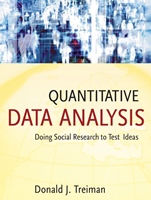
Quantitative Data Analysis: Doing Social Research to Test Ideas
ISBN 9780470380031
Autor: Donald J. Treiman
Wydawca: Wiley
Dostępność: 3-6 tygodni
Cena: 422,10 zł
Przed złożeniem zamówienia prosimy o kontakt mailowy celem potwierdzenia ceny.
ISBN13: |
9780470380031 |
ISBN10: |
0470380039 |
Autor: |
Donald J. Treiman |
Oprawa: |
Paperback |
Rok Wydania: |
2009-01-16 |
Ilość stron: |
480 |
Wymiary: |
242x177 |
Tematy: |
JB |
Advance Praise for Quantitative Data Analysis
"This is a first–rate introduction to modern social science research methods by an acknowledged master and brilliant teacher of the art. Treiman simplifies complexity and offers a mountain of practical tips and best practices. Anyone who wants to learn to do modern quantitative social research (and anyone who plans to teach it) has much to gain from this book."
—Ross M. Stolzenberg, professor of sociology, University of Chicago
"Packed with examples using interesting data sets, this book doesn′t just teach statistics––it teaches how to use statistics to answer questions about the social world. In simple language, from simple percentage tables to fixed–effects models, including how to do the runs in Stata, and packed with examples from real data on how to make and interpret tables, Treiman shows students how to do the craft they are too often never taught."
—Paula England, professor of sociology, Stanford University
"After a distinguished career, Don Treiman shares his trade secrets in this remarkable book, which should be read by everyone wishing to master the art of theoretically informed quantitative research."
—Yu Xie, Otis Dudley Duncan Distinguished University Professor of Sociology and Statistics,
University of Michigan and coauthor, Statistical Methods for Categorical Data Analysis
"This book captures the wisdom arising from Professor Treiman′s many years of data analysis experience. It provides the applied perspective and practical advice that are missing in many books on statistical models."
—Kenneth A. Bollen, H. R. Immerwahr Distinguished Professor of Sociology and director, Howard W. Odum Institute for Research in Social Science, University of North Carolina at Chapel Hill
"There are lots of books on the market that teach statistics. This book, written by a distinguished social scientist, achieves a more ambitious goal
; it teaches students how to use statistics to do first–rate quantitative research."
—Thomas A. DiPrete, professor of sociology, Columbia University
"Treiman′s wealth of teaching and research experience shows in this book. He delivers new insights into
familiar methods and gives us tools we need to solve the puzzles that inevitably arise in real research."
—Michael Hout, professor of sociology and demography, University of California, Berkeley, and member, National Academy of Sciences
"Having taken Don Treiman′s course at UCLA, I highly recommend the book to anyone who wants practical instruction in how survey research is done."
—Christine R. Schwartz, assistant professor, Department of Sociology, University of Wisconsin, Madison
Spis treści:
Tables, Figures, Exhibits, and Boxes.
Preface.
The Author.
Introduction.
1 CROSS–TABULATIONS.
What This Chapter Is About.
Introduction to the Book via a Concrete Example.
Cross–Tabulations.
What This Chapter Has Shown.
2 MORE ON TABLES.
What This Chapter Is About.
The Logic of Elaboration.
Suppressor Variables.
Additive and Interaction Effects.
Direct Standardization.
A Final Note on Statistical Controls Versus Experiments.
What This Chapter Has Shown.
3 STILL MORE ON TABLES.
What This Chapter Is About.
Reorganizing Tables to Extract New Information.
When to Percentage a Table “Backwards”.
Cross–Tabulations in Which the Dependent Variable Is Represented by a Mean.
Index of Dissimilarity.
Writing About Cross–Tabulations.
What This Chapter Has Shown.
4 ON THE MANIPULATION OF DATA BY COMPUTER.
What This Chapter Is About.
Introduction.
How Data Files Are Organized.
Transforming Data.
What This Chapter Has Shown.
Appendix 4.A Doing Analysis Using St
ata.
Tips on Doing Analysis Using Stata.
Some Particularly Useful Stata 10.0 Commands.
5 INTRODUCTION TO CORRELATION AND REGRESSION (ORDINARY LEAST SQUARES).
What This Chapter Is About.
Introduction.
Quantifying the Size of a Relationship: Regression Analysis.
Assessing the Strength of a Relationship: Correlation Analysis.
The Relationship Between Correlation and Regression Coefficients.
Factors Affecting the Size of Correlation (and Regression) Coefficients.
Correlation Ratios.
What This Chapter Has Shown.
6 INTRODUCTION TO MULTIPLE CORRELATION AND REGRESSION (ORDINARY LEAST SQUARES).
What This Chapter Is About.
Introduction.
A Worked Example: The Determinants of Literacy in China.
Dummy Variables.
A Strategy for Comparisons Across Groups.
A Bayesian Alternative for Comparing Models.
Independent Validation.
What This Chapter Has Shown.
7 MULTIPLE REGRESSION TRICKS: TECHNIQUES FOR HANDLING SPECIAL ANALYTIC PROBLEMS.
What This Chapter Is About.
Nonlinear Transformations.
Testing the Equality of Coefficients.
Trend Analysis: Testing the Assumption of Linearity.
Linear Splines.
Expressing Coefficients as Deviations from the Grand Mean (Multiple Classifi cation Analysis).
Other Ways of Representing Dummy Variables.
Decomposing the Difference Between Two Means.
What This Chapter Has Shown.
8 MULTIPLE IMPUTATION OF MISSING DATA.
What This Chapter Is About.
Introduction.
A Worked Example: The Effect of Cultural Capital on Educational Attainment in Russia.
What This Chapter Has Shown.
9 SAMPLE DESIGN AND SURVEY ESTIMATION.
What This Chapter Is About.
Survey Samples.
Conclusion.
What This Chapter Has Shown.
10 REGRESSION DIAGNOSTICS.
What This Chapter Is About.
Introduction.
A Worked Example: Societal Differences in Status Attainment.
Robust Regression.
Bo
otstrapping and Standard Errors.
What This Chapter Has Shown.
11 SCALE CONSTRUCTION.
What This Chapter Is About.
Introduction.
Validity.
Reliability.
Scale Construction.
Errors–in–Variables Regression.
What This Chapter Has Shown.
12 LOG–LINEAR ANALYSIS.
What This Chapter Is About.
Introduction.
Choosing a Preferred Model.
Parsimonious Models.
A Bibliographic Note.
What This Chapter Has Show.
Appendix 12.A Derivation of the Effect Parameters.
Appendix 12.B Introduction to Maximum Likelihood Estimation.
Mean of a Normal Distribution.
Log–Linear Parameters.
13 BINOMIAL LOGISTIC REGRESSION.
What This Chapter Is About.
Introduction.
Relation to Log–Linear Analysis.
A Worked Logistic Regression Example: Predicting Prevalence of Armed Threats.
A Second Worked Example: Schooling Progression Ratios in Japan.
A Third Worked Example (Discrete–Time Hazard–Rate Models): Age at First Marriage.
A Fourth Worked Example (Case–Control Models): Who Was Appointed to a Nomenklatura Position in Russia?
What This Chapter Has Shown.
Appendix 13.A Some Algebra for Logs and Exponents.
Appendix 13.B Introduction to Probit Analysis.
14 MULTINOMIAL AND ORDINAL LOGISTIC REGRESSION AND TOBIT REGRESSION.
What This Chapter Is About.
Multinomial Logit Analysis.
Ordinal Logistic Regression.
Tobit Regression (and Allied Procedures) for Censored Dependent Variables.
Other Models for the Analysis of Limited Dependent Variables.
What This Chapter Has Shown.
15 IMPROVING CAUSAL INFERENCE: FIXED EFFECTS AND RANDOM EFFECTS MODELING.
What This Chapter Is About.
Introduction.
Fixed Effects Models for Continuous Variables.
Random Effects Models for Continuous Variables.
A Worked Example: The Determinants of Income in China.
Fixed Effects Models for Binary Outc
Koszyk
Książek w koszyku: 0 szt.
Wartość zakupów: 0,00 zł
Informacje


Kontakt
Gambit
Centrum Oprogramowania
i Szkoleń Sp. z o.o.
Al. Pokoju 29b/22-24
31-564 Kraków
Siedziba Księgarni
ul. Kordylewskiego 1
31-542 Kraków
+48 12 410 5991
+48 12 410 5987
+48 12 410 5989
Subskrypcje
Administratorem danych osobowych jest firma Gambit COiS Sp. z o.o. Na podany adres będzie wysyłany wyłącznie biuletyn informacyjny.
Autoryzacja płatności

Informacje na temat autoryzacji płatności poprzez PayU.

© Copyright 2012: GAMBIT COiS Sp. z o.o. Wszelkie prawa zastrzeżone.
Projekt i wykonanie: Alchemia Studio Reklamy