


Wydawcy
Katalog tematyczny
- Archeologia (109)
- Ekonomia, finanse, business (13704)
- Filozofia (1445)
- Historia (3040)
- Języki i językoznawstwo (2356)
- Lifestyle, hobby i rozrywka (475)
- Medycyna (9704)
- Nauki humanistyczne (4)
- Nauki o Ziemi i środowisku (2638)
- Nauki ścisłe (20412)
- Nauki społeczne (8486)
- Nauki techniczne (13450)
- Prawo (1696)
- Publikacje informacyjne i interdyscyplinarne (1288)
- Religia i wierzenia (917)
- Technika komputerowa (4067)
- Zdrowie, relacje międzyludzkie i rozwój osobisty (657)





Informacje szczegółowe o książce
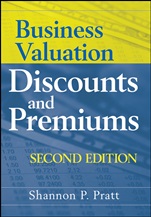
Business Valuation Discounts and Premiums
ISBN 9780470371480
Autor: Shannon P. Pratt
Wydawca: Wiley
Dostępność: 3-6 tygodni
Cena: 592,20 zł
Przed złożeniem zamówienia prosimy o kontakt mailowy celem potwierdzenia ceny.
ISBN13: |
9780470371480 |
ISBN10: |
047037148X |
Autor: |
Shannon P. Pratt |
Oprawa: |
Hardback |
Rok Wydania: |
2009-05-15 |
Numer Wydania: |
2nd Edition |
Ilość stron: |
504 |
Wymiary: |
254x178 |
Tematy: |
KF |
Leading authority Shannon Pratt demystifies discounts and premiums in business valuation
"A must–read! Shannon Pratt continues to add to the business valuation body of knowledge."
–Jay Fishman, FASA
There is often more money in dispute in determining the discounts and premiums in a business valuation than in arriving at the pre–discount value itself. Discounts and premiums affect not only the value of the company, but also play a crucial role in determining the risk involved, control issues, marketability, and contingent liability, to name a few. Approaching a business valuation without a thorough understanding of all the ins and outs of discounts and premiums can cause a deal to topple like a house of cards.
Business guru Shannon Pratt′s critically acclaimed Business Valuation: Discounts and Premiums, Second Edition compiles all the key information practitioners need to successfully and accurately determine discounts and premiums in business valuation.
Thoroughly updated throughout, this must–have tool of the trade for business appraisers, accountants, attorneys, and business owners now includes:New database chapters that help quantify the discount for lack of marketability Analysis of the most comprehensive database, with over 5,000 entries on transactions in minority interests in private company stocks prior to an IPO Scores of valuable court case citations Court cases covering divorces, gift, estate, income taxes, bankruptcies, corporate and partnership dissolutions, and ESOPs Many new, never–before–published studies providing real–world benchmarks that can be applied to the practitioner′s own cases
Learn how to master the complex issues of business valuation and capitalize on the numerous uses for discounts and premiums with the help of the most recognized authority on business valuation, Shannon Pratt.
Spis treści:
List of E
xhibits.
About the Author.
About the Contributing Authors.
Foreword.
Preface.
Acknowledgments.
1 Overview of Business Valuation Discounts and Premiums and the Bases to Which They Are Applied.
Discounts and Premiums Are Big–Money Issues.
“Entity–Level” versus “Shareholder–Level” Discounts and Premiums.
How the Valuation Approaches Used Affect the Level of Value.
Use of Public Company Data to Quantify Discounts and Premiums.
How the Standard of Value Affects Discounts and Premiums.
American Society of Appraisers Business Valuation Standard VII: Valuation Discounts and Premiums.
Summary.
2 Minority Discounts and Control Premiums.
Relevant Definitions.
Basic Minority/Control Value Relationship.
Prerogatives of Control.
Factors Affecting Degree of Control.
How the Valuation Methodology Affects the Minority Discount or Control Premium.
Do Publicly Traded Minority Stock Prices Reflect Control Value?
Treatment of Control Premiums in the Delaware Courts.
How the Purpose of the Valuation Affects Minority Discounts or Control Premiums.
Summary.
3 Empirical Data Regarding Minority Discounts and Control Premiums.
Premiums Paid in Acquisitions.
Identifying Industries with Higher or Lower Control Premiums.
Caveats Regarding Use of Control Premium Data.
Are Control Premiums Too High?
Percentage Discounts from Net Asset Value.
Summary.
4 Minority Discounts and Control Premiums in the Courts.
Gift, Estate, and Income Tax Cases.
Discounts for Lack of Control in Employee Stock Ownership Plan Cases.
Dissenting Shareholder Cases.
Shareholder Oppression Cases.
Marital Dissolution Cases.
Bankruptcy Case.
Summary.
5 Discounts for Lack of Marketability for Minority Interests: Concept and Evidence.
Public Market Benchmark for Marketability.
Empirical Evidence to Quantify Discounts for Lack of Ma
rketability.
Restricted Stock Studies.
Pre–Initial Public Offering Discount for Lack of Marketability Studies.
Courts’ Aversion to “Benchmarking”.
Regulatory and Court Recognition of Empirical Marketability Discount Studies.
Summary.
6 Synopsis of Restricted Stock Studies.
Securities and Exchange Commission Institutional Investor Study.
Gelman Study.
Trout Study.
Moroney Study.
Maher Study.
Standard Research Consultants Study.
Silber Study.
FMV Opinions Study.
Management Planning Study.
Johnson Study.
Columbia Financial Advisors Study.
LiquiStat Database.
Summary.
7 LiquiStat Database (Restricted Stocks, Options, Warrants, and Convertible Securities).
Restricted Stock as a Basis.
Biases Beyond Illiquidity in Traditional Restricted Stock Studies.
How LiquiStat Is Different.
Options and Warrants in LiquiStat.
Convertible Securities in LiquiStat.
Summary.
8 Blockage Discounts.
Blockage Is Distinct from Restricted Stock.
Factors to Analyze in Quantifying Blockage Discounts.
Must Consider Ways of Selling Stock.
“Price Pressure” and “Market Exposure”.
Block Buyer Could Ameliorate Blockage Discount.
Blockage Discounts Recognized in Estate and Gift Tax Regulations.
Blockage Discounts in U.S. Tax Court.
Financial Accounting Standards that May Affect Blockage Discounts.
Blockage Discounts Used to Estimate Illiquidity Discounts.
Summary.
9 John Emory Pre–Initial Public Offering Discount for Lack of Marketability Studies—Complete Underlying Data.
Study #1: Adjusted Study, January 1980–June 1981.
Study #2: Adjusted Study, January 1985–June 1986.
Study #3: Adjusted Study, August 1987–January 1989.
Study #4: Adjusted Study, February 1989–July 1990.
Study #5: Adjusted Study, August 1990–January 1992.
Study #6: Adjusted Study, February
1992–July 1993.
Study #7: Adjusted Study, January 1994–June 1995.
Study #8: Adjusted Study, November 1995–April 1997.
Study #9: Adjusted Study, Dot–Com Companies, May 1997–March 2000.
Study #10: Adjusted Expanded Study, May 1997–December 2000.
Summary.
10 Valuation Advisors Discount for Lack of Marketability Study.
Description of Study.
Results of Study.
Summary.
11 Factors Affecting Discounts for Lack of Marketability for Minority Interests.
Size of Distributions.
Prospects for Liquidity.
Pool of Potential Buyers.
Risk Factors.
Summary.
12 Discounts for Lack of Marketability for Controlling Interests.
Discounts for Lack of Marketability for Controlling Interests: a Controversial Concept.
“Control, Marketable” Is an Oxymoron.
Bases from Which Controlling Interest Discounts for Lack of Marketability May Be Deducted.
Factors Affecting Controlling Interest Discounts for Lack of Marketability.
Public versus Private Company Acquisition Multiples.
Court Treatment of Controlling Interest Discounts for Lack of Marketability.
Summary.
13 The Quantitative Marketability Discount Model: A Shareholder Level DCF Model.
Introduction.
The Structure of the Shareholder Level DCF Model.
A Visual Representation of the Shareholder Level DCF Model.
Factors Contributing to Marketability Discounts.
Summary.
14 Marketability Discounts in the Courts—Minority Interests.
Gift and Estate Tax Cases.
Employee Stock Ownership Plan Case.
Dissenting Shareholder Cases.
Minority Oppression Cases.
Marital Dissolution Cases.
Summary.
15 Marketability Discounts in the Courts—Controlling Interests.
Gift and Estate Tax Cases.
Marital Dissolution Cases.
Summary.
16 Voting versus Nonvoting Stock.
Voting versus Nonvoting Stock Scenarios.
Empirical Studies Show Little D
Koszyk
Książek w koszyku: 0 szt.
Wartość zakupów: 0,00 zł
Informacje


Kontakt
Gambit
Centrum Oprogramowania
i Szkoleń Sp. z o.o.
Al. Pokoju 29b/22-24
31-564 Kraków
Siedziba Księgarni
ul. Kordylewskiego 1
31-542 Kraków
+48 12 410 5991
+48 12 410 5987
+48 12 410 5989
Subskrypcje
Administratorem danych osobowych jest firma Gambit COiS Sp. z o.o. Na podany adres będzie wysyłany wyłącznie biuletyn informacyjny.
Autoryzacja płatności

Informacje na temat autoryzacji płatności poprzez PayU.

© Copyright 2012: GAMBIT COiS Sp. z o.o. Wszelkie prawa zastrzeżone.
Projekt i wykonanie: Alchemia Studio Reklamy