


Wydawcy
Katalog tematyczny
- Archeologia (109)
- Ekonomia, finanse, business (13704)
- Filozofia (1445)
- Historia (3040)
- Języki i językoznawstwo (2356)
- Lifestyle, hobby i rozrywka (475)
- Medycyna (9704)
- Nauki humanistyczne (4)
- Nauki o Ziemi i środowisku (2638)
- Nauki ścisłe (20412)
- Nauki społeczne (8486)
- Nauki techniczne (13450)
- Budownictwo lądowe (1045)
- Chemia przemysłowa (2258)
- Elektronika i telekomunikacja (3287)
- Energetyka (1122)
- Inne nauki stosowane (363)
- Inżynieria biochemiczna (507)
- Inżynieria transportu (232)
- Mechanika i materiały (3316)
- Nauka o środowisku (321)
- Rolnictwo (507)
- Technika, ogólnie (475)
- Prawo (1696)
- Publikacje informacyjne i interdyscyplinarne (1288)
- Religia i wierzenia (917)
- Technika komputerowa (4067)
- Zdrowie, relacje międzyludzkie i rozwój osobisty (657)





Informacje szczegółowe o książce
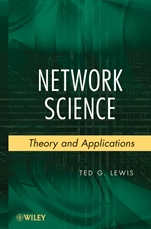
Network Science: Theory and Applications
ISBN 9780470331880
Autor: Ted G. Lewis
Wydawca: Wiley
Dostępność: 3-6 tygodni
Cena: 687,75 zł
Przed złożeniem zamówienia prosimy o kontakt mailowy celem potwierdzenia ceny.
ISBN13: |
9780470331880 |
ISBN10: |
0470331887 |
Autor: |
Ted G. Lewis |
Oprawa: |
Hardback |
Rok Wydania: |
2009-04-03 |
Ilość stron: |
524 |
Wymiary: |
241x173 |
Tematy: |
TJ |
A comprehensive look at the emerging science of networks
Network science helps you design faster, more resilient communication networks; revise infrastructure systems such as electrical power grids, telecommunications networks, and airline routes; model market dynamics; understand synchronization in biological systems; and analyze social interactions among people.
This is the first book to take a comprehensive look at this emerging science. It examines the various kinds of networks (regular, random, small–world, influence, scale–free, and social) and applies network processes and behaviors to emergence, epidemics, synchrony, and risk. The book′s uniqueness lies in its integration of concepts across computer science, biology, physics, social network analysis, economics, and marketing.
The book is divided into easy–to–understand topical chapters and the presentation is augmented with clear illustrations, problems and answers, examples, applications, tutorials, and a discussion of related Java software. Chapters cover:
Origins
Graphs
Regular Networks
Random Networks
Small–World Networks
Scale–Free Networks
Emergence
Epidemics
Synchrony
Influence Networks
Vulnerability
Net Gain
Biology
This book offers a new understanding and interpretation of the field of network science. It is an indispensable resource for researchers, professionals, and technicians in engineering, computing, and biology. It also serves as a valuable textbook for advanced undergraduate and graduate courses in related fields of study.
Spis treści:
1. ORIGINS.
1.1 What is Network Science?.
1.2 A Brief History of Network Science.
1.2.1 The Pre–Network Period (1736–1966).
1.2.2 The Meso–Network Period (1967–1998).
1.2.
3. The Modern Period (1998–present).
1.3 General Principles.
2. GRAPHS.
2.1 Set Theoretical Definition of a Graph.
2.1.1 Nodes, Links, and Mapping Function.
2.1.2 Node Degree and Hubs.
2.1.3 Paths and Circuits.
2.1.4 Connectedness and Components.
2.1.5 Diameter, Radius, and Centrality.
2.1.6 Betweeness and Closeness.
2.2 Matrix Algebra Definition of a Graph.
2.2.1 Connection Matrix.
2.2.2 Adjacency Matrix.
2.2.3 Laplacian Matrix.
2.2.4 Path Matrix.
2.3.1 Euler Path, Euler Circuit.
2.3.2 Formal Definition of the Bridges of K?nigsberg.
2.3.3 Euler’s Solution.
2.4 Spectral Properties of Graphs.
2.4.1 Spectral Radius.
2.4.2 Spectral Gap.
2.5 Types of Graphs.
2.5.1 Barbell, Line, and Ring Graphs.
2.5.2 Structured vs. Random Graphs.
2.5.3. k–Regular Graphs.
2.5.4 Graph Density.
2.6 Topological Structure.
2.6.1 Degree Sequence.
2.6.2 Graph Entropy.
2.6.3 Scale–Free Topology.
2.6.4 Small World Topology.
2.7 Graphs in Software.
2.7.1 Java Nodes and Links.
2.7.2 Java Networks.
2.8. Exercises.
3. REGULAR NETWORKS.
3.1 Diameter, Centrality, and Average Path Length.
3.1.1 Calculating Path Length and Centrality.
3.2 Binary Tree Network.
3.2.1 Entropy of Binary Tree Network.
3.2.2 Path Length of Binary Tree Network.
3.2.3 Link Efficiency of Binary Tree Network.
3.3 Toroidal Network.
3.3.1 Average Path Length of Toroidal Networks.
3.3.2 Link Efficiency of Toroidal Networks.
3.4 Hypercube Networks.
3.4.1 Average Path Length of Hypercube Networks.
3.4.2 Link Efficiency of Hypercube Networks.
3.5 Exercises.
4. RANDOM NETWORKS.
4.1 Generation of Random Networks.
4.1.1 Gilbert Random Network.
4.1.2 Erdos–Renyi (ER) Random Network.
4.1.3 Anchored Random Network.
4.2 Degree Distribution of Random Networks.
4.3 Entropy of Random Networks.
4.3.1 Model of Random Network Entro
py.
4.3.2 Average Path Length of Random Networks.
4.3.3 Cluster Coefficient of Random Networks.
4.3.4 Link Efficiency of Random Networks.
4.4 Diameter, Centrality, and Closeness in Random Networks.
4.4.1 Diameter of Random Networks.
4.4.2 Radius of Random Networks.
4.4.3. Closeness Calculation in Java.
4.4.4 Closeness in Random Networks.
4.5. Weak Ties in Random Networks.
4.6 Randomization of Regular Networks.
4.7 Analysis.
4.8 Exercises.
5. SMALL WORLD NETWORKS.
5.1 Generating a Small World Network.
5.1.1 The Watts–Strogatz Procedure.
5.1.2 Generalized WS Procedure.
5.1.3 Degree Sequence of Small World Networks.
5.2 Properties of Small World Networks.
5.2.1. Entropy vs. Rewiring Probability.
5.2.2 Entropy vs. Density.
5.2.3 Path Length of Small World Networks.
5.2.4 Cluster Coefficient of Small World Networks.
5.2.5 Closeness in Small Worlds.
5.3 Phase Transition.
5.3.1 Path Length and Phase Transition.
5.3.2 Phase Transition in Materials.
5.4 Navigating Small Worlds.
5.5 Weak Ties in Small World Networks.
5.6 Analysis.
5.7 Exercises.
6. SCALE FREE NETWORKS.
6.1 Generating a Scale–Free Network.
6.1.1 The Barabasi–Albert (BA) Network.
6.1.2 Generating BA Networks.
6.1.3 Scale–Free Network Power Law.
6.2 Properties of Scale–Free Networks.
6.2.1 BA Network Entropy.
6.2.2 Hub Degree versus Density.
6.2.3 BA Network Average Path Length.
6.2.4 BA Network Closeness.
6.2.5 Scale–free Network Cluster Coefficient.
6.3 Navigation in Scale–Free Networks.
6.3.1 Max–degree Navigation versus Density.
6.3.2 Max–degree Navigation versus Hub Degree.
6.3.3 Weak Ties in Scale–Free Pointville.
6.4 Analysis.
6.4.1 Entropy.
6.4.2 Path Length and Communication.
6.4.3 Cluster Coefficient.
6.4.4 Hub Degree.
6.5 Exercises.
7. EMERGENCE.
7.1 What is Networ
k Emergence?.
7.1.1 Open Loop Emergence.
7.1.2 Feedback Loop Emergence.
7.2 Emergence in the Sciences.
7.2.1 Emergence in Social Science.
7.2.2 Emergence in Physical Science.
7.2.2 Emergence in Biology.
7.3 Genetic Evolution.
7.3.1 Hub Emergence.
7.3.2 Cluster Emergence.
7.4 Designer Networks.
7.4.1 Degree Sequence Emergence.
7.4.2 Generating Networks with Given Degree Sequence.
7.5 Permutation Network Emergence.
7.5.1 Permutation Micro–Rule.
7.5.2 Permutation and Cluster Coefficient.
7.6 An Application of Emergence.
7.6.1 Link Optimization by Random Permutation.
7.6.2 Optimization by Deterministic Permutation.
7.6.3 Model of Minimum Length Emergence.
7.6.4 Two–Dimensional Layouts.
7.7 Exercises.
8. EPIDEMICS.
8.1. Epidemic Models.
8.1.2 The Kermack–McKendrick Model.
8.1.3 Epidemic Thresholds.
8.1.4 SIR.
8.1.5 Peak Infection Density in Structured Networks.
8.1.6 SIS Epidemics.
8.2 Persistent Epidemics in Networks.
8.2.1 Random Network Epidemic Threshold.
8.2.2 Epidemic Threshold in General Networks.
8.2.3 Fixed–point Infection Density in General Networks.
8.3 Network Epidemic Simulation Software.
8.4 Countermeasures.
8.4.1 Countermeasure Algorithms.
8.4.2 Countermeasure Seeding Strategies.
8.4.3 Antigen Simulation in Java.
8.5 Exercises.
9. SYNCHRONY.
9.1 To Sync or Not To Sync.
9.1.1 Chaotic Maps.
9.1.2 Network Stability.
9.1.2.1 Lyapunov Method.
9.1.2.2 Spectral Decomposition.
9.2 A Cricket Social Network.
9.2.1 Sync Property of the Cricket Social Network.
9.2.2 A More General Model: Atay Networks.
9.2.3 Stability of Atay Networks.
9.3 Kirchhoff Networks.
9.3.1 Kirchhoff Network Model.
9.3.2 Kirchhoff Network Stability.
9.4 Anatomy of Buzz.
9.4.1 A Buzz Network.
9.4.2 Buzz Network Simulator.
9.4.3 Buzz Network Stability.
9.5 Exercises.
10. INFLUENCE NETWO
Koszyk
Książek w koszyku: 0 szt.
Wartość zakupów: 0,00 zł
Informacje


Kontakt
Gambit
Centrum Oprogramowania
i Szkoleń Sp. z o.o.
Al. Pokoju 29b/22-24
31-564 Kraków
Siedziba Księgarni
ul. Kordylewskiego 1
31-542 Kraków
+48 12 410 5991
+48 12 410 5987
+48 12 410 5989
Subskrypcje
Administratorem danych osobowych jest firma Gambit COiS Sp. z o.o. Na podany adres będzie wysyłany wyłącznie biuletyn informacyjny.
Autoryzacja płatności

Informacje na temat autoryzacji płatności poprzez PayU.

© Copyright 2012: GAMBIT COiS Sp. z o.o. Wszelkie prawa zastrzeżone.
Projekt i wykonanie: Alchemia Studio Reklamy