


Wydawcy
Katalog tematyczny
- Archeologia (109)
- Ekonomia, finanse, business (13704)
- Filozofia (1445)
- Historia (3040)
- Języki i językoznawstwo (2356)
- Lifestyle, hobby i rozrywka (475)
- Medycyna (9704)
- Nauki humanistyczne (4)
- Nauki o Ziemi i środowisku (2638)
- Nauki ścisłe (20412)
- Nauki społeczne (8486)
- Nauki techniczne (13450)
- Prawo (1696)
- Publikacje informacyjne i interdyscyplinarne (1288)
- Religia i wierzenia (917)
- Technika komputerowa (4067)
- Zdrowie, relacje międzyludzkie i rozwój osobisty (657)





Informacje szczegółowe o książce
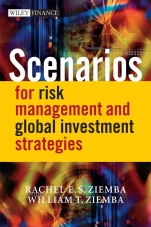
Scenarios for Risk Management and Global Investment Strategies
ISBN 9780470319246
Autor: Rachel E. S. Ziemba, William T. Ziemba
Wydawca: Wiley
Dostępność: 3-6 tygodni
Cena: 359,10 zł
Przed złożeniem zamówienia prosimy o kontakt mailowy celem potwierdzenia ceny.
ISBN13: |
9780470319246 |
ISBN10: |
0470319240 |
Autor: |
Rachel E. S. Ziemba, William T. Ziemba |
Oprawa: |
Hardback |
Rok Wydania: |
2007-11-09 |
Ilość stron: |
334 |
Wymiary: |
253x176 |
Tematy: |
KF |
Scenarios for risk management and global investment strategies
Scenarios for Risk Management and Global Investment Strategies assesses the risks and challenges of modern investing, focusing on the importance of adapting and responding to changing investment climates. This book discusses the probabilities that various future events will occur an how these events and their probable occurrences influence investment decisions. Assessing all possible outcomes is fundamental to risk management, financial engineering and investment and hedge fund strategies. A careful consideration of future scenarios will lead to better investment decisions and help to avoid financial disasters. The book includes empirical studies of key markets and sectors and successful and disastrous investment results along with superior optimization strategies of the great investors. The book contains essential material for hedge fund managers, quants and traders, supplying them with the tools to build accurate investment scenarios and optimize returns.
Key features include:Detailed case studies analysing a wide variety of global investment strategies in key emerging and developed economies and in a variety of asset classes (commodities, fx markets, equities, bonds, alternative investments and hedge funds)New techniques using stochastic programming to build scenarios for managing risk to improve investment performanceShows how to make custom programs for optimal investment decisionsCase studies of individual great investors to show how investors can predict useful market moves and prevent future investment disasters
"This unique team of father and daughter covers the most important areas of investing in depth. They tell the stories, perform the analyses (with just the right amount of math), and give us the macro and global insights. I can wholeheartedly recommend this fascinating and informative book."
—Paul Wilmott, Mathematician and autho
r
"A treasure trove of stimulating and useful ideas about the theory and practice of investing."
—Edward O. Thorp, Edward O. Thorp & Associates
Spis treści:
Acknowledgements.
Preface.
About the authors.
PART I INVESTMENT STRATEGIES: USING THE KELLY CAPITAL GROWTH CRITERION.
1 Take a chance.
The colocation of money and math.
Changing a gamble into an investment.
2 The capital growth theory of investment.
Blackjack.
Commodity trading: Investing in the turn of the year effect with Index Futures.
3 Betting on unpopular lotto numbers using the Kelly criterion.
4 Good and bad properties of the Kelly criterion.
5 Calculating the optimal Kelly fraction.
How to stay above a given wealth path.
6 The great investors, their methods and how we evaluate them: Theory.
The various efficient/inefficient market camps: can you beat the stock market?
How do investors and consultants do in all these cases?
The importance of getting the mean right.
7 The Great Investors, a way to evaluate them.
8 The methods and results of managing top US university endowments.
PART II INVESTMENT STRATEGIES: HEDGE FUNDS.
9 Hedge fund concepts and a typical convergence trade: Nikkei put warrant risk arbitrage.
Gamblers as hedge fund managers.
A typical convergence trade: the Nikkei put warrant market of 1989–90.
NSA puts and calls on the Toronto and American stock exchanges, 1989–92.
10 The recipe for disaster: How to lose money in derivatives.
Derivative disasters.
11 Hedge Fund Risk, Disasters and Their Prevention: The Failure of Long Term Capital Management.
The failure of the top hedge fund team ever assembled.
12 The imported crash of October 27 and 28, 1997.
A week on the wild side.
Postscript.
13 The 2006 Amaranth Advis
ors natural gas hedge fund disaster.
Background.
The trade and the rogue trader.
Is learning possible?
Possible utility functions of hedge fund traders.
Winners and losers.
PART III TOWARDS SCENARIOS: COUNTRY STUDIES.
14 Letter from Cairo.
Some challenges: Currency depreciation.
The challenge in attracting investment.
Postscript: Riding the petrodollar boom: Is recent growth sustainable?
15 Threats, challenges and opportunities of China.
Costs of development.
Overseas investment.
Postscript.
16 Chinese investment markets: Hedge fund scenario analysis.
China’s economy.
The effect of Chinese demand for resources.
Chinese stock markets.
The share alphabet: Definitions of shares available in mainland Chinese Companies.
Estimating the returns on the Chinese stock markets: IPOs, ownership and returns.
How can one participate in this China boom period?
The future: Investing in China requires a leap of faith.
Postscript: Chinese equity markets.
Postscript on economic growth and development.
17 Springtime in Buenos Aires: prospects for investment, how deep is the recovery?
Devaluation of the Argentine peso.
Challenges for the financial sector.
The challenge of promoting long–term value–added production.
Postscript: The new Kirchner era.
18 Cyprus: On the outer edge of Europe, in the middle of the Mediterranean.
US and EU policies towards use of their currencies.
Cyprus: A model EU student.
Promoting Trade and Investment Across the Mediterranean: In Whose Interest?
Postscript.
19 Is Iceland’s growth spurt threatened by financial vulnerabilities?
Amid the strengths, there are issues of concern.
The current account deficit.
Debt.
Inflation.
The currency and interest rates.
Financial (in)stability?
Predicting GDP, recessions and the stock market.
Will the stock market
crash and would it influence other markets?
Prospects for the Future.
Postscript.
20 Would a bridge connect Sicily’s economy to Europe’s heart?
Sicily’s Economic Challenges.
Sicily’s ties to the Mediterranean region.
PART IV SCENARIO ANALYSIS: THE STOCHASTIC PROGRAMMING APPROACH TO MANAGING RISK.
21 Hedge and pension fund risk, disasters and their prevention.
Fixed mix and strategic asset allocation.
Stochastic programming models applied to hedge and pension fund problems.
InnoALM, The Innovest Austrian Pension Fund Financial Planning Model.
22 Setting the scenario.
Extreme scenarios.
23 Hedge fund scenario analysis.
The effect of interest rates.
The 2000–2002 crash in the S&P500.
The effect of the 2004 presidential election.
Postscript.
24 Some approaches for scenario generation and reduction.
Vector autoregressive models.
25 Using economic fundamentals to generate scenarios.
Models to predict relative and absolute asset prices.
26 Some mathematical approaches for scenario generation and reduction.
Moment matching.
The Wasserstein distance minimization approach.
27 Minimizing the effects of disasters by planning ahead.
Planning in advance: stage one of a two period stochastic program.
How much hedging is there against various risks?
Some key markets: crude oil, the S&P500, short and long term interest rates and bond prices.
Volatility.
Future prospects and the 2006 outlook.
Lessons.
Appendix The great investors: some useful books.
William Poundstone.
Nassim Nicholas Taleb.
David F. Swensen.
Closing thoughts.
Postscript: The Renaissance Medallion Fund.
Bibliography.
Index.
Nota biograficzna:
RACHEL E.S. ZIEMBA has a BA in History from the University of Chicago and an MPhil in International Relations
Koszyk
Książek w koszyku: 0 szt.
Wartość zakupów: 0,00 zł
Informacje


Kontakt
Gambit
Centrum Oprogramowania
i Szkoleń Sp. z o.o.
Al. Pokoju 29b/22-24
31-564 Kraków
Siedziba Księgarni
ul. Kordylewskiego 1
31-542 Kraków
+48 12 410 5991
+48 12 410 5987
+48 12 410 5989
Subskrypcje
Administratorem danych osobowych jest firma Gambit COiS Sp. z o.o. Na podany adres będzie wysyłany wyłącznie biuletyn informacyjny.
Autoryzacja płatności

Informacje na temat autoryzacji płatności poprzez PayU.

© Copyright 2012: GAMBIT COiS Sp. z o.o. Wszelkie prawa zastrzeżone.
Projekt i wykonanie: Alchemia Studio Reklamy