


Wydawcy
Katalog tematyczny
- Archeologia (109)
- Ekonomia, finanse, business (13704)
- Filozofia (1445)
- Historia (3040)
- Języki i językoznawstwo (2356)
- Lifestyle, hobby i rozrywka (475)
- Medycyna (9704)
- Nauki humanistyczne (4)
- Nauki o Ziemi i środowisku (2638)
- Nauki ścisłe (20412)
- Nauki społeczne (8486)
- Nauki techniczne (13450)
- Budownictwo lądowe (1045)
- Chemia przemysłowa (2258)
- Elektronika i telekomunikacja (3287)
- Energetyka (1122)
- Elektrotechnika (258)
- Energetyka jądrowa (62)
- Energia odnawialna (372)
- Paliwa kopalne (287)
- Przepływ ciepła (10)
- Inne nauki stosowane (363)
- Inżynieria biochemiczna (507)
- Inżynieria transportu (232)
- Mechanika i materiały (3316)
- Nauka o środowisku (321)
- Rolnictwo (507)
- Technika, ogólnie (475)
- Prawo (1696)
- Publikacje informacyjne i interdyscyplinarne (1288)
- Religia i wierzenia (917)
- Technika komputerowa (4067)
- Zdrowie, relacje międzyludzkie i rozwój osobisty (657)





Informacje szczegółowe o książce
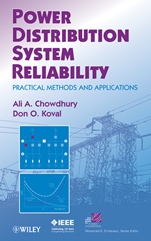
Power Distribution System Reliability: Practical Methods and Applications
ISBN 9780470292280
Autor: Ali Chowdhury, Don Koval
Wydawca: Wiley
Dostępność: 3-6 tygodni
Cena: 757,05 zł
Przed złożeniem zamówienia prosimy o kontakt mailowy celem potwierdzenia ceny.
ISBN13: |
9780470292280 |
ISBN10: |
0470292288 |
Autor: |
Ali Chowdhury, Don Koval |
Oprawa: |
Hardback |
Rok Wydania: |
2009-04-24 |
Ilość stron: |
560 |
Wymiary: |
233x155 |
Tematy: |
THX |
A practical, hands–on approach to power distribution system reliability
As power distribution systems age, the frequency and duration of consumer interruptions will increase significantly. Now more than ever, it is crucial for students and professionals in the electrical power industries to have a solid understanding of designing the reliable and cost–effective utility, industrial, and commercial power distribution systems needed to maintain life activities (e.g., computers, lighting, heating, cooling, etc.).
This books fills the void in the literature by providing readers with everything they need to know to make the best design decisions for new and existing power distribution systems, as well as to make quantitative "cost vs. reliability" trade–off studies. Topical coverage includes:
Engineering economics
Reliability analysis of complex network configurations
Designing reliability into industrial and commercial power systems
Application of zone branch reliability methodology
Equipment outage statistics
Deterministic planning criteria
Customer interruption for cost models for load–point reliability assessment
Isolation and restoration procedures
And much more
Each chapter begins with an introduction and ends with a conclusion and a list of references for further reading. Additionally, the book contains actual utility and industrial power system design problems worked out with real examples, as well as additional problem sets and their solutions. Power Distribution System Reliability is essential reading for practicing engineers, researchers, technicians, and advanced undergraduate and graduate students in electrical power industries.
Spis treści:
Preface.
1 OUTLINE OF THE BOOK.
1.1 Introduction.
1.2 Reliability Assessment of Power Systems.
1.3 Organization of the Chapters.
1.4 Conclusions.
References
.
2 FUNDAMENTALS OF PROBABILITY AND STATISTICS.
2.1 Concept of Frequency.
2.2 Important Parameters of Frequency Distribution.
2.3 Theory of Probability.
2.4 Probability Distribution Model.
2.5 Sampling Theory.
2.6 Statistical Decision Making.
2.7 Conclusions.
References.
3 RELIABILITY PRINCIPLES.
3.1 Failure Rate Model.
3.2 Concept of Reliability of Population.
3.3 Mean Time to Failures.
3.4 Reliability of Complex Systems.
3.5 Standby System Modeling.
3.6 Concepts of Availability and Dependability.
3.7 Reliability Measurement.
3.8 Conclusions.
References.
4 APPLICATIONS OF SIMPLE RELIABILITY MODELS.
4.1 Equipment Failure Mechanism.
4.2 Availability of Equipment.
4.3 Oil Circuit Recloser (OCR) Maintenance Issues.
4.4 Distribution Pole Maintenance Practices.
4.5 Procedures for Ground Testing.
4.6 Insulators Maintenance.
4.7 Customer Service Outages.
4.8 Conclusions.
References.
5 ENGINEERING ECONOMICS.
5.1 Introduction.
5.2 Concept of Interest and Equivalent.
5.3 Common Terms.
5.4 Formulas for Computing Interest.
5.5 Annual Cost.
5.6 Present Value (PV) Concept.
5.7 Theory of Rate of Return.
5.8 Cost–Benefit Analysis Approach.
5.9 Financial Risk Assessment.
5.10 Conclusions.
References.
6 RELIABILITY ANALYSIS OF COMPLEX NETWORK CONFIGURATIONS.
6.1 Introduction.
6.2 State Enumeration Methodologies.
6.3 Network Reduction Methods.
6.4 Bayes. Theorem in Reliability.
6.5 Construction of Fault Tree Diagram.
6.6 The Application of Conditional Probability Theory to System Operating Configurations.
6.7 Conclusions.
References.
7 DESIGNING RELIABILITY INTO INDUSTRIAL AND COMMERCIAL POWER SYSTEMS.
7.1 Introduction.
7.2 Example 1: Simple Radial Distribution System.
7.3 Example 2: Reliability Analysis of a Primary Selective System to the 13.8 kV Utility Supply.
7.4 Exampl
e 3: A Primary Selective System to the Load Side of a 13.8 kV Circuit Breaker.
7.5 Example 4: Primary Selective System to the Primary of the Transformer.
7.6 Example 5: A Secondary Selective System.
7.7 Example 6: A Simple Radial System with Spares.
7.8 Example 7: A Simple Radial System with Cogeneration.
7.9 Reliability Evaluation of Miscellaneous System Configurations.
7.10 Conclusions.
References.
8 ZONE BRANCH RELIABILITY METHODOLOGY.
8.1 Introduction.
8.2 Zone Branch Concepts.
8.3 Industrial System Study.
8.4 Application of Zone Branch Methodology: Case Studies.
.4.5 Case 5: Design .E.—Dual Supply Primary Selective.
8.4.6 Case 6: Design .F.—Double Bus/Double Breaker Radial.
8.4.7 Case 7: Design .G.—Double Bus/Double Breaker Loop.
8.4.8 Case 8: Design .H.—Double Bus/Breaker Primary Selective.
8.5 Conclusions.
References.
9 EQUIPMENT OUTAGE STATISTICS.
9.1 Introduction.
9.2 Interruption Data Collection Scheme.
9.3 Typical Distribution Equipment Outage Statistics.
9.4 Conclusions.
References.
10 HISTORICAL ASSESSMENT.
10.1 Introduction.
10.2 Automatic Outage Management System.
10.3 Historical Assessment.
10.4 Crew Center–Level Analysis.
10.5 Development of a Composite Index for Reliability Performance Analysis at the Circuit Level.
10.6 Conclusions.
References.
11 DETERMINISTIC CRITERIA.
11.1 Introduction.
11.2 Current Distribution Planning and Design Criteria.
11.3 Reliability Cost Versus Reliability Benefit Trade–Offs in Distribution System Planning.
11.4 Alternative Feed Requirements for Overhead Distribution Systems.
11.5 Examples of Deterministic Planning Guidelines for Alternative Feed Requirements.
11.6 Value–Based Alternative Feeder Requirements Planning.
11.7 Conclusions.
References.
12 IMPORTANT FACTORS RELATED TO DISTRIBUTION STANDARDS.
12.1 Introduc
tion.
12.2 Relevant Issues and Factors in Establishing Distribution Reliability Standards.
12.3 Performance Indices at Different System Levels of a Utility.
12.4 Performance Indices for Different Utility Types.
12.5 Conclusions.
References.
13 STANDARDS FOR REREGULATED DISTRIBUTION UTILITY.
13.1 Introduction.
13.2 Cost of Service Regulation versus Performance–Based Regulation.
13.3 A Reward/Penalty Structure in the Performance–Based Rates.
13.4 Historical SAIFI and SAIDI Data and their Distributions.
13.5 Computation of System Risks Based on Historical Reliability Indices.
13.6 Cause Contributions to SAIFI and SAIDI Indices.
13.7 Conclusions.
References.
14 CUSTOMER INTERRUPTION COST MODELS FOR LOAD POINT RELIABILITY ASSESSMENT.
14.1 Introduction.
14.2 Customer Interruption Cost.
14.3 Series and Parallel System Model Equations.
14.4 Dedicated Distribution Radial Feeder Configuration.
14.5 Distribution Radial Feeder Configuration Serving Multiple Customers.
14.6 Distribution Radial Feeder Configuration Serving Multiple Customers with Manual Sectionalizing.
14.7 Distribution Radial Feeder Configuration Serving Multiple Customers with Automatic Sectionalizing.
14.8 Distribution System Looped Radial Feeders.
14.9 Conclusions.
References.
15 VALUE–BASED PREDICTIVE RELIABILITY ASSESSMENT.
15.1 Introduction.
15.2 Value–Based Reliability Planning.
15.3 Distribution System Configuration Characteristics.
15.4 Case Studies.
15.5 Illustrative Example System Problem and Its Reliability Calculations.
15.6 Conclusions.
References.
16 ISOLATION AND RESTORATION PROCEDURES.
16.1 Introduction.
16.2 Distribution System Characteristics.
16.3 Case Studies.
16.4 Major Substation Outages.
16.5 Summary of Load Point Interruption Costs.
16.6 Conclusions.
References.
17 MESHED DISTRIBUTION SYSTEM RELIABILITY.<
Koszyk
Książek w koszyku: 0 szt.
Wartość zakupów: 0,00 zł
Informacje


Kontakt
Gambit
Centrum Oprogramowania
i Szkoleń Sp. z o.o.
Al. Pokoju 29b/22-24
31-564 Kraków
Siedziba Księgarni
ul. Kordylewskiego 1
31-542 Kraków
+48 12 410 5991
+48 12 410 5987
+48 12 410 5989
Subskrypcje
Administratorem danych osobowych jest firma Gambit COiS Sp. z o.o. Na podany adres będzie wysyłany wyłącznie biuletyn informacyjny.
Autoryzacja płatności

Informacje na temat autoryzacji płatności poprzez PayU.

© Copyright 2012: GAMBIT COiS Sp. z o.o. Wszelkie prawa zastrzeżone.
Projekt i wykonanie: Alchemia Studio Reklamy