


Wydawcy
Katalog tematyczny





Informacje szczegółowe o książce
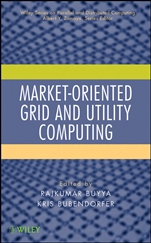
Market–Oriented Grid and Utility Computing
ISBN 9780470287682
Autor: Rajkumar Buyya, Kris Bubendorfer
Wydawca: Wiley
Dostępność: 3-6 tygodni
Cena: 811,65 zł
Przed złożeniem zamówienia prosimy o kontakt mailowy celem potwierdzenia ceny.
ISBN13: |
9780470287682 |
ISBN10: |
0470287683 |
Autor: |
Rajkumar Buyya, Kris Bubendorfer |
Oprawa: |
Hardback |
Rok Wydania: |
2009-11-20 |
Ilość stron: |
644 |
Wymiary: |
238x168 |
Tematy: |
TJ |
The first single–source reference covering the state of the art in grid and utility computing economy research
This book presents the first integrated, single–source reference on market–oriented grid and utility computing. Divided into four main parts—and with contributions from a panel of experts in the field—it systematically and carefully explores:
Foundations—presents the fundamental concepts of market–oriented computing and the issues and challenges in allocating resources in a decentralized computing environment.
Business models—covers business models for service providers and brokers supporting different types of distributed applications, as well as business rules–based models for managing virtual organizations and accounting operations and services in grid computing environments.
Policies and agreements—introduces policies, agreements, and specifications for the negotiation and establishment of contracts between providers and consumers. It also covers different approaches for resource allocation based on service–level agreements (SLAs) and management of risks associated with SLA violations.
Resource allocation and scheduling mechanisms—covers economic models, such as commodity models, reciprocation, auctions, and game theory, and middleware technologies, such as Nimrod/G and Gridbus, for market–oriented grid computing and utility–oriented resource allocation.
This book expertly captures the state of the art in the field while also identifying potential research directions and technologies that will facilitate the creation of global commercial grid and utility computing systems. It is an indispensable reference for systems architects, practitioners, developers, new researchers, and graduate students.
Spis treści:
CONTRIBUTORS.
PREFACE.
ACRONYMS.
PART I FOUNDATIONS.<
/b>
1 Market–Oriented Computing and Global Grids: An Introduction (Rajkumar Buyya and Srikumar Venugopal).
2 Markets, Mechanisms, Games, and Their Implications in Grids (Yibo Sun, Sameer Tilak, Ruppa K. Thulasiram, and Kenneth Chiu).
3 Ownership and Decentralization Issues in Resource Allocation Mechanisms (Tiberiu Stef–Praun).
4 Utility Functions, Prices, and Negotiation (John Wilkes).
5 Options and Commodity Markets for Computing Resources (Dan Cristian Marinescu, John Patrick Morrison, and Howard Jay Siegel).
PART II BUSINESS MODELS.
6 Grid Business Models, Evaluation, and Principles (Steve Taylor and Paul McKee).
7 Grid Business Models for Brokers Executing SLA–Based Workflows (Dang Minh Quan and Jorn Altman).
8 A Business–Rules–Based Model to Manage Virtual Organizations in Collaborative Grid Environments (Pilar Herrero, Jose Luis Bosque, and Marıa S. Perez).
9 Accounting as a Requirement for Market–Oriented Grid Computing (Andrea Guarise and Rosario M. Piro).
PART III POLICIES AND AGREEMENTS.
10 Service–Level Agreements (SLAs) in the Grid Environment (Bastian Koller, Eduardo Oliveros, and Alfonso Sanchez–Macian).
11 SLAs, Negotiation, and Challenges (Paul McKee, Steve Taylor, Mike Surridge, and Richard Lowe).
12 SLA–Based Resource Management and Allocation (Jordi Guitart, Mario Macıas, Omer Rana, Philipp Wieder, Ramin Yahyapour, and Wolfgang Ziegler).
13 Market–Based Resource Allocation for Differentiated Quality Service Levels (H. Howie Huang and Andrew S. Grimshaw).
14 Specification, Planning, and Execution of QoS–Aware Grid Workflows (Ivona Brandic, Sabri Pllana, and Siegfried Benkner).
15 Risk Management In Grids (Karim Djemame, James Padgett, Iain Gourlay, Kerstin Voss, and Odej Kao).
PART IV RESOURCE ALLOC
ATION AND SCHEDULING MECHANISMS.
16 A Reciprocation–Based Economy for Multiple Services in a Computational Grid (Nazareno Andrade, Francisco Brasileiro, Miranda Mowbray, and Walfredo Cirne).
17 The Nimrod/G Grid Resource Broker for Economics–Based Scheduling (Rajkumar Buyya and David Abramson).
18 Techniques for Providing Hard Quality–of–Service Guarantees in Job Scheduling (Pavan Balaji, Ponnuswamy Sadayappan, and Mohammad Islam).
19 Deadline Budget–Based Scheduling of Workflows on Utility Grids (Jia Yu, Kotagiri Ramamohanarao, and Rajkumar Buyya).
20 Game–Theoretic Scheduling of Grid Computations (Yu–Kwong Kwok).
21 Cooperative Game–Theory–Based Cost Optimization for Scientific Workflows (Radu Prodan and Rubing Duan).
22 Auction–Based Resource Allocation (Bjorn Schnizler).
23 Two Auction–Based Resource Allocation Environments: Design and Experience (Alvin AuYoung, Phil Buonadonna, Brent N. Chun, Chaki Ng, David C. Parkes, Jeff Shneidman, Alex C. Snoeren, and Amin Vahdat).
24 Trust in Grid Resource Auctions (Kris Bubendorfer, Ben Palmer, and Wayne Thomson).
25 Using Secure Auctions to Build a Distributed Metascheduler for the Grid (Kyle Chard and Kris Bubendorfer).
26 The Gridbus Middleware for Market–Oriented Computing (Rajkumar Buyya, Srikumar Venugopal, Rajiv Ranjan, and Chee Shin Yeo).
INDEX.
Nota biograficzna:
Dr. Rajkumar Buyya is an Associate Professor of Computer Science and Software Engineering and Director of the Cloud Computing and Distributed Systems (CLOUDS) Laboratory at the University of Melbourne, Australia. Dr. Buyya has contributed to the creation of high–performance computing and communication system software for Indian PARAM supercomputers and has pioneered the economic paradigm for service–oriented grid and cloud computing. He cu
rrently serves as the founding CEO of Manjrasoft, a company producing software systems for utility–oriented grid and cloud computing.
Dr. Kris Bubendorfer lectures in computer science at the Victoria University of Wellington, New Zealand. He teaches courses in networking, operating systems, algorithms, mobile systems, and advanced distributed systems.
Okładka tylna:
The first single–source reference covering the state of the art in grid and utility computing economy research
This book presents the first integrated, single–source reference on market–oriented grid and utility computing. Divided into four main parts—and with contributions from a panel of experts in the field—it systematically and carefully explores:
Foundations—presents the fundamental concepts of market–oriented computing and the issues and challenges in allocating resources in a decentralized computing environment.
Business models—covers business models for service providers and brokers supporting different types of distributed applications, as well as business rules–based models for managing virtual organizations and accounting operations and services in grid computing environments.
Policies and agreements—introduces policies, agreements, and specifications for the negotiation and establishment of contracts between providers and consumers. It also covers different approaches for resource allocation based on service–level agreements (SLAs) and management of risks associated with SLA violations.
Resource allocation and scheduling mechanisms—covers economic models, such as commodity models, reciprocation, auctions, and game theory, and middleware technologies, such as Nimrod/G and Gridbus, for market–oriented grid computing and utility–oriented resource allocation.
This book expertly captures the state of
Koszyk
Książek w koszyku: 0 szt.
Wartość zakupów: 0,00 zł
Informacje


Kontakt
Gambit
Centrum Oprogramowania
i Szkoleń Sp. z o.o.
Al. Pokoju 29b/22-24
31-564 Kraków
Siedziba Księgarni
ul. Kordylewskiego 1
31-542 Kraków
+48 12 410 5991
+48 12 410 5987
+48 12 410 5989
Subskrypcje
Administratorem danych osobowych jest firma Gambit COiS Sp. z o.o. Na podany adres będzie wysyłany wyłącznie biuletyn informacyjny.
Autoryzacja płatności

Informacje na temat autoryzacji płatności poprzez PayU.

© Copyright 2012: GAMBIT COiS Sp. z o.o. Wszelkie prawa zastrzeżone.
Projekt i wykonanie: Alchemia Studio Reklamy