


Wydawcy
Katalog tematyczny
- Archeologia (109)
- Ekonomia, finanse, business (13704)
- Filozofia (1445)
- Historia (3040)
- Języki i językoznawstwo (2356)
- Lifestyle, hobby i rozrywka (475)
- Medycyna (9704)
- Nauki humanistyczne (4)
- Nauki o Ziemi i środowisku (2638)
- Nauki ścisłe (20412)
- Astronomia (294)
- Biologia (5119)
- Chemia (6540)
- Chemia analityczna (361)
- Chemia fizyczna (346)
- Chemia nieorganiczna (137)
- Chemia organiczna (535)
- Krystalografia (27)
- Minerologia (46)
- Fizyka (3309)
- Matematyka (4574)
- Nauki ścisłe, ogólnie (503)
- Nauki społeczne (8486)
- Nauki techniczne (13450)
- Prawo (1696)
- Publikacje informacyjne i interdyscyplinarne (1288)
- Religia i wierzenia (917)
- Technika komputerowa (4067)
- Zdrowie, relacje międzyludzkie i rozwój osobisty (657)





Informacje szczegółowe o książce
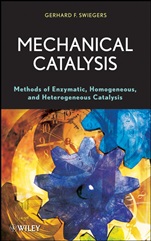
Mechanical Catalysis: Methods of Enzymatic, Homogeneous, and Heterogeneous Catalysis
ISBN 9780470262023
Autor: Gerhard Swiegers
Wydawca: Wiley
Dostępność: 3-6 tygodni
Cena: 603,75 zł
Przed złożeniem zamówienia prosimy o kontakt mailowy celem potwierdzenia ceny.
ISBN13: |
9780470262023 |
ISBN10: |
0470262028 |
Autor: |
Gerhard Swiegers |
Oprawa: |
Hardback |
Rok Wydania: |
2008-10-17 |
Ilość stron: |
384 |
Wymiary: |
245x164 |
Tematy: |
PN |
The authoritative reference on time–dependent (mechanical) catalysis, as employed by many enzymes and sought in their man–made mimics
This book examines the principles of mechanics as they apply to chemistry and, more particularly, catalysis. It′s a unique, comprehensive resource focusing on unconventional time–dependent (mechanical) catalysis, instead of the more familiar energy–dependent (thermodynamic) catalysis. To help practitioners envision how catalyst–reactant dynamism leads to time–dependent catalysis, it:
Demonstrates the existence of two fundamentally different forms of "reaction–limited" catalysis, namely time–dependent (mechanical) and energy–dependent (thermodynamic) catalysis
Describes their physical manifestation in heterogeneous and homogeneous systems
Shows how many enzymes use time–dependent catalytic reactions
Unravels the mystery of enzymatic catalysis, including: the fundamental processes at work, the origin of its general and physical features, the way it has evolved, and how it relates to catalysis in man–made systems
Unifies homogeneous, heterogeneous, and enzymatic catalysis, and explains how the thirty or so general theories of enzymatic catalysis are knit together into a conceptually coherent whole
Describes how to authentically mimic the underlying principles of enzymatic catalysis in man–made systems, including: the design requirements for such catalysts, the difficulties in duplicating the natural process, and the approaches that may be used to overcome these challenges
Describes the role of catalysis in the emerging field of complex systems science
A key resource for chemists, biochemists, and chemical engineers, this is also a reference for students of complex systems science and researchers in a variety of fields, including economics, evolution, weather forecasting, traffic management,
and networking.
Spis treści:
PREFACE.
CONTRIBUTORS.
GLOSSARY.
1. Introduction to Thermodynamic (Energy–Dependent) and Mechanical (Time–Dependent) Processes: What Are They and How Are They Manifested in Chemistry and Catalysis? (Gerhard F. Swiegers).
1.1 Thermodynamic (Energy–Dependent) and Mechanical (Time–Dependent) Processes.
1.2 What Is a Thermodynamic Process?
1.3 What Is a Mechanical Process?
1.4 The Difference between Energy–Dependent (Thermodynamic) and Time–Dependent (Mechanical) Processes.
1.5 Time– and Energy–Dependence in Chemistry and Catalysis.
1.6 The Aims, Structure, and Major Findings of this Series.
2. Heterogeneous, Homogeneous, and Enzymatic Catalysis. A Shared Terminology and Conceptual Platform. The Alternative of Time–Dependence in Catalysis (Gerhard F. Swiegers).
2.1 Introduction: The Problem of Conceptually Unifying Heterogeneous, Homogeneous, and Enzymatic Catalysis? Trends in Catalysis Science.
2.2 Background: What Is Heterogeneous, Homogeneous, and Enzymatic Catalysis.
2.3 Distinctions Within Homogeneous Catalysis: Single–Centered and Multicentered Homogeneous Catalysis.
2.4 The Distinction between Single–Site/Multisite Catalysts and Single–Centered/MultiCentered Catalysts in Heterogeneous Catalysis: An Important Convention Used in This Series.
2.5 The Alternative of Time–Dependence in Catalysis.
3. A Conceptual Description of Energy–Dependent (“Thermodynamic”) and Time–Dependent (“Mechanical”) Processes in Chemistry and Catalysis (Gerhard F. Swiegers).
3.1 Introduction.
3.2 Theoretical Considerations: Common Processes in Uncatalyzed Reactions.
3.3 Theoretical Considerations: Common Processes in Catalyzed Reactions.
4. Time–Dependence in Heterogeneous Catalysis. Sabatier’s Principle Describes Tw
o Independent Catalytic Realms: Time–Dependent (“Mechanical”) Catalysis and Energy–Dependent (“Thermodynamic”) Catalysis (Gerhard F. Swiegers).
4.1 Introduction.
4.2 Sabatier’s Principle in Heterogeneous Catalysis.
4.3 Exceptions to Sabatier’s Principle.
4.4 Sabatier’s Principle in Homogeneous Catalysis.
4.5 Conclusions. Sabatier’s Principle Describes Two Independent Catalytic Domains: Energy– and Time–Dependent Catalysis.
5. Time–Dependence in Homogeneous Catalysis. 1. Many Enzymes Display the Hallmarks of Time–Dependent (“Mechanical”) Catalysis. Nonbiological Homogeneous Catalysts Are Typically Energy–Dependent (“Thermodynamic”) Catalysts (Robin Brimblecombe, Jun Chen, Junhua Huang, Ulrich T. Mueller–Westerhoff and Gerhard F. Swiegers).
5.1 Introduction.
5.2 Historical Background: Are Enzymes Generally Energy–Dependent or Time–Dependent Catalysts?
5.3 The Methodology of This Chapter: Identify, Contrast, and Rationalize the Common Processes Present in Biological and Nonbiological Homogeneous Catalysts.
5.4 Does Michaelis–Menten Kinetics in Enzymes Indicate that They Are Time–Dependent Catalysts?
5.5 Other General Characteristics of Catalysis by Enzymes and Comparable Nonbiological Homogeneous Catalysts.
5.6 Rationalization of the Underlying Processes. The Mechanism of Action in Time–Dependent and Energy–Dependent Catalysts.
5.7 All Generalizations Support Time–Dependence in Enzymes.
5.8 Time–Dependence in a Nonbiological Catalyst Generates the Distinctive Properties of Enzymes.
5.9 Conclusion: Many Enzymes Are Time–Dependent Catalysts.
6. Time–Dependence in Homogeneous Catalysis. 2. The General Actions of Time–Dependent (“Mechanical”) and Energy–Dependent (“Thermodynamic”) Catalyst
s (Robin Brimblecombe, Jun Chen, Junhua Huang, Ulrich T. Mueller–Westerhoff, and Gerhard F. Swiegers).
6.1 Introduction.
6.2 Time– and Energy–Dependent, Multicentered Homogeneous Catalysts.
6.3 The Action of Energy–Dependent, Multicentered Homogeneous Catalysts.
6.4 The Action of Time–Dependent, Multicentered Homogeneous Catalysts.
6.5 The Importance of Recognizing Time–Dependent Catalysis.
6.6 Time–Dependent Catalysis Is Very Different to Energy–Dependent Catalysis and Therefore Seems Unfamiliar.
6.7 Conclusions for Biology.
6.8 Conclusions for Homogeneous Catalysis.
6.9 The “Ideal” Homogeneous Catalyst.
6.10 Conclusions for the Conceptual Unity of the Field of Catalysis.
7. Unifying the Many Theories of Enzymatic Catalysis. Theories of Enzymatic Catalysis Fall into Two Camps: Energy–Dependent (“Thermodynamic”) and Time–Dependent (“Mechanical”) Catalysis (Gerhard F. Swiegers).
7.1 Introduction.
7.2 Theories of Enzymatic Catalysis.
7.3 Theories Explaining Enzymatic Catalysis Fall into Two Camps: Energy–Dependent and Time–Dependent Catalysis.
7.4 Studies Verifying Pauling’s Theory in Model Systems Are Correct, but Describe Energy–Dependent and not Time–Dependent Catalysis.
7.5 The Anomaly Described in the Spatiotemporal Hypothesis Originates, in Part, from the Onset of Time–Dependence.
8. Synergy in Heterogeneous, Homogeneous, and Enzymatic Catalysis. The “Ideal” Catalyst (Gerhard F. Swiegers).
8.1 Introduction.
8.2 Synergy in Heterogeneous Catalysts.
8.3 Single–Centered Nonbiological Homogeneous Catalysts and Their ‘Mutually Enhancing’ Synergies.
8.4 Multicentered, Energy–Dependent Homogeneous Catalysts and Their Functionally Complementary Synergies.
8.5 Enzymes and Their Functionally Convergent Synergi
Koszyk
Książek w koszyku: 0 szt.
Wartość zakupów: 0,00 zł
Informacje


Kontakt
Gambit
Centrum Oprogramowania
i Szkoleń Sp. z o.o.
Al. Pokoju 29b/22-24
31-564 Kraków
Siedziba Księgarni
ul. Kordylewskiego 1
31-542 Kraków
+48 12 410 5991
+48 12 410 5987
+48 12 410 5989
Subskrypcje
Administratorem danych osobowych jest firma Gambit COiS Sp. z o.o. Na podany adres będzie wysyłany wyłącznie biuletyn informacyjny.
Autoryzacja płatności

Informacje na temat autoryzacji płatności poprzez PayU.

© Copyright 2012: GAMBIT COiS Sp. z o.o. Wszelkie prawa zastrzeżone.
Projekt i wykonanie: Alchemia Studio Reklamy