


Wydawcy
Katalog tematyczny
- Archeologia (109)
- Ekonomia, finanse, business (13704)
- Filozofia (1445)
- Historia (3040)
- Języki i językoznawstwo (2356)
- Lifestyle, hobby i rozrywka (475)
- Medycyna (9704)
- Nauki humanistyczne (4)
- Nauki o Ziemi i środowisku (2638)
- Nauki ścisłe (20412)
- Astronomia (294)
- Biologia (5119)
- Chemia (6540)
- Chemia analityczna (361)
- Chemia fizyczna (346)
- Chemia nieorganiczna (137)
- Chemia organiczna (535)
- Krystalografia (27)
- Minerologia (46)
- Fizyka (3309)
- Matematyka (4574)
- Nauki ścisłe, ogólnie (503)
- Nauki społeczne (8486)
- Nauki techniczne (13450)
- Prawo (1696)
- Publikacje informacyjne i interdyscyplinarne (1288)
- Religia i wierzenia (917)
- Technika komputerowa (4067)
- Zdrowie, relacje międzyludzkie i rozwój osobisty (657)





Informacje szczegółowe o książce
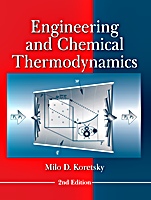
Engineering and Chemical Thermodynamics
ISBN 9780470259610
Autor: Milo D. Koretsky
Wydawca: Wiley
Dostępność: 3-6 tygodni
Cena: 1 347,15 zł
Przed złożeniem zamówienia prosimy o kontakt mailowy celem potwierdzenia ceny.
ISBN13: |
9780470259610 |
ISBN10: |
0470259612 |
Autor: |
Milo D. Koretsky |
Oprawa: |
Hardback |
Rok Wydania: |
2013-08-16 |
Numer Wydania: |
2nd Edition |
Ilość stron: |
704 |
Wymiary: |
265x188 |
Tematy: |
PN |
Koretsky helps students understand and visualize thermodynamics through a qualitative discussion of the role of molecular interactions and a highly visual presentation of the material. By showing how principles of thermodynamics relate to molecular concepts learned in prior courses, Engineering and Chemical Thermodynamics, 2e helps students construct new knowledge on a solid conceptual foundation. Engineering and Chemical Thermodynamics, 2e is designed for Thermodynamics I and Thermodynamics II courses taught out of the Chemical Engineering department to Chemical Engineering majors.
Specifically designed to accommodate students with different learning styles, this text helps establish a solid foundation in engineering and chemical thermodynamics. Clear conceptual development, worked-out examples and numerous end-of-chapter problems promote deep learning of thermodynamics and teach students how to apply thermodynamics to real-world engineering problems.
CHAPTER 1 Measured Thermodynamic Properties and Other Basic Concepts 1
Learning Objectives 1
1.1 Thermodynamics 2
1.2 Preliminary Concepts—The Language of Thermo 3
1.3 Measured Thermodynamic Properties 7
1.4 Equilibrium 15
1.6 The PvT Surface and Its Projections for Pure Substances 20
1.7 Thermodynamic Property Tables 26
1.8 Summary 30
1.9 Problems 31
Conceptual Problems 31
Numerical Problems 34
CHAPTER 2 The First Law of Thermodynamics 36
Learning Objectives 36
2.1 The First Law of Thermodynamics 37
2.2 Construction of Hypothetical Paths 46
2.3 Reversible and Irreversible Processes 48
2.4 The First Law of Thermodynamics for Closed Systems 55
2.5 The First Law of Thermodynamics for Open Systems 60
2.6 Thermochemical Data For U and H 67
2.7 Reversible Processes in Closed Systems 92
2.8 Open-System Energy Balances on Process Equipment 95
2.9 Thermodynamic Cycles and the Carnot Cycle 102
2.10 Summary 108
2.11 Problems 110
Conceptual Problems 110
Numerical Problems 113
CHAPTER 3 Entropy and the Second Law Of Thermodynamics 127
Learning Objectives 127
3.1 Directionality of Processes/Spontaneity 128
3.2 Reversible and Irreversible Processes (Revisited) and their Relationship to Directionality 129
3.3 Entropy, the Thermodynamic Property 131
3.4 The Second Law of Thermodynamics 140
3.5 Other Common Statements of the Second Law of Thermodynamics 142
3.6 The Second Law of Thermodynamics for Closed and Open Systems 143
3.7 Calculation of Ds for an Ideal Gas 151
3.8 The Mechanical Energy Balance and the Bernoulli Equation 160
3.9 Vapor-Compression Power and Refrigeration Cycles 164
3.10 Exergy (Availability) Analysis 172
3.11 Molecular View of Entropy 182
3.12 Summary 190
3.13 Problems 191
Conceptual Problems 191
Numerical Problems 195
CHAPTER 4 Equations of State and Intermolecular Forces 209
Learning Objectives 209
4.1 Introduction 210
4.2 Intermolecular Forces 211
4.3 Equations of State 232
4.4 Generalized Compressibility Charts 246
4.5 Determination of Parameters for Mixtures 249
4.6 Summary 254
4.7 Problems 255
Conceptual Problems 255
Numerical Problems 257
CHAPTER 5 The Thermodynamic Web 265
Learning Objectives 265
5.1 Types of Thermodynamic Properties 265
5.2 Thermodynamic Property Relationships 267
5.3 Calculation of Fundamental and Derived Properties Using Equations of State and Other Measured Quantities 276
5.4 Departure Functions 290
5.5 Joule-Thomson Expansion and Liquefaction 298
5.6 Summary 304
5.7 Problems 305
Conceptual Problems 305
Numerical Problems 307
CHAPTER 6 Phase Equilibria I: Problem Formulation 315
Learning Objectives 315
6.1 Introduction 315
6.2 Pure Species Phase Equilibrium 318
6.3 Thermodynamics of Mixtures 334
6.4 Multicomponent Phase Equilibria 367
6.5 Summary 372
6.6 Problems 373
Conceptual Problems 373
Numerical Problems 377
CHAPTER 7 Phase Equilibria II: Fugacity 391
Learning Objectives 391
7.1 Introduction 391
7.2 The Fugacity 392
7.3 Fugacity in the Vapor Phase 396
7.4 Fugacity in the Liquid Phase 414
7.5 Fugacity in the Solid Phase 449
7.6 Summary 450
7.7 Problems 452
Conceptual Problems 452
Numerical Problems 454
CHAPTER 8 Phase Equilibria III: Applications 466
Learning Objectives 466
8.1 Vapor–Liquid Equilibrium (VLE) 467
8.2 Liquid 1a2—Liquid 1b2 Equilibrium: LLE 511
8.3 Vapor–Liquid 1a2— Liquid 1b2 Equilibrium: VLLE 519
8.4 Solid–Liquid and Solid–Solid Equilibrium: SLE and SSE 523
8.5 Colligative Properties 531
8.6 Summary 538
8.7 Problems 540
Conceptual Problems 540
Numerical Problems 544
CHAPTER 9 Chemical Reaction Equilibria 562
Learning Objectives 562
9.1 Thermodynamics and Kinetics 563
9.2 Chemical Reaction and Gibbs Energy 565
9.3 Equilibrium for a Single Reaction 568
9.4 Calculation of K from Thermochemical Data 572
9.5 Relationship Between the Equilibrium Constant and the Concentrations of Reacting Species 579
9.6 Equilibrium in Electrochemical Systems 589
9.7 Multiple Reactions 599
9.8 Reaction Equilibria of Point Defects in Crystalline Solids 612
9.9 Summary 624
9.10 Problems 626
Conceptual Problems 626
Numerical Problems 628
APPENDIX A Physical Property Data 639
APPENDIX B Steam Tables 647
APPENDIX C Lee–Kesler Generalized Correlation Tables 660
APPENDIX D Unit Systems 676
APPENDIX E ThermoSolver Software 680
APPENDIX F References 685
Index 687
Koszyk
Książek w koszyku: 0 szt.
Wartość zakupów: 0,00 zł
Informacje


Kontakt
Gambit
Centrum Oprogramowania
i Szkoleń Sp. z o.o.
Al. Pokoju 29b/22-24
31-564 Kraków
Siedziba Księgarni
ul. Kordylewskiego 1
31-542 Kraków
+48 12 410 5991
+48 12 410 5987
+48 12 410 5989
Subskrypcje
Administratorem danych osobowych jest firma Gambit COiS Sp. z o.o. Na podany adres będzie wysyłany wyłącznie biuletyn informacyjny.
Autoryzacja płatności

Informacje na temat autoryzacji płatności poprzez PayU.

© Copyright 2012: GAMBIT COiS Sp. z o.o. Wszelkie prawa zastrzeżone.
Projekt i wykonanie: Alchemia Studio Reklamy