


Wydawcy
Katalog tematyczny
- Archeologia (109)
- Ekonomia, finanse, business (13704)
- Filozofia (1445)
- Historia (3040)
- Języki i językoznawstwo (2356)
- Lifestyle, hobby i rozrywka (475)
- Medycyna (9704)
- Nauki humanistyczne (4)
- Nauki o Ziemi i środowisku (2638)
- Nauki ścisłe (20412)
- Astronomia (294)
- Biologia (5119)
- Chemia (6540)
- Fizyka (3309)
- Elektryczność i magnetyzm (90)
- Fizyka atomowa i molekularna (110)
- Fizyka cząstek elementarnych (36)
- Fizyka jądra atomowego (36)
- Fizyka kwantowa (210)
- Fizyka matematyczna (121)
- Fizyka relatywistyczna (36)
- Fizyka statystyczna (51)
- Fizyka stosowana (498)
- Mechanika klasyczna (186)
- Optyka i światło (133)
- Stany materii (202)
- Matematyka (4574)
- Nauki ścisłe, ogólnie (503)
- Nauki społeczne (8486)
- Nauki techniczne (13450)
- Prawo (1696)
- Publikacje informacyjne i interdyscyplinarne (1288)
- Religia i wierzenia (917)
- Technika komputerowa (4067)
- Zdrowie, relacje międzyludzkie i rozwój osobisty (657)





Informacje szczegółowe o książce
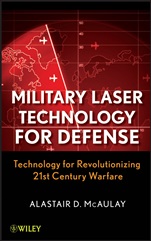
Military Laser Technology for Defense: Technology for Revolutionizing 21st Century Warfare
ISBN 9780470255605
Autor: Alastair D. McAulay
Wydawca: Wiley
Dostępność: 3-6 tygodni
Cena: 447,30 zł
Przed złożeniem zamówienia prosimy o kontakt mailowy celem potwierdzenia ceny.
ISBN13: |
9780470255605 |
ISBN10: |
0470255609 |
Autor: |
Alastair D. McAulay |
Oprawa: |
Hardback |
Rok Wydania: |
2011-05-13 |
Ilość stron: |
336 |
Wymiary: |
234x156 |
Tematy: |
PH |
A timely survey of current and proposed laser system technologyfor warfare
With the rapidly changing nature of conflict today, laser systemdevelopment has benefited from a new focus and urgency. Becauselaser beams can project energy over kilometers inmicroseconds fast enough to eliminate most countermeasureresponses laser technology seems ideal for defense againstmodern weapons. Military Laser Technology for Defense:Technology for Revolutionizing 21st Century Warfare highlightsrecent advances in high–power lasers and impressive airbornedemonstrations of laser weapons that show the enormous potential oflaser technology to revolutionize twenty–first–century warfare.
Including only unclassified or declassified information, thebook focuses on military applications that involve propagation oflaser beams through the atmosphere. Chapters cover:
Optical technology, including optical beams, interferometers,diffraction and propagation of laser light in the atmosphere
Laser technology including efficient ultra–high power lasers,such as the free–electron laser, that will have a major impact onfuture warfare
How laser technology can effectively mitigate six of the mostpressing military threats of the twenty–first century includingmissiles, future nuclear weapons, directed beam weapons, chemicaland biological attack, and terrorists, as well as imagingchallenges in bad weather
Understanding these threats and their associated laserprotection systems is critical for allocating resources because abalance is required between maintaining a strong economy, aneffective infrastructure, and a capable military defense.Military Laser Technology for Defense will providescientists, engineers, military planners, academic researchers andstudents with a comprehensive reference for the design anddevelopment of new laser systems and for strategic planning.
PREFACE.
ACKNOWLEDGMENTS.
ABOUT THE AUTHOR.
I OPTICS TECHNOLOGY FOR DEFENSE SYSTEMS.
1 OPTICAL RAYS.
1.1 Paraxial Optics.
1.2 Geometric or Ray Optics.
1.3 Optics for Launching and Receiving Beams.
2 GAUSSIAN BEAMS AND POLARIZATION.
2.1 Gaussian Beams.
2.2 Polarization.
3 OPTICAL DIFFRACTION.
3.1 Introduction to Diffraction.
3.2 Uncertainty Principle for Fourier Transforms.
3.3 Scalar Diffraction.
3.4 Diffraction–Limited Imaging.
4 DIFFRACTIVE OPTICAL ELEMENTS.
4.1 Applications of DOEs.
4.2 Diffraction Gratings.
4.3 Zone Plate Design and Simulation.
4.4 Gerchberg Saxton Algorithm for Design of DOEs.
5 PROPAGATION AND COMPENSATION FOR ATMOSPHERICTURBULENCE.
5.1 Statistics Involved.
5.2 Optical Turbulence in the Atmosphere.
5.3 Adaptive Optics.
5.4 Computation of Laser Light Through AtmosphericTurbulence.
6 OPTICAL INTERFEROMETERS AND OSCILLATORS.
6.1 Optical Interferometers.
6.2 Fabry Perot Resonators.
6.3 Thin–Film Interferometric Filters and DielectricMirrors.
II LASER TECHNOLOGY FOR DEFENSE SYSTEMS.
7 PRINCIPLES FOR BOUND ELECTRON STATE LASERS.
7.1 Laser Generation of Bound Electron State CoherentRadiation.
7.2 Semiconductor Laser Diodes.
7.3 Semiconductor Optical Amplifiers.
8 POWER LASERS.
8.1 Characteristics.
8.2 Solid–State Lasers.
8.3 Powerful Gas Lasers.
9 PULSED HIGH PEAK POWER LASERS.
9.1 Situations in which Pulsed Lasers may be Preferable.
9.2 Mode–Locked Lasers.
9.3 Q–Switched Lasers.
9.4 Space and Time Focusing of Laser Light.
10 ULTRAHIGH–POWER CYCLOTRON MASERS/LASERS.
10.1 Introduction to Cyclotron or Gyro Lasers and Masers.
10.2 Gyrotron–Type Lasers and Masers.
10.3 Vircator Impulse Source.
11 FREE–ELECTRON LASER/MASER.
11.1 Significance and Principles of Free–ElectronLaser/Maser.
11.2 Explanation of Free–Electron Laser Operation.
11.3 Description of High– and Low–Power Demonstrations.
III APPLICATIONS TO PROTECT AGAINST MILITARY THREATS.
12 LASER PROTECTION FROM MISSILES.
12.1 Protecting from Missiles and Nuclear–Tipped ICBMs.
12.2 The Airborne Laser Program for Protecting from ICBMs.
12.3 Protecting from Homing Missiles.
12.4 Protecting Assets from Missiles.
13 LASER TO ADDRESS THREAT OF NEW NUCLEAR WEAPONS.
13.1 Laser Solution to Nuclear Weapons Threat.
13.2 Description of National Infrastructure Laser.
14 PROTECTING ASSETS FROM DIRECTED ENERGY LASERS.
14.1 Laser Characteristics Estimated by Laser WarningDevice.
14.2 Laser Warning Devices.
15 LIDAR PROTECTS FROM CHEMICAL/BIOLOGICAL WEAPONS.
15.1 Introduction to Lidar and Military Applications.
15.2 Description of Typical Lidar System.
15.3 Spectrometers.
15.4 Spectroscopic Lidar Senses Chemical Weapons.
16 94 GHz RADAR DETECTS/TRACKS/IDENTIFIES OBJECTS IN BADWEATHER.
16.1 Propagation of Electromagnetic Radiation ThroughAtmosphere.
16.2 High–Resolution Inclement Weather 94 GHz Radar.
16.3 Applications, Monitoring Space, High Doppler, and Low SeaElevation.
17 PROTECTING FROM TERRORISTS WITH W–BAND.
17.1 Nonlethal Crowd Control with Active Denial System.
17.2 Body Scanning for Hidden Weapons.
17.3 Inspecting Unopened Packages.
17.4 Destruction and Protection of Electronics.
BIBLIOGRAPHY.
INDEX.
Alastair D. McAulay, PhD, is Professor of Electrical andComputer Engineering at Lehigh University. Previously he was NCRprofessor and chairman of the Department of Computer Science andEngineering at Wright State University and program manager in theCentral Research Laboratories of Texas Instruments. He haspublished more than 150 papers and his book Optical ComputerArchitectures, published by Wiley in 1991, has been used forcourses around the world and reprinted several times.
Contact the author at www.linkedin.com/in/alastairmcaulay
Koszyk
Książek w koszyku: 0 szt.
Wartość zakupów: 0,00 zł
Informacje


Kontakt
Gambit
Centrum Oprogramowania
i Szkoleń Sp. z o.o.
Al. Pokoju 29b/22-24
31-564 Kraków
Siedziba Księgarni
ul. Kordylewskiego 1
31-542 Kraków
+48 12 410 5991
+48 12 410 5987
+48 12 410 5989
Subskrypcje
Administratorem danych osobowych jest firma Gambit COiS Sp. z o.o. Na podany adres będzie wysyłany wyłącznie biuletyn informacyjny.
Autoryzacja płatności

Informacje na temat autoryzacji płatności poprzez PayU.

© Copyright 2012: GAMBIT COiS Sp. z o.o. Wszelkie prawa zastrzeżone.
Projekt i wykonanie: Alchemia Studio Reklamy