


Wydawcy
Katalog tematyczny
- Archeologia (109)
- Ekonomia, finanse, business (13704)
- Filozofia (1445)
- Historia (3040)
- Języki i językoznawstwo (2356)
- Lifestyle, hobby i rozrywka (475)
- Medycyna (9704)
- Nauki humanistyczne (4)
- Nauki o Ziemi i środowisku (2638)
- Nauki ścisłe (20412)
- Nauki społeczne (8486)
- Nauki techniczne (13450)
- Budownictwo lądowe (1045)
- Chemia przemysłowa (2258)
- Elektronika i telekomunikacja (3287)
- Energetyka (1122)
- Inne nauki stosowane (363)
- Inżynieria biochemiczna (507)
- Inżynieria transportu (232)
- Mechanika i materiały (3316)
- Nauka o środowisku (321)
- Rolnictwo (507)
- Technika, ogólnie (475)
- Prawo (1696)
- Publikacje informacyjne i interdyscyplinarne (1288)
- Religia i wierzenia (917)
- Technika komputerowa (4067)
- Zdrowie, relacje międzyludzkie i rozwój osobisty (657)





Informacje szczegółowe o książce
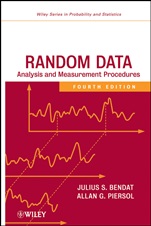
Random Data: Analysis and Measurement Procedures
ISBN 9780470248775
Autor: Julius S. Bendat, Allan G. Piersol
Wydawca: Wiley
Dostępność: 3-6 tygodni
Cena: 833,70 zł
Przed złożeniem zamówienia prosimy o kontakt mailowy celem potwierdzenia ceny.
ISBN13: |
9780470248775 |
ISBN10: |
0470248777 |
Autor: |
Julius S. Bendat, Allan G. Piersol |
Oprawa: |
Hardback |
Rok Wydania: |
2010-03-05 |
Numer Wydania: |
4th Edition |
Ilość stron: |
640 |
Wymiary: |
237x165 |
Tematy: |
TG |
A timely update of the classic book on the theory and application of random data analysis
First published in 1971, Random Data served as an authoritative book on the analysis of experimental physical data for engineering and scientific applications. This Fourth Edition features coverage of new developments in random data management and analysis procedures that are applicable to a broad range of applied fields, from the aerospace and automotive industries to oceanographic and biomedical research.
This new edition continues to maintain a balance of classic theory and novel techniques. The authors expand on the treatment of random data analysis theory, including derivations of key relationships in probability and random process theory. The book remains unique in its practical treatment of nonstationary data analysis and nonlinear system analysis, presenting the latest techniques on modern data acquisition, storage, conversion, and qualification of random data prior to its digital analysis. The Fourth Edition also includes:
A new chapter on frequency domain techniques to model and identify nonlinear systems from measured input/output random data
New material on the analysis of multiple–input/single–output linear models
The latest recommended methods for data acquisition and processing of random data
Important mathematical formulas to design experiments and evaluate results of random data analysis and measurement procedures
Answers to the problem in each chapter
Comprehensive and self–contained, Random Data, Fourth Edition is an indispensible book for courses on random data analysis theory and applications at the upper–undergraduate and graduate level. It is also an insightful reference for engineers and scientists who use statistical methods to investigate and solve problems with dynamic data.
Spis treści:
Preface.
Preface to the Third Edit
ion.
Glossary of Symbols.
1. Basic Descriptions and Properties.
1.1. Deterministic Versus Random Data.
1.2. Classifications of Deterministic Data.
1.3. Classifications of Random Data.
1.4. Analysis of Random Data.
2. Linear Physical Systems.
2.1. Constant–Parameter Linear Systems.
2.2. Basic Dynamic Characteristics.
2.3. Frequency Response Functions.
2.4. Illustrations of Frequency Response Functions.
2.5. Practical Considerations.
3. Probability Fundamentals.
3.1. One Random Variable.
3.2. Two Random Variables.
3.3. Gaussian (Normal) Distribution.
3.4. Rayleigh Distribution.
3.5. Higher Order Changes of Variables.
4. Statistical Principles.
4.1. Sample Values and Parameter Estimation.
4.2. Important Probability Distribution Functions.
4.3. Sampling Distributions and Illustrations.
4.4. Confidence Intervals.
4.5. Hypothesis Tests.
4.6. Correlation and Regression Procedures.
5. Stationary Random Processes.
5.1. Basic Concepts.
5.2. Spectral Density Functions.
5.3. Ergodic and Gaussian Random Processes.
5.4. Derivative Random Processes.
5.5. Level Crossings and Peak Values.
6. Single–Input/Output Relationships.
6.1. Single–Input/Single–Output Models.
6.2. Single–Input/Multiple–Output Models.
7. Multiple–Input/Output Relationships.
7.1. Multiple–Input/Single–Output Models.
7.2. Two–Input/One–Output Models.
7.3. General and Conditioned Multiple–Input Models.
7.4. Modified Procedure to Solve Multiple–Input/Single–Output Models.
7.5. Matrix Formulas for Multiple–Input/Multiple–Output Models.
8. Statistical Errors in Basic Estimates.
8.1. Definition of Errors.
8.2. Mean and Mean Square Value Estimates.
8.3. Probability Density Function Estimates.
8.4. Correlation Function Estimates.
8.5.
Autospectral Density Function Estimates.
8.6. Record Length Requirements.
9. Statistical Errors in Advanced Estimates.
9.1. Cross–Spectral Density Function Estimates.
9.2. Single–Input/Output Model Estimates.
9.3. Multiple–Input/Output Model Estimates.
10. Data Acquisition and Processing.
10.1. Data Acquisition.
10.2. Data Conversion.
10.3. Data Qualification.
10.4. Data Analysis Procedures.
11. Data Analysis.
11.1. Data Preparation.
11.2. Fourier Series and Fast Fourier Transforms.
11.3. Probability Density Functions.
11.4. Autocorrelation Functions.
11.5. Autospectral Density Functions.
11.6. Joint Record Functions.
11.7. Multiple–Input/Output Functions.
12. Nonstationary Data Analysis.
12.1. Classes of Nonstationary Data.
12.2. Probability Structure of Nonstationary Data.
12.3. Nonstationary Mean Values.
12.4. Nonstationary Mean Square Values.
12.5. Correlation Structure of Nonstationary Data.
12.6. Spectral Structure of Nonstationary Data.
12.7. Input/Output Relations for Nonstationary Data.
13. The Hilbert Transform.
13.1. Hilbert Transforms for General Records.
13.2. Hilbert Transforms for Correlation Functions.
13.3. Envelope Detection Followed by Correlation.
14. Nonlinear System Analysis.
14.1. Zero–Memory and Finite–Memory Nonlinear Systems.
14.2. Square–Law and Cubic Nonlinear Models.
14.3. Volterra Nonlinear Models.
14.4. SI/SO Models with Parallel Linear and Nonlinear Systems.
14.5. SI/SO Models with Nonlinear Feedback.
14.6. Recommended Nonlinear Models and Techniques.
14.7. Duffing SDOF Nonlinear System.
14.8. Nonlinear Drift Force Model.
Bibliography.
Appendix A: Statistical Tables.
Appendix B: Definitions for Random Data Analysis.
List of Figures.
List of Tables.
List of Examples.
Answers to Problems in Random Data.
Index.
Nota biograficzna:
JULIUS S. BENDAT, PhD, is President of the J. S. Bendat Company, an independent mathematical consulting firm in Los Angeles, California. An internationally recognized authority in the field, Dr. Bendat has over fifty years of consulting experience in the formulation of mathematical models, the development of statistical error analysis criteria, and the interpretation of engineering results. He is the author of Nonlinear System Techniques and Applications and coauthor of Engineering Applications of Correlation and Spectral Analysis, Second Edition, both published by Wiley.
The late ALLAN G. PIERSOL, PE, was president of Piersol Engineering Company. His consulting career spanned over fifty years and focused on a wide range of topics including the development of machinery condition monitoring techniques and the statistical analysis of all types of mechanical shock, vibration, and acoustic data. A Fellow of the Acoustical Society of America and the Institute of Environmental Sciences and Technology, Piersol is the coauthor of Engineering Applications of Correlation and Spectral Analysis, Second Edition.
Okładka tylna:
A timely update of the classic book on the theory and application of random data analysis
First published in 1971, Random Data served as an authoritative book on the analysis of experimental physical data for engineering and scientific applications. This Fourth Edition features coverage of new developments in random data management and analysis procedures that are applicable to a broad range of applied fields, from the aerospace and automotive industries to oceanographic and biomedical research.
This new edition continues to maintain a balance of classic theory and novel techniques. The authors expand on the treatment of random data analysis theory, including derivations of key relationships in probability and random process theory. The book remains unique in its practical treatment
of nonstationary data analysis and nonlinear system analysis, presenting the latest techniques on modern data acquisition, storage, conversion, and qualification of random data prior to its digital analysis. The Fourth Edition also includes:
A new chapter on frequency domain techniques to model and identify nonlinear systems from measured input/output random data
New material on the analysis of multiple–input/single–output linear models
The latest recommended methods for data acquisition and processing of random data
Important mathematical formulas to design experiments and evaluate results of random data analysis and measurement procedures
Answers to the problem in each chapter
Comprehensive and self–contained, Random Data, Fourth Edition is an indispensible book for courses on random data analysis theory and applications at the upper–undergraduate and graduate level. It is also an insightful reference for engineers and scientists who use statistical methods to investigate and solve problems with dynamic data.
Koszyk
Książek w koszyku: 0 szt.
Wartość zakupów: 0,00 zł
Informacje


Kontakt
Gambit
Centrum Oprogramowania
i Szkoleń Sp. z o.o.
Al. Pokoju 29b/22-24
31-564 Kraków
Siedziba Księgarni
ul. Kordylewskiego 1
31-542 Kraków
+48 12 410 5991
+48 12 410 5987
+48 12 410 5989
Subskrypcje
Administratorem danych osobowych jest firma Gambit COiS Sp. z o.o. Na podany adres będzie wysyłany wyłącznie biuletyn informacyjny.
Autoryzacja płatności

Informacje na temat autoryzacji płatności poprzez PayU.

© Copyright 2012: GAMBIT COiS Sp. z o.o. Wszelkie prawa zastrzeżone.
Projekt i wykonanie: Alchemia Studio Reklamy