


Wydawcy
Katalog tematyczny
- Archeologia (109)
- Ekonomia, finanse, business (13704)
- Filozofia (1445)
- Historia (3040)
- Języki i językoznawstwo (2356)
- Lifestyle, hobby i rozrywka (475)
- Medycyna (9704)
- Nauki humanistyczne (4)
- Nauki o Ziemi i środowisku (2638)
- Nauki ścisłe (20412)
- Nauki społeczne (8486)
- Nauki techniczne (13450)
- Prawo (1696)
- Publikacje informacyjne i interdyscyplinarne (1288)
- Religia i wierzenia (917)
- Technika komputerowa (4067)
- Zdrowie, relacje międzyludzkie i rozwój osobisty (657)





Informacje szczegółowe o książce
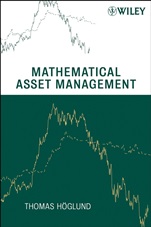
Mathematical Asset Management
ISBN 9780470232873
Autor: Thomas Höglund
Wydawca: Wiley
Dostępność: 3-6 tygodni
Cena: 597,45 zł
Przed złożeniem zamówienia prosimy o kontakt mailowy celem potwierdzenia ceny.
ISBN13: |
9780470232873 |
ISBN10: |
0470232870 |
Autor: |
Thomas Höglund |
Oprawa: |
Hardback |
Rok Wydania: |
2008-05-23 |
Ilość stron: |
232 |
Wymiary: |
234x163 |
Tematy: |
KF |
A practical approach to the mathematical tools needed to increase portfolio growth, learn successful trading strategies, and manage the risks associated with market fluctuation
Mathematical Asset Management presents an accessible and practical introduction to financial derivatives and portfolio selection while also acting as a basis for further study in mathematical finance.
Assuming a fundamental background in calculus, real analysis, and linear algebra, the book uses mathematical tools only as needed and provides comprehensive, yet concise, coverage of various topics, such as:
Interest rates and the connection between present value and arbitrage
Financial instruments beyond bonds that serve as building blocks for portfolios
Trading strategies and risk performance measures
Stochastic properties of stock prices
The difference between expected return and expected growth and the geometric Brownian motion
Diversification through the creation of optimal portfolios under various constraints
The use of the Capital Asset Pricing Model to accurately estimate the difference between the return of the market and the short rate
To further demonstrate the reality of the discussed concepts, the author analyzes five active stocks over a four–year period and highlights the different methods and portfolios that exist in today′s economic world. Exercises are also provided throughout the text, along with the solutions, allowing readers to measure their understanding of presented techniques as well as see how the methods work in real life.
Mathematical Asset Management is an excellent book for courses in mathematical finance, actuarial mathematics, financial derivatives, and financial engineering at the upper–undergraduate and graduate levels. It is also a valuable reference for practitioners in banking, insurance, and asset management industries.
Spis treści:
Preface.
1. Interest Rate.
1.1 Flat Rate.
1.1.1 Compound Interest.
1.1.2 Present Value.
1.1.3 Cash Streams.
1.1.4 Effective Rate.
1.1.5 Bonds.
1.1.6 The Effective Rate as a Measure of Valuation.
1.2 Dependence on the Maturity Date.
1.2.1 Zero–Coupon Bonds.
1.2.2 Arbitrage Free Cash Streams.
1.2.3 The Arbitrage Theorem.
1.2.4 The Movements of the Interest Rate Curve.
1.2.5 Sensitivity to Change of Rates.
1.2.6 Immunization.
1.3 Notes.
2. Further Financial Instruments.
2.1 Stocks.
2.1.1 Earnings, Interest Rate and Stock Price.
2.2 Forwards.
2.3 Options.
2.3.1 European Options.
2.3.2 American Options.
2.3.3 Option Strategies.
2.4 Further Exercises.
2.5 Notes.
3. Trading Strategies.
3.1 Trading Strategies.
3.1.1 Model Assumptions.
3.1.2 Interest Rate.
3.1.3 Exotic Options.
3.2 An Asymptotic Result.
3.2.1 The Model of Cox, Ross and Rubinstein.
3.2.2 An Asymptotic Result.
3.3 Implementing Trading Strategies.
3.3.1 Portfolio Insurance.
4. Stochastic Properties of Stock Prices.
4.1 Growth.
4.1.1 The Distribution of the Growth.
4.1.2 Drift and Volatility.
4.1.3 The Stability of the Volatility Estimator.
4.2 Return.
4.3 Covariation.
4.3.1 The Asymptotic Distribution of the Estimated Covariance Matrix.
5. Trading Strategies with Clock Time Horizon.
5.1 Clock Time Horizon.
5.2 Black–Scholes Pricing Formulas.
5.2.1 Sensitivity to Perturbations.
5.2.2 Hedging a Written Call.
5.2.3 Three Options Strategies Again.
5.3 The Black–Scholes Equation.
5.4 Trading Strategies for Several Assets.
5.4.1 An Unsymmetrical Formulation.
5.4.2 A Symmetrical Formulation.
5.4.3 Examples.
5.5 Notes.
6. Diversification.
6.1 Risk and Diversification.
6.1.1 The Minimum–Variance Portfolio.
6.1.2 Stability of the Estimates of the Weight
s.
6.2 Growth Portfolios.
6.2.1 The Auxiliary Portfolio.
6.2.2 Maximal Drift.
6.2.3 Constraint on Portfolio Volatility.
6.2.4 Constraints on Total Stock Weight.
6.2.5 Constraints on Total Stock Weight and Volatility.
6.2.6 The Efficient Frontier.
6.2.7 Summary.
6.3 Rebalancing.
6.3.1 The Portfolio Development as a Function of the Development of the Stocks.
6.3.2 Empirical Verification.
6.4 Optimal Portfolios with Positive Weights.
6.5 Notes.
7. Covariation with the Market.
7.1 Beta.
7.1.1 The Market.
7.1.2 Beta Value.
7.2 Portfolios Related to the Market.
7.2.1 The Beta Portfolio.
7.2.2 Stability of the Estimates of the Weights.
7.2.3 Market Neutral Portfolios.
7.3 Capital Asset Pricing Model.
7.3.1 The CAPM–Identity.
7.3.2 Consequences of CAPM.
7.3.3 The Market Portfolio.
7.4 Notes.
8. Performance and Risk measures.
8.1 PerformanceMeasures.
8.2 Risk Measures.
8.2.1 Value at Risk.
8.2.2 Downside Risk.
8.3 Risk Adjustment.
9. Simple Covariation.
9.1 Equal Correlations.
9.1.1 Matrix Calculations.
9.1.2 Optimal Portfolios.
9.1.3 Comparison with the General Model.
9.1.4 Positive Weights.
9.2 Multiplicative Correlations.
9.2.1 Uniqueness of the Parameters.
9.2.2 Matrix Calculations.
9.2.3 Parameter Estimation.
9.2.4 Optimal Portfolios.
9.2.5 Positive Weights.
9.3 Notes.
Appendix A: Answers and solutions to exercises.
References.
Nota biograficzna:
Thomas Höglund, PhD, is Lecturer in the Department of Mathematics at Stockholm University in Sweden, where he participated in the creation of a program in mathematics and economics. A former head mathematician for the Swedish Intelligence Service, Dr. Höglund conducts research in mathematical statistics and probability theory.
Okładka tylna:
A practical approach to the mathematical tools needed to increase
portfolio growth, learn successful trading strategies, and manage the risks associated with market fluctuation
Mathematical Asset Management presents an accessible and practical introduction to financial derivatives and portfolio selection while also acting as a basis for further study in mathematical finance.
Assuming a fundamental background in calculus, real analysis, and linear algebra, the book uses mathematical tools only as needed and provides comprehensive, yet concise, coverage of various topics, such as:
Interest rates and the connection between present value and arbitrage
Financial instruments beyond bonds that serve as building blocks for portfolios
Trading strategies and risk performance measures
Stochastic properties of stock prices
The difference between expected return and expected growth and the geometric Brownian motion
Diversification through the creation of optimal portfolios under various constraints
The use of the Capital Asset Pricing Model to accurately estimate the difference between the return of the market and the short rate
To further demonstrate the reality of the discussed concepts, the author analyzes five active stocks over a four–year period and highlights the different methods and portfolios that exist in today′s economic world. Exercises are also provided throughout the text, along with the solutions, allowing readers to measure their understanding of presented techniques as well as see how the methods work in real life.
Mathematical Asset Management is an excellent book for courses in mathematical finance, actuarial mathematics, financial derivatives, and financial engineering at the upper–undergraduate and graduate levels. It is also a valuable reference for practitioners in banking, insurance, and asset management industries.
Koszyk
Książek w koszyku: 0 szt.
Wartość zakupów: 0,00 zł
Informacje


Kontakt
Gambit
Centrum Oprogramowania
i Szkoleń Sp. z o.o.
Al. Pokoju 29b/22-24
31-564 Kraków
Siedziba Księgarni
ul. Kordylewskiego 1
31-542 Kraków
+48 12 410 5991
+48 12 410 5987
+48 12 410 5989
Subskrypcje
Administratorem danych osobowych jest firma Gambit COiS Sp. z o.o. Na podany adres będzie wysyłany wyłącznie biuletyn informacyjny.
Autoryzacja płatności

Informacje na temat autoryzacji płatności poprzez PayU.

© Copyright 2012: GAMBIT COiS Sp. z o.o. Wszelkie prawa zastrzeżone.
Projekt i wykonanie: Alchemia Studio Reklamy