


Wydawcy
Katalog tematyczny
- Archeologia (109)
- Ekonomia, finanse, business (13704)
- Filozofia (1445)
- Historia (3040)
- Języki i językoznawstwo (2356)
- Lifestyle, hobby i rozrywka (475)
- Medycyna (9704)
- Nauki humanistyczne (4)
- Nauki o Ziemi i środowisku (2638)
- Nauki ścisłe (20412)
- Nauki społeczne (8486)
- Nauki techniczne (13450)
- Prawo (1696)
- Publikacje informacyjne i interdyscyplinarne (1288)
- Religia i wierzenia (917)
- Technika komputerowa (4067)
- Zdrowie, relacje międzyludzkie i rozwój osobisty (657)





Informacje szczegółowe o książce
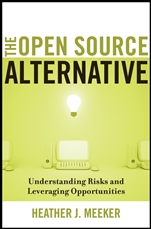
The Open Source Alternative: Understanding Risks and Leveraging Opportunities
ISBN 9780470194959
Autor: Heather J. Meeker
Wydawca: Wiley
Dostępność: 3-6 tygodni
Cena: 233,10 zł
Przed złożeniem zamówienia prosimy o kontakt mailowy celem potwierdzenia ceny.
ISBN13: |
9780470194959 |
ISBN10: |
0470194952 |
Autor: |
Heather J. Meeker |
Oprawa: |
Hardback |
Rok Wydania: |
2008-04-11 |
Ilość stron: |
304 |
Wymiary: |
237x160 |
Tematy: |
KM |
A practical guide to leveraging open source in business
The law of open source is complex and constantly changing. Some legal issues related to it are thorny and undecided. Those called upon to make decisions about open source have found little information to guide them in traditional legal materials . . . until now. Author Heather Meeker—voted one of the top thirty intellectual property lawyers in California—brings her ten years of extensive involvement in open source legal issues to bear in The Open Source Alternative—a practical resource to help you implement open source intelligently, without compromising the value of your intellectual property or stepping into a potential lawsuit.
Written in plain English for both lawyers and professionals, The Open Source Alternative provides an accessible discussion of the different licensing strategies to consider with open source. This invaluable reference tool for CIOs, CFOs, IT managers, auditors, and attorneys, as well as all interested professionals, provides you with the background and tools you need to understand this area of law and develop your own conclusions and best practices. Divided into two parts—leveraging opportunities and understanding risks—the book explores: the rules of the road for use of open source in proprietary products, assessing legal risk of using open source, how to understand and leverage patents and trademarks in the open source landscape, and developing policies for use of open source in your business.
Formulating best practices in open source development requires familiarity with a complex set of facts and industry practices, as well as the political, business, and legal principles behind them. The Open Source Alternative is a must–read for any professional who needs to stay on top of this rapidly changing field.
Spis treści:
Preface.
Part One: Leveraging Opportunities.
Chapter 1: Introduction: How UNIX Gave
Birth to Linux, and a New Software Paradigm.
In the Beginning Was the Word, and the Word Was UNIX.
Along Comes Linux.
Now, What Is Open Source?
And This Is Just the Beginning.
Chapter 2: Free Software and Open Source.
Viruses and Freedoms.
Philosophy of Free Software.
Open Source Initiative.
Mozilla Foundation.
Linus Torvalds.
Defi nitions: Free Software and Open Source.
What’s in a Name? The Viral and the Nonviral.
Open Source Development Model.
Chapter 3: Common Open Source Licenses and Their Structure.
Direct Licensing.
GPL.
GPL Exception (or Special Exception).
GPL FLOSS Exception.
LGPL.
Corporate Hereditary Software Licenses.
Other Hereditary Software Licenses.
Permissive Licenses.
Apache 1.0.
Apache 1.1.
Apache 2.0.
Artistic License.
Miscellaneous Licenses.
Non–Software Licenses.
Chapter 4: Due Diligence, License Proliferation, and Compatibility.
What Is the Problem with Combining Software?
What Is Due Diligence?
License Conditions and Diligence Problems.
License Compatibility.
Choices in an Incompatible World.
An Embarrassment of Riches?
Reusability.
Chapter 5: Audits and Compliance Initiatives.
Provenance and Objective Checking.
Applying Policy and Legal Review.
Some Nuts and Bolts.
Chapter 6: Notice Requirements.
Chapter 7: Patents and Open Source.
Patent Debate.
Patent Portfolio Management.
Chapter 8: Trademarks and Open Source.
Trademark Law and Open Source Licensing.
Trademarks in the Open Source World.
AT&T UNIX Battle.
Chapter 9: Open Source and Open Standards.
Chapter 10: Developing a Corporate Open Source Policy.
Appendix 10A: Open Source Corporate Policy.
Chapter 11: Open Source Code Releases.
Choosing a License.
Effect on Patent Portfolio.
Effect on Trademarks.
Open Source Busin
ess Models.
Dual Licensing.
“Ur–Licensor” and Open Source Decision Models.
Contribution Agreements.
Reissuing Code.
Corporate Organization.
Appendix 11A Open Source Trademark Policy.
Part Two: Understanding Risks.
Chapter 12: Technical Background: Operating System Kernels, User Space, and Elements of Programming.
What Is the difference Between an Application and an Operating System?
What Is an Operating System Kernel?
What Is an Application?
Dynamic and Static Linking, and Inline Code.
Header Files.
Monoliths and Loadable Kernel Modules.
Chapter 13: Enforcement of Open Source Licenses.
Past Enforcement.
Enforcement Obstacles.
Lack of Track Record: GPL Has Never Been Tested in Court.
Waiver/Estoppel: Occasional and Selective Enforcement of GPL Means It Is Unenforceable.
Formation: GPL Is Not Validly Accepted by Licensees.
GPL Constitutes Copyright Misuse.
Joint Work Arguments.
Standing and Joinder Arguments.
Chapter 14: The Border Dispute of GPL2.
Defining the Border Dispute.
What the GPL Says.
Rules of Contract Construction.
Applying the Four Corners Rule to GPL2.
Applying the Rules of Contract Construction of GPL2.
Trade Usage and Other Extrinsic Evidence.
Derivative Works Question.
The Facts.
Legal Rules.
Analyzing the Case of Two Works.
Is the Result One or Two Works?
Policy Arguments.
Non–U.S. Law Interpretations.
Approach of Legal Realism.
Outside the Four Corners.
Loadable Kernel Modules.
The Hardest Cases.
LGPL Compliance.
Chapter 15: License or Contract?
Contract Formation.
Arguments Supporting Formation.
Implications of Absence of Contract Formation.
Incentives for Formation Arguments.
Chapter 16: Defi ning Distribution.
Chapter 17: Open Source in Mergers and Acquisitions and Other Transactions.
Open Source in Licensing and Commercial Tr
ansactions.
Development Agreements.
Chapter 18: GPL Version 3.0.
What Is the Effect of the Release of GPL3?
Adoption of GPL3.
Politics and Context.
“Derivative Works” Problem.
“Propagation” and “Conveying”.
Patents.
Digital Millennium Copyright Act Provisions.
“Java Problem”.
Disabling and Obfuscation.
ASP Problem.
License Compatibility.
Chapter 19: LGPL Version 3.0.
New Approach for LGPL.
Adoption of LGPL3.
Politics and Context.
Defi nitions.
Compliance.
Drawbacks.
Appendix A: Open Source Development Agreement.
Glossary.
Index.
Nota biograficzna:
Heather J. Meeker is a shareholder at Greenberg Traurig, LLP, one of the largest law firms in the United States. Heather has provided open source counseling to clients ranging from technology startups using open source in product development, to public technology companies conducting open source code releases, to venture capitalists assessing new business models in the software industry. She also serves as an adjunct professor at the U.C. Berkeley School of Law, is a member of the American Law Institute, and in 2005, was selected by the Daily Journal as one of the top thirty intellectual property lawyers in California.
Okładka tylna:
A practical guide to leveraging open source in business
The law of open source is complex and constantly changing. Some legal issues related to it are thorny and undecided. Those called upon to make decisions about open source have found little information to guide them in traditional legal materials . . . until now. Author Heather Meeker—voted one of the top thirty intellectual property lawyers in California—brings her ten years of extensive involvement in open source legal issues to bear in The Open Source Alternative—a practical resource to help you implement open source intellige
Koszyk
Książek w koszyku: 0 szt.
Wartość zakupów: 0,00 zł
Informacje


Kontakt
Gambit
Centrum Oprogramowania
i Szkoleń Sp. z o.o.
Al. Pokoju 29b/22-24
31-564 Kraków
Siedziba Księgarni
ul. Kordylewskiego 1
31-542 Kraków
+48 12 410 5991
+48 12 410 5987
+48 12 410 5989
Subskrypcje
Administratorem danych osobowych jest firma Gambit COiS Sp. z o.o. Na podany adres będzie wysyłany wyłącznie biuletyn informacyjny.
Autoryzacja płatności

Informacje na temat autoryzacji płatności poprzez PayU.

© Copyright 2012: GAMBIT COiS Sp. z o.o. Wszelkie prawa zastrzeżone.
Projekt i wykonanie: Alchemia Studio Reklamy