


Wydawcy
Katalog tematyczny
- Archeologia (109)
- Ekonomia, finanse, business (13704)
- Filozofia (1445)
- Historia (3040)
- Języki i językoznawstwo (2356)
- Lifestyle, hobby i rozrywka (475)
- Medycyna (9704)
- Nauki humanistyczne (4)
- Nauki o Ziemi i środowisku (2638)
- Nauki ścisłe (20412)
- Nauki społeczne (8486)
- Nauki techniczne (13450)
- Prawo (1696)
- Publikacje informacyjne i interdyscyplinarne (1288)
- Religia i wierzenia (917)
- Technika komputerowa (4067)
- Zdrowie, relacje międzyludzkie i rozwój osobisty (657)





Informacje szczegółowe o książce
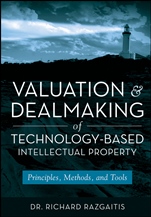
Valuation and Dealmaking of Technology–Based Intellectual Property: Principles, Methods and Tools
ISBN 9780470193334
Autor: Richard Razgaitis
Wydawca: Wiley
Dostępność: 3-6 tygodni
Cena: 729,75 zł
Przed złożeniem zamówienia prosimy o kontakt mailowy celem potwierdzenia ceny.
ISBN13: |
9780470193334 |
ISBN10: |
0470193336 |
Autor: |
Richard Razgaitis |
Oprawa: |
Hardback |
Rok Wydania: |
2009-09-04 |
Numer Wydania: |
2nd Edition |
Ilość stron: |
624 |
Wymiary: |
263x178 |
Tematy: |
KM |
Valuation & Dealmaking of Technology–Based Intellectual Property
Principles, Methods, and Tools
Dr. Richard Razgaitis
Updated, expanded—and proven—methods to account for risk and assign value, from Richard Razgaitis
Developers of cutting–edge technologies are confronted with compelling questions years before their technologies even reach the marketplace: To develop or not to develop? To license or not to license? What price will be a true reflection of the product′s value from the buyer′s and seller′s points of view?
In Valuation and Dealmaking of Technology–Based Intellectual Property, author Richard Razgaitis answers these questions and more, offering updated and complete coverage of the issues, methods, and art of valuing and pricing "early–stage" technologies.
This guide presents three core technology commercialization business processes: opportunity Discovery, Valuation, and Dealmaking, or Technology Licensing D–V–D, authoritatively covering topics including:
Risk and Reward
Taxonomy of Technology Licensing
Principle Based Valuation Methods (and Tools)
Monte Carlo and Real Options as an Advanced Valuation Method
Identifying and Prioritizing Technology Opportunities
Term Sheets and Deal Teams for Negotiation Readiness and Dealmaking
Drawing upon over thirty years of experience in developing technology–based intellectual property, the author thoroughly examines these challenging business processes from a practical, experienced–based perspective. An accompanying Web site, www.razgaitis.com, provides spreadsheets used in this book and a free trial of the Monte Carlo software to allow you to run your own simulations.
Presenting six proven valuation methods as well as a series of case studies showing them in action, Valuation and Dealmaking of Technology–Based Intellectual P
roperty is an essential addition to every technology/R&D manager, M&A dealmaker, and IP lawyer′s professional library.
Spis treści:
Preface.
Disclaimer.
Acknowledgments.
Chapter 1: Introduction to OpportunityDiscovery, Valuation, and Dealmaking (D–V–D).
Introduction: Licensing D–V–D.
Taxonomy of Technology Licensing.
High Significance, High Ambiguity Contexts.
Licensing D–V–D and Innovation.
Going Forward.
Notes.
Chapter 2: Risk and Reward.
Uncertainty.
Phronesis (Judgment).
Technology Uncertainty.
More on Risk.
Value and Price.
Two Final Points on buying and selling.
Notes.
Approach 1: Opportunity Discovery.
Chapter 3: Identifying and Prioritizing Technology Opportunities.
Seller “Opportunity Space”.
The Technology Box.
Buy–Side Expressions of Value: The Wheelbarrow.
Overview of Valuation Methods.
The Six Valuation Methods.
Conclusion.
Notes.
Approach 2: Valuation.
Chapter 4: Method One: Use of Industry Standards for Valuation.
The Concept and Limitations of “Industry Standards”.
Sources of Industry Standard Data and Information.
Survey Results as a Source of Industry Standards Data and Information.
Proposed or Established Norms.
Shopped Term Sheets and Price Lists.
News Sources of License Agreement Information.
Journals, Proprietary Databases, Reports, and Consultants.
Published License Agreements as a Source of Industry Standards.
Court Cases/Judgments as a Source of Industry Standards.
Patent Pools.
Lifetime and Organizational Learning.
Average Error51.
Concluding Observations and Cautionary Notes.
Notes.
Appendix 4A: Outline of Agreement Between DuPont and University of Houston (UH).
Chapter 5: Method Two: The Rating/Ranking Method, and Tool.
Ubiquity of Rating/Rankin
g.
Overview of How Rating/Ranking Can Be Used in Valuation.
Groups and Grouping as a Fundamental Knowledge–Forming Process.
Using Rating/Ranking to Value Technology: Factor Assessment.
Developing Criteria for Using Rating/Ranking for Valuation of Technologies.
Illustrations of Applying the Rating/Ranking Method.
Issues in Interpreting Value from a Rating/Ranking Result.
Using Rating/Ranking to Value Technology: Classified Value.
Uses of Rating/Ranking with Approaches and as a General Tool.
Perspectives on Rating/Ranking as an Approach with Licensing D–V–D.
Knowledge, Uncertainty, and Humility.
Conclusion.
Appendix 5A: Factors in Pricing License (A checklist of 100 important considerations in setting value of technology license).
Notes.
Bibliography.
Chapter 6: Method Three: Rules of Thumb to Determine Valuation.
Foundations of Rules of Thumb.
Cost Savings Example of the 25 Percent Rule.
Perspectives on the 25 Percent Rule.
Use of the 25 Percent Rule for Apportioning New Profits.
Examples of Applying the 25 Percent Rule to New Profits Licensing.
A Universal Rule of Thumb Chart.
Other Percent Rule Values.
Some Misuses / Misapplications of the 25 Percent Rule.
Other Valuation Rules of Thumb Used (or Have Been Proposed).
Summary Points on the Use of the 25 Percent Rule.
Conclusion.
Notes.
Chapter 7: Method Four: Discounted Cash Flow Method to Determine Valuation.
Overview of the DCF Method.
Basic Financial Concepts.
Quantification, Classification of Risk (RAHR).
An Example Cash Flow Projection from a License.
Additional Considerations for Calculating DCF.
Segment and Scenario Analysis.
Cash Flow Projections.
Other Issues to Be Considered with the DCF Method.
Conclusion.
Sources of Information to Develop Business Projections.
Notes.
Chapter 8: Method Five: Advanced Valuation Methods.
Monte Carlo and Real Option
s.
Modified DCF Method.
Monte Carlo Method.
Real Option Methods.
Conclusion.
Appendix 8A: Example Crystal Ball Report for Exhibit 8.18.
Appendix 8B: Crystal Ball Report Corresponding to the Results Presented in Exhibit 8.XX for a Double–Humped Cost Distribution Assumption.
Notes.
Chapter 9: Method 6: Valuation by Auctions.
Introduction to Auctions.
When Auctions are Feasible.
Auction Examples.
Auctions as Distinct from Other Types of Dealmaking.
Auction Strategies for Buyers.
Auction Caution.
Conclusion.
Appendix 9A: Bidder′s Agreement.
Notes.
Approach 3: Dealmaking.
Chapter 10: Approach: Deal Structure.
Return to the “Box” and “Wheelbarrow”.
“Cash When” Pricing Structures.
“Cash As” Pricing Structures.
“Cash If” Pricing Structures.
Cash Maybe: Options.
Consideration Forms Beyond Simple Cash.
Special Form of Cash If: Equity.
Balancing Simplicity with Comprehensiveness.
Conclusion.
Notes.
Chapter 11: People, Process, and Lessons Learned.
Introduction.
Deal Team.
Deal Targets.
Negotiating Plan.
Plan B.
Concluding Advice from Technology Dealmakers.
Notes.
Chapter 12: In Conclusion.
Approach of Opportunity Discovery as a Quest.
Approach of Valuation: A Review of the Six Valuation Methods.
Approach of Dealmaking.
Closing Thoughts.
Website Resources.
Notes.
Appendix: List of Abbreviations and Trademarks.
Bibliography.
About the Author.
Index.
Nota biograficzna:
Dr. Richard Razgaitis is a Senior Advisor at CRAI, an international consulting firm providing expertise in economics, finance, and business strategy. He has over thirty years of experience working with the develop–ment, commercialization, and strategic management of technology, more than twenty–five of
Koszyk
Książek w koszyku: 0 szt.
Wartość zakupów: 0,00 zł
Informacje


Kontakt
Gambit
Centrum Oprogramowania
i Szkoleń Sp. z o.o.
Al. Pokoju 29b/22-24
31-564 Kraków
Siedziba Księgarni
ul. Kordylewskiego 1
31-542 Kraków
+48 12 410 5991
+48 12 410 5987
+48 12 410 5989
Subskrypcje
Administratorem danych osobowych jest firma Gambit COiS Sp. z o.o. Na podany adres będzie wysyłany wyłącznie biuletyn informacyjny.
Autoryzacja płatności

Informacje na temat autoryzacji płatności poprzez PayU.

© Copyright 2012: GAMBIT COiS Sp. z o.o. Wszelkie prawa zastrzeżone.
Projekt i wykonanie: Alchemia Studio Reklamy