


Wydawcy
Katalog tematyczny
- Archeologia (109)
- Ekonomia, finanse, business (13704)
- Filozofia (1445)
- Historia (3040)
- Języki i językoznawstwo (2356)
- Lifestyle, hobby i rozrywka (475)
- Medycyna (9704)
- Nauki humanistyczne (4)
- Nauki o Ziemi i środowisku (2638)
- Nauki ścisłe (20412)
- Nauki społeczne (8486)
- Nauki techniczne (13450)
- Prawo (1696)
- Publikacje informacyjne i interdyscyplinarne (1288)
- Religia i wierzenia (917)
- Technika komputerowa (4067)
- Zdrowie, relacje międzyludzkie i rozwój osobisty (657)





Informacje szczegółowe o książce
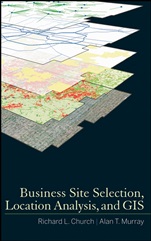
Business Site Selection, Location Analysis and GIS
ISBN 9780470191064
Autor: Richard L. Church, Alan T. Murray
Wydawca: Wiley
Dostępność: 3-6 tygodni
Cena: 665,70 zł
Przed złożeniem zamówienia prosimy o kontakt mailowy celem potwierdzenia ceny.
ISBN13: |
9780470191064 |
ISBN10: |
0470191066 |
Autor: |
Richard L. Church, Alan T. Murray |
Oprawa: |
Hardback |
Rok Wydania: |
2008-10-24 |
Ilość stron: |
320 |
Wymiary: |
251x160 |
Tematy: |
KM |
New integrated approach to site selection makes it easier to find optimal sites
Responding to the increasingly complex nature of modern commerce and trade, this book integrates location science and modeling with geographical information systems (GIS). As you advance through the text, you′ll discover optimal solutions for practical, real–life "siting" problems. In addition, the authors successfully demonstrate how this integrated approach enables you to:
Be more productive and more efficient
Produce better data and models
Develop better techniques for arriving at a solution
Provide better graphic representations of location alternatives
Business Site Selection, Location Analysis, and GIS begins with a general introduct–ory chapter followed by introductory chapters on GIS and model building fundamentals. Next, the authors explore how to use models to analyze existing marketing and distribution systems as well as the siting of a single facility. Lastly, the book examines designing a system while making multiple simultaneous siting decisions.
Each chapter features exercises that enable you to put your new skills and knowledge into practice, solving realistic siting problems. In addition, all chapters include a section that defines key terms and concepts as well as a reference section that enables you to explore individual topics in greater depth.
Clearly written and easy to follow, this text does not require any prerequisites, making it appro–priate for undergraduate and graduate courses as well as for any professional who wants to take advantage of the most advanced and effective methods for optimizing the site selection for a business.
Spis treści:
Dedication.
Preface & Acknowledgment.
Chapter 1: Introduction.
1.0. Motivation.
1.1. History.
1.2. First Principles.
1.3. Planning context.
1.4. Role of GIS.
1.5. Sum
mary.
1.6. Terms.
1.7. References.
1.8. Exercises.
Chapter 2: GIS.
2.0 Introduction.
2.1 Data Acquisition.
2.1.1 Existing sources.
2.1.2 Semi–existing sources.
2.1.3 Surveying and airborne approaches.
2.2 Data Management.
2.2.1 Raster.
2.2.2 Vector.
2.3 Data Manipulation.
2.3.1 Conversion.
2.3.2 Aggregation.
2.3.3 Overlay.
2.3.4 Interpolation.
2.4 Data Analysis.
2.4.1 Query.
2.4.2 Proximity.
2.4.3 Centrality.
2.4.4 Service zone.
2.5 Data Display.
2.6 Summary.
2.7 Terms.
2.8 References.
2.9 Exercises.
Chapter 3: Model Building Fundamentals.
3.0 Introduction.
3.1 Review of Mathematical Notation.
3.1.1 Variables.
3.1.2 Mathematical expressions.
3.1.3 Inequalities.
3.2 Formulating an Optimization Model.
3.2.1 Apple shipment.
3.2.2 Manufacturing plant location.
3.2.3 School consolidation.
3.3 Model solution.
3.3.1 Apple shipment application.
3.3.2 Manufacturing plant location application.
3.3.3 School consolidation application.
3.4 Summary.
3.5 Terms.
3.6 References.
3.7 Exercises.
Chapter 4: Trade and Service Areas.
4.0 Introduction.
4.1 Problem Definition and Motivation.
4.1.1 Descriptive trade area.
4.1.2 Prescriptive service area.
4.2 Mathematical Representation.
4.2.1 Descriptive trade area.
4.2.2 Prescriptive service area.
4.3 GIScience.
4.4 Modeling Application.
4.4.1 Descriptive trade area.
4.4.2 Prescriptive service area.
4.5 Advanced Topics.
4.5.1 Spatial interaction considerations.
4.5.2 Transportation problem considerations.
4.5.3 Using trade and service area models in site selection.
4.6 Summary.
4.7 Terms and Concepts.
4.8 References.
4.9 Exercises.
Chapter 5: Suitability Analysis.
5.0 Introduction.
5.1 Problem Definition and Motivation.
5.2 Suitability Assessment Process.
5.2.1 Absolute suitability.
5.2.2 Relativ
e suitability.
5.3 GIScience.
5.3.1 Map algebra.
5.3.2 Attribute data measurement.
5.4 Model Application.
5.4.1 Absolute suitability.
5.4.2 Relative suitability.
5.5 Advanced Topics .
5.6 Summary.
5.7 Terms and Concepts.
5.8 References.
5.9 Exercises.
Chapter 6: Point–Based Location .
6.0 Introduction.
6.1 Problem Definition and Motivation.
6.2 Mathematical Representation.
6.2.1 Formulating the Weber problem.
6.2.2 Iterative solution approach for the Weber problem.
6.3 GIScience.
6.3.1 Projections and coordinate systems.
6.3.2 Spherical distance.
6.3.3 Planar distance.
6.4 Modeling Application.
6.4.1 Solution using commercial software.
6.4.2 Iterative solution.
6.5 Advanced Topics.
6.5.1 Variants of planar single facility location.
6.5.2 Fallacy of the centroid .
6.5.3 Location on a sphere.
6.5.4 Continuously distributed demand.
6.6 Summary .
6.7 Terms and Concepts.
6.8 References.
6.9 Exercises.
Chapter 7: Line–Based Location.
7.0 Introduction.
7.1 Motivation and Problem Definition.
7.2 Mathematical Representation.
7.2.1 Shortest path model.
7.2.3 Exact solution approach.
7.3 GIScience.
7.3.1 Defining the network.
7.4 Modeling Application.
7.4.1 Path.
7.4.2 Corridor siting in ArcGIS.
7.5 Advanced Topics.
7.5.1 Expanding the network.
7.5.2 Shortest path variants.
7.6 Summary.
7.7 Terms and Concepts.
7.8 References.
7.9 Exercises.
Chapter 8: Area–Based Location.
8.0 Introduction.
8.1 Problem Definition and Motivation.
8.2 Mathematical Representation.
8.2.1 Knapsack model.
8.2.2 Threshold model.
8.2.3 Shape model.
8.3 GIScience.
8.4 Modeling Application.
8.4.1 Knapsack model application.
8.4.2 Threshold model application.
8.4.3 Shape model application.
8.5 Advanced Topics.
8.6 Summary.
8.7 Terms.
8.8 References.
8.9 Exercises.Chapter 9: Coverage.
9.0 Introduction.
9.1 Problem Definition and Motivation.
9.1.1 Complete coverage.
9.1.2 Maximal coverage.
9.2 Mathematical Representation.
9.2.1 Complete coverage.
9.2.2 Maximal coverage.
9.3 GIScience.
9.4 Modeling Application.
9.4.1 LSCP.
9.4.2 MCLP.
9.5 Advanced topics.
9.5.1 Backup coverage.
9.5.2 Service availability.
9.5.3 Spatial representation.
9.6 Summary.
9.7 Terms and concepts.
9.8 References.
9.9 Exercises.
Chapter 10: Dispersion.
10.0 Introduction.
10.1 Problem Definition and Motivation.
10.2 Mathematical Representation.
10.2.1 Neighborhood restrictions.
10.2.2 Pairwise restrictions.
10.2.3 Clique restrictions.
10.3 GIScience.
10.4 Modeling Application.
10.4.1 Neighborhood restrictions.
10.4.2 Pairwise restrictions.
10.4.3 Clique restrictions.
10.5 Advanced Topics.
10.5.1 Hybrid restrictions.
10.5.2 Max–min–min dispersion.
10.6 Summary.
10.7 Terms and concepts.
10.8 References.
10.9 Exercises.
Chapter 11: Location–Allocation.
11.0 Introduction.
11.1 Problem Definition and Motivation.
11.2 Mathematical Representation.
11.2.1 Heuristic solution.
11.3 GIScience.
11.4 Modeling Application.
11.5 Advanced Topics.
11.5.1 Continuous space siting.
11.5.2 Service capacities and fixed costs.
11.5.3 Accounting for uncertainty and error.
11.6 Summary.
11.7 Terms and Concepts.
11.8 References .
11.9 Exercises.
Chapter 12: Conclusion.
12.0 Introduction.
12.1 Classes of Location Models.
12.2 Class Variety and Extensions.
12.3 Solution Approaches.
12.4 Final Thoughts.
12.5 References.
Glossary.
Index.
Nota biograficzna:
Richard L. Church, PhD, is Professor of Geography at University of California, Santa Barbara, specializing in the analysis of problems defined over space and time, including logisti
Koszyk
Książek w koszyku: 0 szt.
Wartość zakupów: 0,00 zł
Informacje


Kontakt
Gambit
Centrum Oprogramowania
i Szkoleń Sp. z o.o.
Al. Pokoju 29b/22-24
31-564 Kraków
Siedziba Księgarni
ul. Kordylewskiego 1
31-542 Kraków
+48 12 410 5991
+48 12 410 5987
+48 12 410 5989
Subskrypcje
Administratorem danych osobowych jest firma Gambit COiS Sp. z o.o. Na podany adres będzie wysyłany wyłącznie biuletyn informacyjny.
Autoryzacja płatności

Informacje na temat autoryzacji płatności poprzez PayU.

© Copyright 2012: GAMBIT COiS Sp. z o.o. Wszelkie prawa zastrzeżone.
Projekt i wykonanie: Alchemia Studio Reklamy