


Wydawcy
Katalog tematyczny
- Archeologia (109)
- Ekonomia, finanse, business (13704)
- Filozofia (1445)
- Historia (3040)
- Języki i językoznawstwo (2356)
- Lifestyle, hobby i rozrywka (475)
- Medycyna (9704)
- Nauki humanistyczne (4)
- Nauki o Ziemi i środowisku (2638)
- Nauki ścisłe (20412)
- Nauki społeczne (8486)
- Nauki techniczne (13450)
- Prawo (1696)
- Publikacje informacyjne i interdyscyplinarne (1288)
- Religia i wierzenia (917)
- Technika komputerowa (4067)
- Zdrowie, relacje międzyludzkie i rozwój osobisty (657)





Informacje szczegółowe o książce
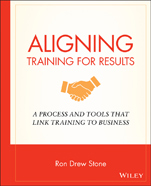
Aligning Training for Results: A Process and Tools That Link Training to Business
ISBN 9780470181751
Autor: Ron Drew Stone
Wydawca: Wiley
Dostępność: 3-6 tygodni
Cena: 318,15 zł
Przed złożeniem zamówienia prosimy o kontakt mailowy celem potwierdzenia ceny.
ISBN13: |
9780470181751 |
ISBN10: |
0470181753 |
Autor: |
Ron Drew Stone |
Oprawa: |
Hardback |
Rok Wydania: |
2008-11-11 |
Ilość stron: |
376 |
Wymiary: |
240x187 |
Tematy: |
KM |
Praise for Aligning Training for Results
"If you follow the PAL process, you will get the desired training result! The process includes clearly defined, well–structured tools that will definitely benefit both training professionals and line managers to achieve training effectiveness."
—Han Qing, director, Siemens Management Institute
"Ron′s book is a much–needed contribution to the training profession and provides a refreshing view of how a results–centered training process should function. ?His process provides the guidance to initiate and sustain alignment with the business, and his tools and templates provide the how–to."
—Stephen M. R. Covey, best–selling author of The Speed of Trust
"At last, a book I can use as a guide to ensure that our programs are designed for business needs and stay aligned throughout the training process to achieve business results. A great contribution to our profession and a great resource for training fellows."
—Sunny Niu Peie, regional director, Field Force Effectiveness, Japan/Asia, Pfizer, Inc.
"Ron′s work is a key resource for all of us in the learning space. Two concepts in particular are not to be missed: the Performance–Centered Framework is a great blueprint for building alignment with business challenges and the Active Management Reinforcement connects the performer with the manager and the work setting and the work, a perfect recipe for success."
—Rebecca L. Ray, group head, Global Talent Management & Development, MasterCard Worldwide
"This is a brilliant book that is packed with sage advice and instructive examples. It moves the traditional trainer role into one of performance consultant. The author provides numerous tools and strategies that will allow all professionals to be guided in assisting their stakeholders to achieve transfer of skills into the workplace. A must–read for those who wa
nt to align their learning initiatives to business outcomes."
—Pam Poggi, vice president, Corporate Human Resources Development, Safeway Inc.
Spis treści:
About This Book.
Tables, Figures, and Exhibits.
Web Site Tools.
Preface.
Introduction.
Audience.
How This Book Is Organized.
Getting the Most from This Resource.
Key Terms Used Throughout the Book.
1 Thinking Performance in the Twenty–First Century.
Performance Is Our Business.
Performers Do Have a Choice.
Viewing Training Through a Different Lens.
Client–Friendly Performance Framework.
Business Outcome.
Execution in the Work Setting.
Performance Readiness.
Preferences.
The Training and Performance Process.
Top Three Barriers to Performance.
Summary.
2 Five Key Factors of Alignment.
It’s About Results.
Performance Results Defined.
Keys to Alignment and Linkage.
Factor One: Business Outcome Need Is Identifi ed Up Front.
Factor Two: The Training and Performance Design Is Guided by the Root Cause and Relevant Needs.
Factor Three: Development and Delivery Are Focused and Linked to the Training and Performance Design.
Factor Four: Following Delivery, Performers Choose to Execute in the Work Setting.
Factor Five: Execution Is Linked to One or More Business Outcome Measures.
Summary.
3 PAL: The Alignment of Our Processes.
With a New View Come New Processes.
Introduction to the PAL Process.
Phase One: Situational Needs Assessment and Performance Design.
Step 1: Scope the Project and Utilize Six Signals to Determine Assessment Strategy.
Step 2: Conduct Detailed Assessment and Analysis and Identify Alternative Solutions.
Step 3: Administer Situational Risk Assessment and Analysis.
Step 4: Propose the Solution and Negotiate Performance Alignment Contract.
Step 5: Go/No Go Solution Decision.
Phase Two: Design and Development.
Step 6: F
inalize Delivery Design and Strategy for Performance Transfer.
Step 7: Develop and/or Acquire Focused Performance Solution Components.
Phase Three: Delivery and Execution.
Step 8: Implement Pre–Engagement Action.
Step 9: Deliver Performance Solution and Assess Learning Readiness and Initial Reaction.
Step 10: Trigger Transfer Strategy and Work Setting Execution.
Phase Four: Verifi cation and Follow–Up.
Step 11: Rapid Verifi cation of Results and Follow–Up Action Steps.
Guiding Principles.
Summary.
4 Situational Needs Assessment: Opening the Door.
A Process with Many Names.
Getting Started.
Two Roles for Needs Assessment.
Proactive Role.
Client Request Role.
Client Key Behavior and Suggested Solutions.
Client Resistance to Our Processes.
The Initial Meeting: Let the Client Talk.
Step 1 of the PAL Process: Scope the Project.
The Six Signals.
Intake Scope and Alignment Document.
Summary.
5 Situational Needs Assessment: The Analysis.
Step 2 of the PAL Process: Conduct Detailed Assessment and Analysis.
The Approach.
The Strategy.
Sampling.
Data Collection Methods and Sources.
Data Collection Methods.
Data Collection Sources.
Detailed Analysis.
Execution Gap Analysis.
Root Cause Analysis.
The Acid Test.
Step 3 of the PAL Process: Administer Situational Risk Assessment and Analysis.
The Guiding Objectives and Measures.
Risk Analysis: Assessing the Need for a Transfer Action and Strategy.
Summary.
6 Aligning and Proposing the Solution.
Believe in Your Solution.
Infl uencing the Client.
Step 4 of the PAL Process: Propose the Solution and Negotiate Performance Alignment Contract.
Educating the Client.
Negotiating the Solution and the Performance Alignment Contract.
Evaluation Inquiry.
Step 5 of the PAL Process: Go/No Go Decision.
Forecasting the Return on Investment.
Summary.
7 Aligning De
sign and Development.
The Alignment Continues.
The Phase Two Handoff.
Step 6 of the PAL Process: Finalize Delivery Design and Transfer Strategy.
The Handoff Briefing.
Step 7 of the PAL Process: Develop or Acquire Focused Solution Components.
Key Factors for Learning and Performance.
The Training Manager’s Role.
Summary.
8 Aligning Delivery and Execution.
Enabling the Performer.
Phase Three of the PAL Process.
Step 8 of the PAL Process: Implement Pre–Engagement Action.
Step 9 of the PAL Process: Deliver Performance Solution and Assess Readiness.
The Delivery.
Learner Readiness and Initial Reaction.
Step 10 of the PAL Process: Trigger Transfer Strategy and Execution.
The Follow–Up Transfer Action and Strategy.
Developing a Transfer Strategy.
The Signifi cance of Active Management Reinforcement.
Summary.
9 Rapid Verifi cation of Results.
In The End It’s Results That Count.
The Evaluation Decision.
Evaluation Framework.
Step 11 of the PAL Process: Rapid Verifi cation of Results.
Step 1: Determine Purpose and Verify Sponsorship for Evaluation.
Step 2: Develop Detailed Plans for Low–Intensity Rapid Verifi cation Strategy.
Step 3: Collect and Analyze Readiness Data.
Step 4: Collect and Analyze Follow–Up Performance Data.
Step 5: Communicate Findings and Recommend Follow–Up Action.
Summary.
10 Cultivating and Sustaining Sponsorship.
Contribution and Survival.
Importance of Sponsorship.
Infl uencing Sponsorship.
Channel One: Direct Use Knowledge.
Channel Two: Casual Indicators.
Channel Three: Communication of Demonstrated Results.
The Outside View.
It’s Time to Stop Doing—and Start Doing.
Working Our Processes.
A Few Closing Thoughts.
Summary.
Bibliography.
About the Author.
Index.
Nota biograficzna:
Ron Drew Stone, an inte
Koszyk
Książek w koszyku: 0 szt.
Wartość zakupów: 0,00 zł
Informacje


Kontakt
Gambit
Centrum Oprogramowania
i Szkoleń Sp. z o.o.
Al. Pokoju 29b/22-24
31-564 Kraków
Siedziba Księgarni
ul. Kordylewskiego 1
31-542 Kraków
+48 12 410 5991
+48 12 410 5987
+48 12 410 5989
Subskrypcje
Administratorem danych osobowych jest firma Gambit COiS Sp. z o.o. Na podany adres będzie wysyłany wyłącznie biuletyn informacyjny.
Autoryzacja płatności

Informacje na temat autoryzacji płatności poprzez PayU.

© Copyright 2012: GAMBIT COiS Sp. z o.o. Wszelkie prawa zastrzeżone.
Projekt i wykonanie: Alchemia Studio Reklamy