


Wydawcy
Katalog tematyczny
- Archeologia (109)
- Ekonomia, finanse, business (13704)
- Filozofia (1445)
- Historia (3040)
- Języki i językoznawstwo (2356)
- Lifestyle, hobby i rozrywka (475)
- Medycyna (9704)
- Nauki humanistyczne (4)
- Nauki o Ziemi i środowisku (2638)
- Nauki ścisłe (20412)
- Nauki społeczne (8486)
- Nauki techniczne (13450)
- Budownictwo lądowe (1045)
- Chemia przemysłowa (2258)
- Elektronika i telekomunikacja (3287)
- Energetyka (1122)
- Inne nauki stosowane (363)
- Inżynieria biochemiczna (507)
- Inżynieria transportu (232)
- Mechanika i materiały (3316)
- Nauka o środowisku (321)
- Rolnictwo (507)
- Technika, ogólnie (475)
- Prawo (1696)
- Publikacje informacyjne i interdyscyplinarne (1288)
- Religia i wierzenia (917)
- Technika komputerowa (4067)
- Zdrowie, relacje międzyludzkie i rozwój osobisty (657)





Informacje szczegółowe o książce
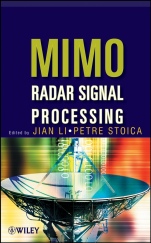
MIMO Radar Signal Processing
ISBN 9780470178980
Autor: Jian Li, Petre Stoica
Wydawca: Wiley
Dostępność: 3-6 tygodni
Cena: 736,05 zł
Przed złożeniem zamówienia prosimy o kontakt mailowy celem potwierdzenia ceny.
ISBN13: |
9780470178980 |
ISBN10: |
0470178981 |
Autor: |
Jian Li, Petre Stoica |
Oprawa: |
Hardback |
Rok Wydania: |
2008-10-31 |
Ilość stron: |
448 |
Wymiary: |
242x157 |
Tematy: |
TJ |
The first book to present a systematic and coherent picture of MIMO radars
Due to its potential to improve target detection and discrimination capability, Multiple–Input and Multiple–Output (MIMO) radar has generated significant attention and widespread interest in academia, industry, government labs, and funding agencies. This important new work fills the need for a comprehensive treatment of this emerging field.
Edited and authored by leading researchers in the field of MIMO radar research, this book introduces recent developments in the area of MIMO radar to stimulate new concepts, theories, and applications of the topic, and to foster further cross–fertilization of ideas with MIMO communications. Topical coverage includes:
Adaptive MIMO radar
Beampattern analysis and optimization for MIMO radar
MIMO radar for target detection, parameter estimation, tracking,association, and recognition
MIMO radar prototypes and measurements
Space–time codes for MIMO radar
Statistical MIMO radar
Waveform design for MIMO radar
Written in an easy–to–follow tutorial style, MIMO Radar Signal Processing serves as an excellent course book for graduate students and a valuable reference for researchers in academia and industry.
Spis treści:
PREFACE.
CONTRIBUTORS.
1 MIMO Radar — Diversity Means Superiority (Jian Li and Petre Stoica).
1.1 Introduction.
1.2 Problem Formulation.
1.3 Parameter Identifiability.
1.4 Nonparametric Adaptive Techniques for Parameter Estimation.
1.5 Parametric Techniques for Parameter Estimation.
1.6 Transmit Beampattern Designs.
1.7 Conclusions.
Appendix IA Generalized Likelihood Ratio Test.
Appendix 1B Lemma and Proof.
Acknowledgments.
References.
2 MIMO Radar: Concepts, Performance Enhancements, and Applications (Keith W. Forsythe and Daniel W. Bliss).
2.1 I
ntroduction.
2.2 Notation.
2.3 MIMO Radar Virtual Aperture.
2.4 MIMO Radar in Clutter–Free Environments.
2.5 Optimality of MIMO Radar for Detection.
2.6 MIMO Radar with Moving Targets in Clutter: GMTI Radars.
2.7 Summary.
Appendix 2A A Localization Principle.
Appendix 2B Bounds on R(N).
Appendix 2C An Operator Norm Inequality.
Appendix 2D Negligible Terms.
Appendix 2E Bound on Eigenvalues.
Appendix 2F Some Inner Products.
Appendix 2G An Invariant Inner Product.
Appendix 2H Kro¨necker and Tensor Products.
Acknowledgments.
References.
3 Generalized MIMO Radar Ambiguity Functions (Geoffrey San Antonio, Daniel R. Fuhrmann, and Frank C. Robey).
3.1 Introduction.
3.2 Background.
3.3 MIMO Signal Model.
3.4 MIMO Parametric Channel Model.
3.5 MIMO Ambiguity Function.
3.6 Results and Examples.
3.7 Conclusion.
References.
4 Performance Bounds and Techniques for Target Localization Using MIMO Radars (Joseph Tabrikian).
4.1 Introduction.
4.2 Problem Formulation.
4.3 Properties.
4.4 Target Localization.
4.5 Performance Lower Bound for Target Localization.
4.6 Simulation Results.
4.7 Discussion and Conclusions.
Appendix 4A Log–Likelihood Derivation.
Appendix 4B Transmit–Receive Pattern Derivation.
Appendix 4C Fisher Information Matrix Derivation.
References.
5 Adaptive Signal Design For MIMO Radars (Benjamin Friedlander).
5.1 Introduction.
5.2 Problem Formulation.
5.3 Estimation.
5.4 Detection.
5.5 MIMO Radar and Phased Arrays.
Appendix 5A Theoretical SINR Calculation.
References.
6 MIMO Radar Spacetime Adaptive Processing and Signal Design (Chun–Yang Chen and P. P. Vaidyanathan).
6.1 Introduction.
6.2 The Virtual Array Concept.
6.3 Spacetime Adaptive Processing in MIMO Radar.
6.4 Clutter Subspace in MIMO Radar.
6.5 New STAP Method for MIMO Radar.
6.6
Numerical Examples.
6.7 Signal Design of the STAP Radar System.
6.8 Conclusions.
Acknowledgments.
References.
7 Slow–Time MIMO SpaceTime Adaptive Processing (Vito F. Mecca, Dinesh Ramakrishnan, Frank C. Robey, and Jeffrey L. Krolik).
7.1 Introduction.
7.2 SIMO Radar Modeling and Processing.
7.3 Slow–Time MIMO Radar Modeling.
7.4 Slow–Time MIMO Radar Processing.
7.5 OTHr Propagation and Clutter Model.
7.6 Simulations Examples.
7.7 Conclusion.
Acknowledgment.
References.
8 MIMO as a Distributed Radar System (H. D. Griffiths, C. J. Baker, P. F. Sammartino, and M. Rangaswamy).
8.1 Introduction.
8.2 Systems.
8.3 Performance.
8.4 Conclusions.
Acknowledgment.
References.
9 Concepts and Applications of A MIMO Radar System with Widely Separated Antennas (Hana Godrich, Alexander M. Haimovich, and Rick S. Blum).
9.1 Background.
9.2 MIMO Radar Concept.
9.3 NonCoherent MIMO Radar Applications.
9.4 Coherent MIMO Radar Applications.
9.5 Chapter Summary.
Appendix 9A Deriving the FIM.
Appendix 9B Deriving the CRLB on the Location Estimate Error.
Appendix 9C MLE of Time Delays — Error Statistics.
Appendix 9D Deriving the Lowest GDOP for Special Cases.
Acknowledgments.
References.
10 SpaceTime Coding for MIMO Radar (Antonio De Maio and Marco Lops).
10.1 Introduction.
10.2 System Model.
10.3 Detection In MIMO Radars.
10.4 Spacetime Code Design.
10.5 The Interplay Between STC and Detection Performance.
10.6 Numerical Results.
10.7 Adaptive Implementation.
10.8 Conclusions.
Acknowledgment.
References.
INDEX.
Nota biograficzna:
Jian Li, PhD, is Professor and Director of the Spectral Analysis Laboratory of the Department of Electrical and Computer Engineering at the University of Florida. She has coedited one book, coauthored one book and four book chapters, an
d published approximately 300 refereed technical conference contributions and journal papers, many of which are on topics related to array signal processing.
Petre Stoica, PhD, is Professor of System Modeling in the Information Technology Department at Uppsala University, Sweden. He has coedited two books, coauthored nine books, and published approximately 500 refereed technical conference contributions and journal papers, many of which are on topics related to array signal processing.
Okładka tylna:
The first book to present a systematic and coherent picture of MIMO radars
Due to its potential to improve target detection and discrimination capability, Multiple–Input and Multiple–Output (MIMO) radar has generated significant attention and widespread interest in academia, industry, government labs, and funding agencies. This important new work fills the need for a comprehensive treatment of this emerging field.
Edited and authored by leading researchers in the field of MIMO radar research, this book introduces recent developments in the area of MIMO radar to stimulate new concepts, theories, and applications of the topic, and to foster further cross–fertilization of ideas with MIMO communications. Topical coverage includes:
Adaptive MIMO radar
Beampattern analysis and optimization for MIMO radar
MIMO radar for target detection, parameter estimation, tracking,association, and recognition
MIMO radar prototypes and measurements
Space–time codes for MIMO radar
Statistical MIMO radar
Waveform design for MIMO radar
Written in an easy–to–follow tutorial style, MIMO Radar Signal Processing serves as an excellent course book for graduate students and a valuable reference for researchers in academia and industry.
Koszyk
Książek w koszyku: 0 szt.
Wartość zakupów: 0,00 zł
Informacje


Kontakt
Gambit
Centrum Oprogramowania
i Szkoleń Sp. z o.o.
Al. Pokoju 29b/22-24
31-564 Kraków
Siedziba Księgarni
ul. Kordylewskiego 1
31-542 Kraków
+48 12 410 5991
+48 12 410 5987
+48 12 410 5989
Subskrypcje
Administratorem danych osobowych jest firma Gambit COiS Sp. z o.o. Na podany adres będzie wysyłany wyłącznie biuletyn informacyjny.
Autoryzacja płatności

Informacje na temat autoryzacji płatności poprzez PayU.

© Copyright 2012: GAMBIT COiS Sp. z o.o. Wszelkie prawa zastrzeżone.
Projekt i wykonanie: Alchemia Studio Reklamy