


Wydawcy
Katalog tematyczny
- Archeologia (109)
- Ekonomia, finanse, business (13704)
- Filozofia (1445)
- Historia (3040)
- Języki i językoznawstwo (2356)
- Lifestyle, hobby i rozrywka (475)
- Medycyna (9704)
- Chirurgia (272)
- Inne gałęzie medycyny (1871)
- Medycyna kliniczna (4187)
- Medycyna niekonwencjonalna (14)
- Medycyna przedkliniczna (269)
- Medycyna, ogólnie (1740)
- Medyczne służby pomocnicze (745)
- Studia medyczne (16)
- Weterynaria (548)
- Nauki humanistyczne (4)
- Nauki o Ziemi i środowisku (2638)
- Nauki ścisłe (20412)
- Nauki społeczne (8486)
- Nauki techniczne (13450)
- Prawo (1696)
- Publikacje informacyjne i interdyscyplinarne (1288)
- Religia i wierzenia (917)
- Technika komputerowa (4067)
- Zdrowie, relacje międzyludzkie i rozwój osobisty (657)





Informacje szczegółowe o książce
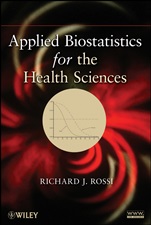
Applied Biostatistics for the Health Sciences
ISBN 9780470147641
Autor: Richard J. Rossi
Wydawca: Wiley
Dostępność: 3-6 tygodni
Cena: 730,80 zł
Przed złożeniem zamówienia prosimy o kontakt mailowy celem potwierdzenia ceny.
ISBN13: |
9780470147641 |
ISBN10: |
0470147644 |
Autor: |
Richard J. Rossi |
Oprawa: |
Hardback |
Rok Wydania: |
2010-01-15 |
Ilość stron: |
664 |
Wymiary: |
265x184 |
Tematy: |
MFN |
An authoritative, yet accessible, introduction to essential key methods used in the statistical analysis of data in the health sciences
Applied Biostatistics for the Health Sciences successfully introduces readers to the basic ideas and modeling approaches used in biostatistics through both step–by–step explanations and the use of data from the latest research in the field. By focusing on the correct use and interpretation of statistics rather than computation, this book covers a wide range of modern statistical methods without requiring a high level of mathematical preparation.
The book promotes a primary emphasis on the correct usage, interpretation, and conceptual ideas associated with each presented concept. The author begins with a discussion of basic biostatistical methods used to describe sample data arising in biomedical or health–related studies. Subsequent chapters explore numerous modeling approaches used with biomedical and health care data, including simple and multiple regression, logistic regression, experimental design, and survival analysis, Combined with a focus on the importance of constructing and implementing well–designed sampling plans, the book outlines the importance of assessing the quality of observed data, collecting quality data, and using confidence intervals in conjunction with hypothesis and significance tests.
Composed of extensively class–tested material, the book contains numerous pedagogical features that assist readers with a complete understanding of the presented concepts. Key formulae, procedures, and definitions are highlighted in enclosed boxes, and a glossary at the end of each chapter reviews key terminology and ideas. Worked–out examples and exercises illustrate important concepts and the proper use of statistical methods using MINITAB® output, and the examples in each section showcase the relevance of the discussed topics in modern re
search. A related Web site houses all of the data related to the book’s case studies and exercises.
Applied Biostatistics for the Health Sciences is an excellent introductory book for health science and biostatistics courses at the undergraduate and graduate levels. It is also a valuable resource for practitioners and professionals in the fields of pharmacy, biochemistry, nursing, health care informatics, and the applied health sciences.
Spis treści:
Preface.
Chapter 1 Introduction to Biostatistics.
1.1 What is Biostatistics?
1.2 Populations, Samples, and Statistics.
1.3 Clinical Trials.
1.4 Data Set Descriptions.
Glossary.
Exercises.
Chapter 2 Describing Populations.
2.1 Populations and Variables.
2.2 Population Distributions and Parameters.
2.3 Probability.
2.4 Probability Models.
Glossary.
Exercises.
Chapter 3 Random Sampling.
3.1 Obtaining Representative Data.
3.2 Commonly Used Sampling Plans.
3.3 Determining the Sample Size.
Glossary.
Exercises.
Chapter 4 Summarizing Random Samples.
4.1 Samples and Inferential Statistics.
4.2 Inferential Graphical Statistics.
4.3 Numerical Statistics for Univariate Datasets.
4.4 Statistics for Multivariate Data Sets.
Glossary.
Exercises.
Chapter 5 Measuring the Reliability of Statistics.
5.1 Sampling Distributions.
5.2 The Sampling Distribution of a Sample Proportion.
5.3 The Sampling Distribution of x .
5.4 Comparisons Based on Two Samples.
5.5 Bootstrapping the Sampling Distribution of a Statistic.
Glossary.
Exercises.
Chapter 6 Confidence Intervals.
6.1 Interval Estimation.
6.2 Confidence Intervals.
6.3 Single Sample Confidence Intervals.
6.4 Bootstrap Confidence Intervals.
6.5 Two Sample Comparative Confidence Intervals.
Glossary.
Exercises.
Chapter 7 Testing Statistical Hypotheses.
7.1 Hypothesis Tes
ting.
7.2 Testing Hypotheses about Proportions.
7.3 Testing Hypotheses about Means.
7.4 Some Final Comments on Hypothesis Testing.
Glossary.
Exercises.
Chapter 8 Simple Linear Regression.
8.1 Bivariate Data, Scatterplots, and Correlation.
8.2 The Simple Linear Regression Model.
8.3 Fitting a Simple Linear Regression Model.
8.4 Assessing the Assumptions and Fit of a Simple Linear Regression Model.
8.5 Statistical Inferences based on a Fitted Model.
8.6 Inferences about the Response Variable.
8.7 Some Final Comments on Simple Linear Regression.
Glossary.
Exercises.
Chapter 9 Multiple Regression.
9.1 Investigating Multivariate Relationships.
9.2 The Multiple Linear Regression Model.
9.3 Fitting a Multiple Linear Regression Model.
9.4 Assessing the Assumptions of a Multiple Linear Regression Model.
9.5 Assessing the Adequacy of Fit of a Multiple Regression Model.
9.6 Statistical Inferences Based Multiple Regression Model.
9.7 Comparing Multiple Regression Models.
9.8 Multiple Regression Models with Categorical Variables.
9.9 Variable Selection Techniques.
9.10 Some Final Comments on Multiple Regression.
Glossary.
Exercises.
Chapter 10 Logistic Regression.
10.1 Odds and Odds Ratios.
10.2 The Logistic Regression Model.
10.3 Fitting a Logistic Regression Model.
10.4 Assessing the Fit of a Logistic Regression Model.
10.5 Statistical Inferences Based on a Logistic Regression Model.
10.6 Variable Selection.
10.7 Some Final Comments on Logistic Regression.
Glossary.
Exercises.
Chapter 11 Design of Experiments.
11.1 Experiments versus Observational Studies.
11.2 The Basic Principles of Experimental Design.
11.3 Experimental Designs.
11.4 Factorial Experiments.
11.5 Models for Designed Experiments.
11.6 Some Final Comments of Designed Experiments.
Glossary.
Exercises.
Chapter 12 Analysis of Variance.12.1 Single–Factor Analysis of Variance.
12.2 Randomized Block Analysis of Variance.
12.3 Multifactor Analysis of Variance.
12.4 Selecting the Number of Replicates in Analysis of Variance.
12.5 Some Final Comments on Analysis of Variance.
Glossary.
Exercises.
Chapter 13 Survival Analysis.
13.1 The Kaplan Meier Estimate of the Survival Function.
13.2 The Proportional Hazards Model.
13.3 Logistic Regression and Survival Analysis.
13.4 Some Final Comments on Survival Analysis.
Glossary.
Exercises.
References.
Appendix A.
Problem Solutions.
Index.
Nota biograficzna:
Richard J. Rossi, PhD, is Professor and Head of the Department of Mathematical Sciences at Montana Tech of the University of Montana. He has previously served as president of the Montana Chapter of the American Statistical Association (1996 and 2001) and as associate editor for Biometrics. Dr. Rossi has published journal articles in his areas of research interest, which include nonparametric density estimation, finite mixture models, and computational statistics.¿He is the author of Theorems, Corollaries, Lemmas, and Methods of Proof, also published by Wiley.
Okładka tylna:
An authoritative, yet accessible, introduction to essential key methods used in the statistical analysis of data in the health sciences
Applied Biostatistics for the Health Sciences successfully introduces readers to the basic ideas and modeling approaches used in biostatistics through both step–by–step explanations and the use of data from the latest research in the field. By focusing on the correct use and interpretation of statistics rather than computation, this book covers a wide range of modern statistical methods without requiring a high level of mathematical preparation.
The book promotes a primary emphasis on the correct usage, interpretation, and conceptual ideas associated w
ith each presented concept. The author begins with a discussion of basic biostatistical methods used to describe sample data arising in biomedical or health–related studies. Subsequent chapters explore numerous modeling approaches used with biomedical and health care data, including simple and multiple regression, logistic regression, experimental design, and survival analysis, Combined with a focus on the importance of constructing and implementing well–designed sampling plans, the book outlines the importance of assessing the quality of observed data, collecting quality data, and using confidence intervals in conjunction with hypothesis and significance tests.
Composed of extensively class–tested material, the book contains numerous pedagogical features that assist readers with a complete understanding of the presented concepts. Key formulae, procedures, and definitions are highlighted in enclosed boxes, and a glossary at the end of each chapter reviews key terminology and ideas. Worked–out examples and exercises illustrate important concepts and the proper use of statistical methods using MINITAB® output, and the examples in each section showcase the relevance of the discussed topics in modern research. A related Web site houses all of the data related to the book’s case studies and exercises.
Applied Biostatistics for the Health Sciences is an excellent introductory book for health science and biostatistics courses at the undergraduate and graduate levels. It is also a valuable resource for practitioners and professionals in the fields of pharmacy, biochemistry, nursing, health care informatics, and the applied health sciences.
Koszyk
Książek w koszyku: 0 szt.
Wartość zakupów: 0,00 zł
Informacje


Kontakt
Gambit
Centrum Oprogramowania
i Szkoleń Sp. z o.o.
Al. Pokoju 29b/22-24
31-564 Kraków
Siedziba Księgarni
ul. Kordylewskiego 1
31-542 Kraków
+48 12 410 5991
+48 12 410 5987
+48 12 410 5989
Subskrypcje
Administratorem danych osobowych jest firma Gambit COiS Sp. z o.o. Na podany adres będzie wysyłany wyłącznie biuletyn informacyjny.
Autoryzacja płatności

Informacje na temat autoryzacji płatności poprzez PayU.

© Copyright 2012: GAMBIT COiS Sp. z o.o. Wszelkie prawa zastrzeżone.
Projekt i wykonanie: Alchemia Studio Reklamy