


Wydawcy
Katalog tematyczny
- Archeologia (109)
- Ekonomia, finanse, business (13704)
- Filozofia (1445)
- Historia (3040)
- Języki i językoznawstwo (2356)
- Lifestyle, hobby i rozrywka (475)
- Medycyna (9704)
- Nauki humanistyczne (4)
- Nauki o Ziemi i środowisku (2638)
- Nauki ścisłe (20412)
- Nauki społeczne (8486)
- Nauki techniczne (13450)
- Budownictwo lądowe (1045)
- Chemia przemysłowa (2258)
- Elektronika i telekomunikacja (3287)
- Energetyka (1122)
- Inne nauki stosowane (363)
- Inżynieria biochemiczna (507)
- Inżynieria transportu (232)
- Mechanika i materiały (3316)
- Nauka o środowisku (321)
- Rolnictwo (507)
- Technika, ogólnie (475)
- Prawo (1696)
- Publikacje informacyjne i interdyscyplinarne (1288)
- Religia i wierzenia (917)
- Technika komputerowa (4067)
- Zdrowie, relacje międzyludzkie i rozwój osobisty (657)





Informacje szczegółowe o książce
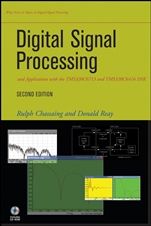
Digital Signal Processing and Applications with the TMS320C6713 and TMS320C6416 DSK
ISBN 9780470138663
Autor: Rulph Chassaing, Donald S. Reay
Wydawca: Wiley
Dostępność: 3-6 tygodni
Cena: 768,60 zł
Przed złożeniem zamówienia prosimy o kontakt mailowy celem potwierdzenia ceny.
ISBN13: |
9780470138663 |
ISBN10: |
0470138661 |
Autor: |
Rulph Chassaing, Donald S. Reay |
Oprawa: |
Hardback |
Rok Wydania: |
2008-05-23 |
Numer Wydania: |
2nd Edition |
Ilość stron: |
608 |
Wymiary: |
256x186 |
Tematy: |
TJ |
Now in a new edition—the most comprehensive, hands–on introduction to digital signal processing
The first edition of Digital Signal Processing and Applications with the TMS320C6713 and TMS320C6416 DSK is widely accepted as the most extensive text available on the hands–on teaching of Digital Signal Processing (DSP). Now, it has been fully updated in this valuable Second Edition to be compatible with the latest version (3.1) of Texas Instruments Code Composer Studio (CCS) development environment. Maintaining the original′s comprehensive, hands–on approach that has made it an instructor′s favorite, this new edition also features:
Added program examples that illustrate DSP concepts in real–time and in the laboratory
Expanded coverage of analog input and output
New material on frame–based processing
A revised chapter on IIR, which includes a number of floating–point example programs that explore IIR filters more comprehensively
More extensive coverage of DSP/BIOS
All programs listed in the text—plus additional applications—which are available on a companion CD–ROM
No other book provides such an extensive or comprehensive set of program examples to aid instructors in teaching DSP in a laboratory using audio frequency signals—making this an ideal text for DSP courses at the senior undergraduate and postgraduate levels. It also serves as a valuable resource for researchers, DSP developers, business managers, and technology solution providers who are looking for an overview and examples of DSP algorithms implemented using the TMS320C6713 and TMS320C6416 DSK.
Spis treści:
Preface to second edition.
Preface.
List of Examples.
Programs/Files on Accompanying CD.
1. DSP Development System.
1.1 Introduction.
1.2 DSK SUPPORT TOOLS.
1.2.1 C6713 and C6416 DSK Boards.
1.2.2 TMS320C6713 Digital Signal Processor.
1.2.3 TMS320C6416 Digital Signal Processor.
1.3 CODE COMPOSER STUDIO.
1.3.1 CCS version 3.1 Installation and Support.
1.3.2 Installation of Files Supplied with this Book.
1.3.3 File Types.
1.4 QUICK TESTS OF THE DSK (on power on and using CCS).
1.5 PROGRAMMING EXAMPLES TO TEST THE DSK TOOLS.
1.6 SUPPORT FILES.
1.6.1 Initialization/Communication File (c6713dskinit.c).
1.6.2 Header file (c6713dskinit.h).
1.6.3 Vector Files (vectors—intr.asm, vectors—poll.asm).
1.6.4 Linker Command File (c6713dsk.cmd).
1.7 ASSIGNMENTS.
REFERENCES.
2. Input and Output with the DSK.
2.1 INTRODUCTION.
2.2 TLV320AIC23 (AIC23) ONBOARD STEREO CODEC FOR INPUT AND OUTPUT.
2.3 PROGRAMMING EXAMPLES USING C CODE.
2.4 ASSIGNMENTS.
REFERENCES.
3. Architecture and Instruction Set of the C6x Processor.
3.1 Introduction.
3.2 TMS320C6x Architecture.
3.3 Functional Units.
3.4 Fetch and Execute Packets.
3.5 Pipelining.
3.6 Registers.
3.7 Linear and Circular Addressing Modes.
3.7.1 Indirect Addressing.
3.7.2 Circular Addressing.
3.8 TMS320C6x Instruction Set.
3.8.1 Assembly Code Format.
3.8.2 Types of Instructions.
3.9 Assembler Directives.
3.10 Linear Assembly.
3.11 ASM Statement within C.
3.12 C–Callable Assembly Function.
3.13 Timers.
3.14 Interrupts.
3.14.1 Interrupt Control Registers.
3.14.2 Interrupt Acknowledgment.
3.15 Multichannel Buffered Serial Ports.
3.16 Direct Memory Access.
3.17 Memory Considerations.
3.17.1 Data Allocation.
3.17.2 Data Alignment.
3.17.3 Pragma Directives.
3.17.4 Memory Models.
3.18 Fixed– and Floating–Point Format.
3.18.1 Data Types.
3.18.2 Floating–Point Format.
3.18.3 Division.
3.19 Code Improvement.
3.19.1 Intrinsics.
3.19.2 Trip Directive for Loop Count.
3.19.3 Cross–Paths.
3.19.4 Software Pipelining.
3.20 Constraints.
3.20.1 Memory Constraints.
3.20.2 Cross–Path Constraints.
3.20.3 Load/Store Constraints.
3.20.4 Pipelining Effects with More Than One EP within an FP.
3.21 Programming Examples Using C, Assembly, and Linear Assembly.
3.22 Assignments.
References.
4. Finite Impulse Response Filters.
4.1 Introduction to the z–Transform.
4.1.1 Mapping from s–Plane to z–Plane.
4.1.2 Difference Equations.
4.2 Discrete Signals.
4.3 FIR Filters.
4.4 FIR Lattice Structure.
4.5 FIR Implementation Using Fourier Series.
4.6 Window Functions.
4.6.1 Hamming Window.
4.6.2 Hanning Window.
4.6.3 Blackman Window.
4.6.4 Kaiser Window.
4.6.5 Computer–Aided Approximation.
4.7 Programming Examples Using C and ASM Code.
4.8 Assignments.
References.
5. Infinite Impulse Response Filters.
5.1 INTRODUCTION.
5.2 IIR FILTER STRUCTURES.
5.2.1 Direct Form I Structure.
5.2.2 Direct Form II Structure.
5.2.3 Direct Form II Transpose.
5.2.4 Cascade Structure.
5.2.5 Parallel Form Structure.
5.3 BILINEAR TRANSFORMATION.
5.3.1 BLT Design Procedure.
5.4 PROGRAMMING EXAMPLES USING C AND ASM CODE.
5.5 Assignments.
REFERENCES.
6. Fast Fourier Transform.
6.1 Introduction.
6.2 Development of the FFT Algorithm with Radix–2.
6.3 Decimation–in–Frequency FFT Algorithm with Radix–2.
6.4 Decimation–in–Time FFT Algorithm with Radix–2.
6.5 Bit Reversal for Unscrambling.
6.6 Development of the FFT Algorithm with Radix–4.
6.7 Inverse Fast Fourier Transform.
6.8 Programming Examples.
6.8.1 FRAME–BASED PROCESSING.
6.8.2 Fast Convolution.
References.
7. Adaptive Filters.
7.1 Introduction.
7.2 Adaptive Structures.
7.3 Adaptive Linear Combiner.
7.4 Performance Function.
7.5 Searching for the Minimum.
7.6 Programming Examples for Noise Cancell
ation and System Identification.
References.
8. Code Optimization.
8.1 Introduction.
8.2 Optimization Steps.
8.2.1 Compiler Options.
8.2.2 Intrinsic C Functions.
8.3 Procedure for Code Optimization.
8.4 Programming Examples Using Code Optimization Techniques.
8.5 Software Pipelining for Code Optimization.
8.5.1 Procedure for Hand–Coded Software Pipelining.
8.5.2 Dependency Graph.
8.5.3 Scheduling Table.
8.6 Execution Cycles for Different Optimization Schemes.
References.
9. DSP/BIOS and RTDX Using MATLAB, Visual C++, Visual Basic, and LabView.
9.1 INTRODUCTION TO DSP/BIOS.
9.1.1 Periodic Functions.
9.1.2 Hardware Interrupts.
9.1.3 Real–Time Analysis with DSP/BIOS.
9.1.4 Software Interrupts.
9.2 RTDX Using MATLAB to Provide Interface Between PC and DSK.
9.3 RTDX Using Visual C++ to Interface with DSK.
9.4 RTDX Using Visual Basic to Provide Interface Between PC and DSK.
9.5 RTDX Using LabVIEW to Provide Interface Between PC and DSK.
Acknowledgments.
References.
10. DSP Applications and Student Projects.
10.1 DTMF Detection Using Correlation, FFT, and Goertzel Algorithm.
10.1.1 Using a Correlation Scheme and Onboard LEDs for Verifying Detection.
10.1.2 Using RTDX with Visual C++ to Display Detected DTMF Signals on the PC.
10.1.3 Using FFT and Onboard LEDs for Verifying Detection.
10.1.4 Using Goertzel Algorithm.
10.2 Beat Detection Using Onboard LEDs.
10.3 FIR with RTDX Using Visual C++ for Transfer of Filter Coefficients.
10.4 Radix–4 FFT with RTDX Using Visual C++ and MATLAB for Plotting.
10.5 Spectrum Display Through EMIF Using a Bank of 32 LEDs.
10.6 Spectrum Display Through EMIF Using LCDs.
10.7 Time–Frequency Analysis of Signals with Spectrogram.
10.7.1 Simulation Using MATLAB.
10.7.2 Spectrogram with RTDX Using MATLAB.
10.7.3 Spectrogram with RTDX Using Visual C++.
10.8 Audio Effects (Echo and
Koszyk
Książek w koszyku: 0 szt.
Wartość zakupów: 0,00 zł
Informacje


Kontakt
Gambit
Centrum Oprogramowania
i Szkoleń Sp. z o.o.
Al. Pokoju 29b/22-24
31-564 Kraków
Siedziba Księgarni
ul. Kordylewskiego 1
31-542 Kraków
+48 12 410 5991
+48 12 410 5987
+48 12 410 5989
Subskrypcje
Administratorem danych osobowych jest firma Gambit COiS Sp. z o.o. Na podany adres będzie wysyłany wyłącznie biuletyn informacyjny.
Autoryzacja płatności

Informacje na temat autoryzacji płatności poprzez PayU.

© Copyright 2012: GAMBIT COiS Sp. z o.o. Wszelkie prawa zastrzeżone.
Projekt i wykonanie: Alchemia Studio Reklamy