


Wydawcy
Katalog tematyczny
- Archeologia (109)
- Ekonomia, finanse, business (13704)
- Filozofia (1445)
- Historia (3040)
- Języki i językoznawstwo (2356)
- Lifestyle, hobby i rozrywka (475)
- Medycyna (9704)
- Nauki humanistyczne (4)
- Nauki o Ziemi i środowisku (2638)
- Nauki ścisłe (20412)
- Nauki społeczne (8486)
- Nauki techniczne (13450)
- Budownictwo lądowe (1045)
- Chemia przemysłowa (2258)
- Elektronika i telekomunikacja (3287)
- Energetyka (1122)
- Inne nauki stosowane (363)
- Inżynieria biochemiczna (507)
- Inżynieria transportu (232)
- Mechanika i materiały (3316)
- Nauka o środowisku (321)
- Rolnictwo (507)
- Technika, ogólnie (475)
- Prawo (1696)
- Publikacje informacyjne i interdyscyplinarne (1288)
- Religia i wierzenia (917)
- Technika komputerowa (4067)
- Zdrowie, relacje międzyludzkie i rozwój osobisty (657)





Informacje szczegółowe o książce
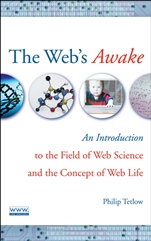
The Webs Awake: An Introduction to the Field of Web Science and the Concept of Web Life
ISBN 9780470137949
Autor: Philip D. Tetlow
Wydawca: Wiley
Dostępność: 3-6 tygodni
Cena: 387,45 zł
Przed złożeniem zamówienia prosimy o kontakt mailowy celem potwierdzenia ceny.
ISBN13: |
9780470137949 |
ISBN10: |
0470137940 |
Autor: |
Philip D. Tetlow |
Oprawa: |
Hardback |
Rok Wydania: |
2007-05-25 |
Ilość stron: |
264 |
Wymiary: |
245x168 |
Tematy: |
TJ |
A fascinating perspective on what the Web is and what it will be
Has the World Wide Web evolved into a new life form? The author of this provocative book, Philip Tetlow, presents a very compelling argument that it indeed has.
Drawing from theories originating in the natural sciences, mathematics, and information technology, The Web′s Awake explores how the continued growth and increasing complexity of the Web are quickly outstripping our capability to control it. In other words, the Web has quite literally taken on a life of its own.
Stringently researched and clearly presented, the book examines a number of emergent characteristics and behaviors of the Web that have not been programmed, but rather have evolved. As the number and strength of these new Web characteristics and behaviors continue to increase, the author persuasively argues that the Web should be considered a living organism in its own right, a new post–human species consisting of a single member.
Having established a new understanding of what the Web is, the author next offers a remarkable perspective on how the Web is evolving towards independence. He further argues that understanding the Web′s evolution as an act of nature enables us to better harness the Web′s resources for the good of society.
While researchers in the emerging field of Web science have attempted to categorize what the Web is, this book takes a radically new approach that will change your understanding of the very nature and essence of the Web—what it is and where it is heading. Whether your interest lies in computing, information technology, evolution, physics, or biology, the author′s clearly written, plain–English arguments are fascinating material for thought.
Spis treści:
Foreword.
Preface.
Acknowledgments.
Prologue.
CHAPTER 1 THE WEB AND LIFE.
Introduction.
Almost None of This Is New.
Where to Begin?—
Web Misconceptions and Folklore.
Our Understandings of the Web.
Power of the People.
The Dark Side of the Force.
What Would a Web Be Without the Holes?
Structure Abounds.
Four Dimensions Are Not Enough.
Our Understandings of Life.
Life’s Playground—A Universe of Infinite Possibilities.
Enquiries into the Definition of Life.
More Contemporary Viewpoints on Life.
CHAPTER 2 THE SPECTRUM OF COMPLEXITY.
A Complex Web.
The Natural Mix of Order and Disorder.
Emergence—The Complexity Sweet Spot.
Mankind, Complexity, and Our Attempts to Understand the Unreal.
Could You Repeat That Please?
Self–Similarity and Recursion.
Back to Measures of Complexity.
The Theory of Complexity.
The Crossover Between Orderly and Chaotic Systems.
Onwards to Chaos.
Modern–Day Approaches to Complexity.
CHAPTER 3 THE IMPORTANCE OF DISCRETENESS AND SYMMETRY IN SYSTEMS.
Let’s Be Discrete.
A Brief Word of Warning.
Boiling the Numbers Out of Computing.
The Power of Two.
Let’s Split the Difference.
Symmetry in Systems.
CHAPTER 4 NATURAL STRUCTURES FOR MAN–MADE MACHINES— CURVATURE IN INFORMATION AND COMPUTATION.
Engineering Problems.
Arrows Everywhere—Graph Theory and Feynman–Like Diagrams.
Relays and Switches by Any Other Name.
Differentiation Through Divergence.
Relationships and Twisting Sequences.
Growth Spirals, Fibonacci Progressions, and Other Sequential Patterns.
L–Systems.
Information Compression and Maximization in Biological Systems.
Degrees of Freedom and Information Representation in Biological Systems.
A More Detailed Account of DNA’s Structure.
More Evidence of Efficiency at Play in DNA and Higher Levels of Physiology.
Books, Bytes, Computers, and Biological Systems—An Analogy.
CHAPTER 5 POSITIONAL INFORMATION AND SCALE–FREE NETWORK
S.
A Right Place for Everything.
What Is Information Anyway?
A Bow to Tie Coincidence Together.
Why Is Kevin Bacon so Important?
Scale–Free Networks.
The Web’s Body Mass.
DNA as an Ontogenetic Database.
Back to Gödel—Compression, Keys, Catalysts, and Restrictors.
CHAPTER 6 EVOLUTION THROUGH ENGINEERING.
Some Key Questions Still Remain.
Memes and Universal Darwinism.
Boolean Logic, Regulatory Networks, and New Forms of Life.
Binary Biological Machines.
nK Networks.
“X” as a Canonical Super Pattern.
Autocatalytic Sets.
CHAPTER 7 A LESS–THAN–SIMPLE MATTER OF BOUNDLESS ORGANICS.
Open Worlds, Feedback, and Critical Self–Organization.
Gödel, Incompleteness, and Maintenance Through Changing Boundaries.
An Abstractionless Universe.
Self–Sustaining, Self–Organizing Systems.
CHAPTER 8 EMERGENT INTELLIGENCE AND POSTHUMAN CONCEPTS.
Why on the Web?
Technology Lock–In.
Swarm Behavior.
Artificial Life.
The Swarm Being that Is the Web.
The Web’s Core Memory and Its Place in Information Value.
The Apparent Failure of Artificial Intelligence.
Posthuman Philosophies and Collective Consciousness.
The Penrose Paradox.
CHAPTER 9 THE PHYSICS OF INFORMATION AND COMPUTING.
The Attraction of “Why” and the Ubiquity of Complexity as a Metaproperty.
Spin Glass.
Quantum Comparisons.
More about Dimensions.
Strange Loops, Spin Networks, and Problems with the Web’s Constitution.
Computational Duality.
The Web’s Superposition.
Could Penrose Be Right After All?
Quantum Brains.
One Big Spiny String Thing.
Quantum Darwinism.
CHAPTER 10 COUNTER ARGUMENTS.
All Those Against.
Computing the Incomputable.
Observation and Practicality in Computation.
Spaceships Can Come in Handy.
When Is a Curve not a Curve, Wh
en Is a Brain not a Brain?
A Matter of What, not How.
CHAPTER 11 OBJECTIVE OPINIONS.
Opinions of the Uber–Geeks.
Are We Right to Talk about a Global “Brain”?
Over the Horizon.
A Final Sprinkle of Philosophy.
APPENDIX A AN OUTLINE OF THE SEMANTIC WEB AND ITS POTENTIAL FOR SOFTWARE ENGINEERING.
Blue Chips.
Semantic Web Technologies Make the Web’s Meaning Much More Specific.
Autonomic Systems and Software Engineering.
The Future of Software Engineering Lies with Discovery.
Smushing.
Runtime Autonomic Semantic Applications.
StumbleUpon.
APPENDIX B BEYOND THE SEMANTIC WEB.
Overlaps.
A Semantic Web Primer for Object–Oriented Software Practitioners.
References.
Index.
About the Author.
Nota biograficzna:
Philip Tetlow is a Senior Certified IT Architect in IBM′s Global Business Services Division, a Chartered Engineer, and an Open Group Master IT Architect. He has more than twenty years of experience in the IT industry, specializing in the application of Web–based technologies, metadata, and transformation techniques on large central government systems. He is a member of the World Wide Web Consortium and was responsible for coordinating its task force on the application of the semantic Web in software engineering.
Okładka tylna:
A fascinating perspective on what the Web is and what it will be
Has the World Wide Web evolved into a new life form? The author of this provocative book, Philip Tetlow, presents a very compelling argument that it indeed has.
Drawing from theories originating in the natural sciences, mathematics, and information technology, The Web′s Awake explores how the continued growth and increasing complexity of the Web are quickly outstripping our capability to control it. In other words, the Web has quite literally taken on a life of its own.
Stringe
Koszyk
Książek w koszyku: 0 szt.
Wartość zakupów: 0,00 zł
Informacje


Kontakt
Gambit
Centrum Oprogramowania
i Szkoleń Sp. z o.o.
Al. Pokoju 29b/22-24
31-564 Kraków
Siedziba Księgarni
ul. Kordylewskiego 1
31-542 Kraków
+48 12 410 5991
+48 12 410 5987
+48 12 410 5989
Subskrypcje
Administratorem danych osobowych jest firma Gambit COiS Sp. z o.o. Na podany adres będzie wysyłany wyłącznie biuletyn informacyjny.
Autoryzacja płatności

Informacje na temat autoryzacji płatności poprzez PayU.

© Copyright 2012: GAMBIT COiS Sp. z o.o. Wszelkie prawa zastrzeżone.
Projekt i wykonanie: Alchemia Studio Reklamy