


Wydawcy
Katalog tematyczny
- Archeologia (1)
- Ekonomia, finanse, business (698)
- Filozofia (20)
- Historia (57)
- Języki i językoznawstwo (4)
- Lifestyle, hobby i rozrywka (32)
- Medycyna (1025)
- Nauki humanistyczne (2)
- Nauki o Ziemi i środowisku (430)
- Nauki ścisłe (1680)
- Nauki społeczne (1297)
- Nauki techniczne (530)
- Prawo (1437)
- Publikacje informacyjne i interdyscyplinarne (32)
- Religia i wierzenia (15)
- Technika komputerowa (237)
- Zdrowie, relacje międzyludzkie i rozwój osobisty (4)





Informacje szczegółowe o książce
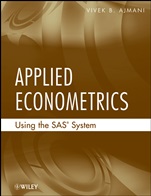
Applied Econometrics Using the SAS System
ISBN 9780470129494
Autor: Vivek Ajmani
Wydawca: Wiley
Dostępność: 3-6 tygodni
Cena: 508,20 zł
Przed złożeniem zamówienia prosimy o kontakt mailowy celem potwierdzenia ceny.
ISBN13: |
9780470129494 |
ISBN10: |
0470129492 |
Autor: |
Vivek Ajmani |
Oprawa: |
Paperback |
Rok Wydania: |
2009-07-03 |
Ilość stron: |
328 |
Wymiary: |
278x214 |
Tematy: |
KC |
The first cutting–edge guide to using the SAS® system for the analysis of econometric data
Applied Econometrics Using the SAS® System is the first book of its kind to treat the analysis of basic econometric data using SAS®, one of the most commonly used software tools among today′s statisticians in business and industry. This book thoroughly examines econometric methods and discusses how data collected in economic studies can easily be analyzed using the SAS® system.
In addition to addressing the computational aspects of econometric data analysis, the author provides a statistical foundation by introducing the underlying theory behind each method before delving into the related SAS® routines. The book begins with a basic introduction to econometrics and the relationship between classical regression analysis models and econometric models. Subsequent chapters balance essential concepts with SAS® tools and cover key topics such as:
Regression analysis using Proc IML and Proc Reg
Hypothesis testing
Instrumental variables analysis, with a discussion of measurement errors, the assumptions incorporated into the analysis, and specification tests
Heteroscedasticity, including GLS and FGLS estimation, group–wise heteroscedasticity, and GARCH models
Panel data analysis
Discrete choice models, along with coverage of binary choice models and Poisson regression
Duration analysis models
Assuming only a working knowledge of SAS®, this book is a one–stop reference for using the software to analyze econometric data. Additional features include complete SAS® code, Proc IML routines plus a tutorial on Proc IML, and an appendix with additional programs and data sets. Applied Econometrics Using the SAS® System serves as a relevant and valuable reference for practitioners in the fields of business, economics, and finance. In addition, most students
of econometrics are taught using GAUSS and STATA, yet SAS® is the standard in the working world; therefore, this book is an ideal supplement for upper–undergraduate and graduate courses in statistics, economics, and other social sciences since it prepares readers for real–world careers.
Spis treści:
Preface.
Acknowledgments.
1 Introduction to Regression Analysis.
1.1 Introduction.
1.2 Matrix Form of the Multiple Regression Model.
1.3 Basic Theory of Least Squares.
1.4 Analysis of Variance.
1.5 The Frisch–Waugh Theorem.
1.6 Goodness of Fit.
1.7 Hypothesis Testing and Confidence Intervals.
1.8 Some Further Notes.
2 Regression Analysis Using Proc IML and Proc Reg.
2.1 Introduction.
2.2 Regression Analysis Using Proc IML.
2.3 Analyzing the Data Using Proc Reg.
2.4 Extending the Investment Equation Model to the Complete Data Set.
2.5 Plotting the Data.
2.6 Correlation Between Variables.
2.7 Predictions of the Dependent Variable.
2.8 Residual Analysis.
2.9 Multicollinearity.
3 Hypothesis Testing.
3.1 Introduction.
3.2 Using SAS to Conduct the General Linear Hypothesis.
3.3 The Restricted Least Squares Estimator.
3.4 Alternative Methods of Testing the General Linear Hypothesis.
3.5 Testing for Structural Breaks in Data.
3.6 The CUSUM Test.
3.7 Models with Dummy Variables.
4 Instrumental Variables.
4.1 Introduction.
4.2 Omitted Variable Bias.
4.3 Measurement Errors.
4.4 Instrumental Variable Estimation.
4.5 Specification Tests.
5 Nonspherical Disturbances and Heteroscedasticity.
5.1 Introduction.
5.2 Nonspherical Disturbances.
5.3 Detecting Heteroscedasticity.
5.4 Formal Hypothesis Tests to Detect Heteroscedasticity.
5.5 Estimation of b Revisited.
5.6 Weighted Least Squares and FGLS Estimation.
5.7 Autoregressive Conditional Heteroscedasticity.
6 Autocorrel
ation.
6.1 Introduction.
6.2 Problems Associated with OLS Estimation Under Autocorrelation.
6.3 Estimation Under the Assumption of Serial Correlation.
6.4 Detecting Autocorrelation.
6.5 Using SAS to Fit the AR Models.
7 Panel Data Analysis.
7.1 What is Panel Data?
7.2 Panel Data Models.
7.3 The Pooled Regression Model.
7.4 The Fixed Effects Model
7.5 Random Effects Models..
8 Systems of Regression Equations.
8.1 Introduction.
8.2 Estimation Using Generalized Least Squares.
8.3 Special Cases of the Seemingly Unrelated Regression Model.
8.4 Feasible Generalized Least Squares.
9 Simultaneous Equations.
9.1 Introduction.
9.2 Problems with OLS Estimation.
9.3 Structural and Reduced Form Equations.
9.4 The Problem of Identification.
9.5 Estimation of Simultaneous Equation Models.
9.6 Hausman’s Specification Test.
10 Discrete Choice Models.
10.1 Introduction.
10.2 Binary Response Models.
10.3 Poisson Regression.
11 Duration Analysis.
11.1 Introduction.
11.2 Failure Times and Censoring.
11.3 The Survival and Hazard Functions.
11.4 Commonly Used Distribution Functions in Duration Analysis.
11.5 Regression Analysis with Duration Data.
12 Special Topics.
12.1 Iterative FGLS Estimation Under Heteroscedasticity.
12.2 Maximum Likelihood Estimation Under Heteroscedasticity.
12.3 Harvey’s Multiplicative Heteroscedasticity.
12.4 Groupwise Heteroscedasticity.
12.5 Hausman–Taylor Estimator for the Random Effects Model.
12.6 Robust Estimation of Covariance Matrices in Panel Data.
12.7 Dynamic Panel Data Models.
12.8 Heterogeneity and Autocorrelation in Panel Data Models.
12.9 Autocorrelation in Panel Data.
Appendix A Basic Matrix Algebra for Econometrics.
B.1 Assigning Scalars.
Appendix C Simulating the Large Sample Properties of the OLS Estimators.
Appendix D Introduction to Bootstr
ap Estimation.
Appendix E Complete Programs and Proc IML Routines.
References.
Index
Nota biograficzna:
Vivek B. Ajmani, PhD, is Senior Marketing Analyst at U.S. Bank in St. Paul, Minnesota, where he applies econometric modeling, data mining, and predictive modeling techniques to his work with innovative banking products and solutions. Dr. Ajmani has also held positions at Ameriprise Financial, General Mills, Intel Corporation, and the 3M Company, and he has received honors for his use of statistics in the development of quality products.
Okładka tylna:
The first cutting–edge guide to using the SAS® system for the analysis of econometric data
Applied Econometrics Using the SAS® System is the first book of its kind to treat the analysis of basic econometric data using SAS®, one of the most commonly used software tools among today′s statisticians in business and industry. This book thoroughly examines econometric methods and discusses how data collected in economic studies can easily be analyzed using the SAS® system.
In addition to addressing the computational aspects of econometric data analysis, the author provides a statistical foundation by introducing the underlying theory behind each method before delving into the related SAS® routines. The book begins with a basic introduction to econometrics and the relationship between classical regression analysis models and econometric models. Subsequent chapters balance essential concepts with SAS® tools and cover key topics such as:
Regression analysis using Proc IML and Proc Reg
Hypothesis testing
Instrumental variables analysis, with a discussion of measurement errors, the assumptions incorporated into the analysis, and specification tests
Heteroscedasticity, including GLS and FGLS estimation, group–wise heteroscedasticity, and GARCH models
Panel data analysis
Di
Koszyk
Książek w koszyku: 0 szt.
Wartość zakupów: 0,00 zł
Informacje


Kontakt
Gambit
Centrum Oprogramowania
i Szkoleń Sp. z o.o.
Al. Pokoju 29b/22-24
31-564 Kraków
Siedziba Księgarni
ul. Kordylewskiego 1
31-542 Kraków
+48 12 410 5991
+48 12 410 5987
+48 12 410 5989
Subskrypcje
Administratorem danych osobowych jest firma Gambit COiS Sp. z o.o. Na podany adres będzie wysyłany wyłącznie biuletyn informacyjny.
Autoryzacja płatności

Informacje na temat autoryzacji płatności poprzez PayU.

© Copyright 2012: GAMBIT COiS Sp. z o.o. Wszelkie prawa zastrzeżone.
Projekt i wykonanie: Alchemia Studio Reklamy