


Wydawcy
Katalog tematyczny
- Archeologia (109)
- Ekonomia, finanse, business (13704)
- Filozofia (1445)
- Historia (3040)
- Języki i językoznawstwo (2356)
- Lifestyle, hobby i rozrywka (475)
- Medycyna (9704)
- Nauki humanistyczne (4)
- Nauki o Ziemi i środowisku (2638)
- Nauki ścisłe (20412)
- Nauki społeczne (8486)
- Nauki techniczne (13450)
- Prawo (1696)
- Publikacje informacyjne i interdyscyplinarne (1288)
- Religia i wierzenia (917)
- Technika komputerowa (4067)
- Zdrowie, relacje międzyludzkie i rozwój osobisty (657)





Informacje szczegółowe o książce
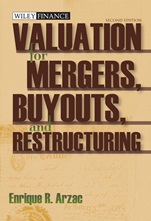
Valuation: Mergers, Buyouts and Restructuring
ISBN 9780470128893
Autor: Enrique R. Arzac
Wydawca: Wiley
Dostępność: 3-6 tygodni
Cena: 941,85 zł
Przed złożeniem zamówienia prosimy o kontakt mailowy celem potwierdzenia ceny.
ISBN13: |
9780470128893 |
ISBN10: |
0470128895 |
Autor: |
Enrique R. Arzac |
Oprawa: |
Hardback |
Rok Wydania: |
2007-12-21 |
Numer Wydania: |
2nd Edition |
Ilość stron: |
480 |
Wymiary: |
260x185 |
Tematy: |
KF |
Praise for Valuation for Mergers, Buyouts, and Restructuring
“Enrique Arzac has provided an excellent analytical framework for the LBO business.”—William T. Comfort, Chairman, Citigroup Venture Capital
“Enrique Arzac has created a masterpiece—his work combines the theoretical with the practical. He has created an invaluable reference guide that is thoughtful, complete and very user friendly. He provides insight into the theory behind core valuation, LBO’s, and options pricing, which creates the foundation for mergers, buyouts and restructuring. In addition to the theoretical, he provides practical insight into deal structuring and deal dynamics. His work should be standard material for all incoming associates.”—James P. McVeigh, Managing Director, Corporate & Investment Banking, Banc of America Securities
“This first–rate book of applied financial theory provides the tools for financial institutions and capital market participants seeking a methodology for comparing, contrasting, and evaluating investment opportunities and options. By incorporating over 30 years of research, teaching, and practical experience, Professor Arzac has created a text that us not only timely, but timeless in its usefulness to anyone interested in learning the applications of financial theory for the best and most useful allocation of the scarcest economic resource in the world—capital.”—William W. Priest, Co–Managing Partner, Steinberg, Priest and Sloane Capital Management and Former Chairman and CEO of Credit Suisse Asset Management
“There are two important aspects in graduate business education. The first is acquiring a thorough understanding of the theories of modern finance and the second is acquiring an appreciation for how these theories can be applied to important decisions. Enrique Arzac has taken on this task and made it a successful venture for readers of this boo
k. Unlike other texts on valuation, he explains the reasons for the process and sequence that he recommends rather than just providing the ingredients and the recipe without explanation. This is a welcome addition to the literature in applied corporate finance.”—Joel M. Stern, Managing Partner, Stern, Stewart & Co.
Spis treści:
Part One: The Tools of Valuation.
1. A User′s Guide.
1.1. Valuation of Stand–Alone Firms and Business Units.
1.1.1 Free Cash–flow Valuation.
1.1.2 Cost of Capital.
1.1.3 Valuation Multiples.
1.2. Economic Value Added.
1.3. Valuation with Changing Capital Structure.
1.4. Valuation in Developed and Emerging Markets.
1.5. Mergers and Acquisitions.
1.6. Deal Design and Special Offer Structures.
1.7. Leveraged Buyouts.
1.8. Recapitalization of Troubled Companies.
1.9. Asset Restructuring.
1.10. Real Options: Valuing Entry and Exit Options.
1.10.1 Financial Options.
1.11. Technical Notes and Problems.
1.12. Valuation Aids and DealModeler® Software.
2. Forecasting and Valuation of Free Cash Flows.
2.1. Free Cash Flows.
2.2. Building a Financial Model.
2.3. Enterprise Valuation.
2.4. Continuation Value.
2.4.1 Forecast Consistency.
2.4.2 Forecasting FCFT.
2.4.3 A Wrong Way to Forecast Continuation Value.
2.4.4 Sensitivity to Parameter Estimates.
2.4.5 Competitive Advantage Period.
2.4.6 EBITDA Multiples.
2.5. An Equivalent Approach: Valuing the Cash Flow to Equity.
2.5.1 Decomposition of Free Cash Flows: Cash Flows to Equity and Debt.
2.5.2 Equity Valuation.
2.5.3 Debt Valuation.
2.5.4 Financial Policy and Dividends.
2.6. Some Practical Aspects.
2.6.1 Choosing the Valuation Method.
2.6.2 Personal Taxes and Enterprise Value.
2.6.3 Enterprise Value in Tax–imputation Countries.
2.6.4 Balance Sheet Adjustments.
2.6.5 Cash and M
arketable Securities.
2.6.6 Mid–year Discounting.
2.6.7 Dealing with Equity–linked and Other Securities in the Capital Structure.
2.6.8 Restructuring Expenses.
2.7. Analysis of Results: The Value of Franchise and Growth.
2.8 Summary.
Problems.
3. The Equity Premium and the Cost of Capital.
3.1. Estimating the Cost of Capital.
3.2. The Cost of Equity.
3.2.1 The Capital Asset Pricing Model Approach.
3.2.2 Choosing the Riskless Rate.
3.2.3 Estimating the Equity Premium: Historical Analyses.
3.2.4 Time Varying Equity Premium.
3.2.5 Prospective Equity Premium.
3.3. The Cost of Equity of Large Capitalization Companies.
3.4. The Cost of Equity and Leverage.
3.5. Beyond the Capital Asset Pricing Model.
3.5.1 The Original CAPM.
3.5.2 The Fama–French Three–factor Model.
3.5.3 Arbitrage Pricing Theory.
3.5.4 Liquidity and Expected Returns.
3.6. The Cost of Equity of Small Capitalization Companies.
3.7. Estimating the Cost of Equity: A Detailed Example.
3.8. The Cost of Debt and Other Components of the Capital Structure.
3.8.1 Investment–grade Debt.
3.8.2 High–yield Debt and Preferred Stock.
3.8.3 Convertible Securities, Warrants, and Other Options.
3.9. Estimation of the Cost of Capital in Practice.
3.10. Summary.
Problems.
4. Metrics and Multiples.
4.1. The Use of Multiples in Valuation.
4.2. Using Comparables: An Example.
4.3. Multiples and Continuation Value.
4.4. Relationships Among Valuation Multiples.
4.5. Adjusting Multiples for Leverage and Growth.
4.6. The Franchise Factor in Valuation Multiples.
4.7. Normalizing P/E Ratios by the Growth Rate.
4.8. Summary.
Problems.
5. Economic Value Added.
5.1. Measuring Value Creation.
5.2. Relation to Free Cash–Flow Valuation.
5.3. A Detailed Example of EVA Valuation.
5.4. The Sources of Value: Franchise and Growth.
5.5. Economic Va
lue–Added and Market Value.
5.6. Some Empirical Evidence.
5.7. Summary.
Problems.
6. Valuation with Changing Capital Structure.
6.1. Leverage Changes and Enterprise Value.
6.2. Adjusted Present Value and The Value of the Tax Shield.
6.3. A Detailed Example of APV Valuation.
6.4. Valuing an Acquisition with Leverage Above Target.
6.5. Recursive WACC Valuation.
6.6. Compressed APV.
6.7. Uncertain Leverage: A Recursive APV Model.
6.8. Valuing Equity as an Option.
6.9. Summary.
Problems.
7. Debt Capacity for Acquisition Financing.
7.1. Financial Interdependencies.
7.2. Financing Growth.
7.3. Growth via Acquisitions.
7.4. Sustainable Debt.
7.5. The Target Debt Ratio Assumed in WACC Valuation, Debt Capacity, and Interest Coverage.
7.6. Debt Capacity in Leveraged Buyouts and Recapitalizations.
7.7. The Debt Capacity Multiple in Practice.
7.8. Summary.
Problems.
8. Valuing Entry and Exit Options.
8.1. Net Present Value and Options.
8.1.1 Accounting for Flexibility.
8.1.2 Option Pricing.
8.2. A Continuous–Time Model of Free Cash Flows.
8.3. Valuation in Discrete and Continuous Times.
8.4. Valuing a Going Concern in Continuous Time.
8.5. Valuing the Entry Option.
8.6. Entry and Exit Options.
8.7. Valuing Foothold and Growth Options.
8.7.1 Foothold Investment with an Expansion Option.
8.7.2 Valuing Foothold and Expansion Options.
8.8. Allowing for Uncertain Costs in Foothold Investments.
8.9. Sensitivity of DCF Values in the Presence of Real Options.
8.10. Summary.
Problems.
Part Two: Mergers, Acquisitions, and Buyouts.
9. Mergers and Acquisitions.
9.1. Value Creation and Mergers.
9.2. Legal Form of the Transaction and Tax Considerations.
9.3. Examples of Tax Consequences.
9.4. Tax–Free Reorganizations.
9.5. Merger Accounting.
9.6. Premiums and the Iron Law of M&A.
9.6.1
Koszyk
Książek w koszyku: 0 szt.
Wartość zakupów: 0,00 zł
Informacje


Kontakt
Gambit
Centrum Oprogramowania
i Szkoleń Sp. z o.o.
Al. Pokoju 29b/22-24
31-564 Kraków
Siedziba Księgarni
ul. Kordylewskiego 1
31-542 Kraków
+48 12 410 5991
+48 12 410 5987
+48 12 410 5989
Subskrypcje
Administratorem danych osobowych jest firma Gambit COiS Sp. z o.o. Na podany adres będzie wysyłany wyłącznie biuletyn informacyjny.
Autoryzacja płatności

Informacje na temat autoryzacji płatności poprzez PayU.

© Copyright 2012: GAMBIT COiS Sp. z o.o. Wszelkie prawa zastrzeżone.
Projekt i wykonanie: Alchemia Studio Reklamy