


Wydawcy
Katalog tematyczny
- Archeologia (109)
- Ekonomia, finanse, business (13704)
- Filozofia (1445)
- Historia (3040)
- Języki i językoznawstwo (2356)
- Lifestyle, hobby i rozrywka (475)
- Medycyna (9704)
- Nauki humanistyczne (4)
- Nauki o Ziemi i środowisku (2638)
- Nauki ścisłe (20412)
- Nauki społeczne (8486)
- Nauki techniczne (13450)
- Prawo (1696)
- Publikacje informacyjne i interdyscyplinarne (1288)
- Religia i wierzenia (917)
- Technika komputerowa (4067)
- Zdrowie, relacje międzyludzkie i rozwój osobisty (657)





Informacje szczegółowe o książce
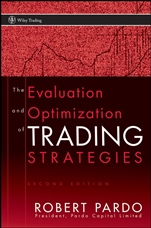
The Evaluation and Optimization of Trading Strategies
ISBN 9780470128015
Autor: Robert Pardo
Wydawca: Wiley
Dostępność: 3-6 tygodni
Cena: 476,70 zł
Przed złożeniem zamówienia prosimy o kontakt mailowy celem potwierdzenia ceny.
ISBN13: |
9780470128015 |
ISBN10: |
0470128011 |
Autor: |
Robert Pardo |
Oprawa: |
Hardback |
Rok Wydania: |
2008-03-11 |
Numer Wydania: |
2nd Edition |
Ilość stron: |
368 |
Wymiary: |
229x152 |
Tematy: |
KF |
Praise For The Evaluation and Optimization of Trading Strategies
SECOND EDITION
"The testing process is key to a profitable trading method and Bob Pardo brings order and sanity to it. He shows the reader how to navigate the minefield of optimization and offers walk–forward testing as a way to change a static system into a dynamic one."
—Perry Kaufman author of New Trading Systems and Methods, Fourth Edition
"Will your system work in the future? In this book Bob Pardo shows you exactly how to construct a trading system and then take the most important walk of them all—the walk forward test—to find out if your system is really worth trading. Now you can know before you trade!"
—Larry Williamsauthor of Trading Stocks & Commodities with the Insiders: Secrets of the COT Report, and Long–Term Secrets to Short–Term Trading
"How to evaluate likely future trading system performance is not just a question—it′s the question, and Pardo′s 1992 Design, Testing, and Optimization of Trading Systems was a milestone work in the field. Now his approach has been updated and expanded to reflect technological change as well as many insights gained along the way. A must read for anyone who takes trading seriously."
—Bruce DeVaultPresident, Quantevo—Algorithmic Trading Development
"Ask serious system developers for their recommended reading list, and Bob Pardo′s book is likely to be among the first mentioned. This book is the real deal; a serious work that seeks to teach you what to look for and what to avoid in your quest for workable trading methodologies. Best of all, it helps you achieve the kind of objective, critical thinking necessary for mechanical trading success. Seekers of magical holy grails would be advised to look elsewhere, but for earnest professional trading aspirants, this is a most rewarding read."
—Art Collins author of Beating the Financial Futures Ma
rket: Combining Small Biases Into Powerful Money Making Strategies
"This book is the definitive book on designing, testing, and using trading systems. There is no better book on the market."
—Courtney smith Courtney Smith & Co., Inc.
Spis treści:
Foreword.
Preface.
Acknowledgments.
Introduction.
Chapter 1. On Trading Strategies.
Why This Book Was Written.
Who Will Benefit from this Book?
The Goals of this Book.
The Lay of the Land.
Chapter 2. The Systematic Trading "Edge".
Discretionary Trading.
Raising the Bar.
Verification.
Quantification.
Risk and Reward.
The Performance Profile.
Objectivity.
Consistency.
Extensibility.
The Benefits of the Historical Simulation.
Positive Expectancy.
The Likelihood of Future Profit.
The Performance Profile.
Proper Capitalization.
A Measure of Real–Time Trading Performance.
The Benefits of Optimization.
The Benefits of the Walk–Forward Analysis.
The Advantages of a Thorough Understanding.
Confidence.
Strategy Refinement.
Chapter 3. The Trading Strategy Development Process.
Two Philosophical Approaches to Strategy Development.
The Scientific Approach.
The Path of Empirical Development.
An Overview of the Trading Strategy Design Process.
Step 1: Formulate the Trading Strategy.
Step 2: Translate the Rules into a Definitive Form.
Step 3: Preliminary Testing.
Step 4: Optimize the Trading strategy.
Step 5: the Walk Forward Analysis™.
Step 6: Trade the System.
Step 7: Evaluate Real–Time Performance.
Step 8: Improving the System.
Chapter 4. The Strategy Development Platform.
The Scripting Language.
Diagnostics.
Reporting.
Optimization.
The Objective Function.
Speed.
Automation.
Walk Forward Analysis™.
Portfolio Analysis.
In Conclusion.
Chapter 5. The Elements of Strategy Design.
The Three Principle Components of a Strategy.
Entry and Exit.
Risk Management.
Position Sizing.
An Overview of a Typical Trading Strategy.
A Trade Equals an Entry and an Exit.
Entry Filters.
The Management of Risk.
Trade Risk.
Strategy Risk.
Portfolio Risk.
The Management of Profit.
The Trailing Stop.
Profit Targets.
Position Sizing.
Advanced Strategies.
Summary.
Chapter 6. The Historical Simulation.
The Essential Reports.
The Performance Summary.
The Trade List.
The Equity Curve.
Performance by Period.
The Importance of Accuracy.
Software Limitations.
Rounding Issues.
Phantom Trades.
Price Orders.
Realistic Assumptions.
Price and Trade Slippage.
Opening Gap Slippage.
Opening and Closing Range Slippage.
Slippage Due to Size.
The Significance of Slippage.
Limit Moves.
Major Events and Dates.
Historical Data.
Stock Prices.
Cash Markets.
Futures Markets.
The Continuous Contract.
The Perpetual Contract.
Adjusted Continuous Contracts.
The Size of the Test Window.
Statistical Requirements.
Sample Size and Statistical Error.
How Many Trades?
Stability.
Degrees of Freedom.
Frequency of Trading.
Types of Markets.
The Bull Market.
The Bear Market.
The Cyclic Market.
The Congested Market.
Efficient Markets.
The Life Cycle of a Trading Strategy.
Window Size and Model Life.
Chapter 7. Formulation and Specification.
Formulate the Trading Strategy.
Specification – "Translate" The Idea Into A Testable Strategy.
Make a Vague Idea Precise.
Chapter 8. Preliminary Testing.
Verification of Calculations and Trades.
Calculations.
Trading Rules.
In Summary.
Theoretical Expectations.
Preliminary Profitability.
The Multi–Market and Multi–Period Test.
Selecting the Basket.
Determining the Length of the Test Period.
Segmenting the Data.The Test.
The Results of the Test.
Chapter 9. Search and Judgment.
Search Methods.
The Grid Search.
The Prioritized Step Search.
Hill Climbing Search Algorithms.
Multi–Point Hill Climbing Search.
Advanced Search Methods.
Simulated Annealing.
Genetic Algorithms.
Particle Swarm Optimization.
General Problems with Search Methods.
The Objective Function.
A Review of a Variety of Evaluation Methods.
Multiple Evaluation Types.
Chapter 10. Optimization.
Optimization contra Overfitting.
A Simple Optimization.
The Optimization Framework.
The Parameters.
The Scan Range.
The Historical Sample.
The Objective Function.
The Optimization Evaluation.
A Multi–Market and Multi–Period Optimization.
The Evaluation of the Optimization.
The Robust Trading Strategy.
The Robust Optimization.
The Statistically Significant Optimization Profile.
The Distribution of the Optimization Profile.
The Shape of the Optimization Profile.
How Does the Strategy Respond to Optimization?
Does the Strategy Deserve Further Development?
Chapter 11. Walk–Forward Analysis.
Is the Trading Strategy Robust?
Robustness and Walk–Forward Efficiency.
The Cure for Overfitting.
A More Reliable Measure of Risk and Return.
Assessing the Impact of Market Changes.
The Best Parameter Set for Trading.
The Theory of Relevant Data.
Peak Performance.
Statistical Rigor.
Shifting Markets.
The Varieties of Market Conditions.
The Walk–Forward.
The Role of the Walk Forward.
Setting Up a Walk–Forward.
An Example of a Walk–Forward Test.
The Walk–Forward Analysis.
The Purpose of the Walk–Forward Analysis.
An Example of a Walk–Forward Analysis.
Is the Strategy Robust?
What Rate of Profit Should We Expect?
What Is the Risk?
Walk–Forward Analysis and the Portfolio.
Chapter
Koszyk
Książek w koszyku: 0 szt.
Wartość zakupów: 0,00 zł
Informacje


Kontakt
Gambit
Centrum Oprogramowania
i Szkoleń Sp. z o.o.
Al. Pokoju 29b/22-24
31-564 Kraków
Siedziba Księgarni
ul. Kordylewskiego 1
31-542 Kraków
+48 12 410 5991
+48 12 410 5987
+48 12 410 5989
Subskrypcje
Administratorem danych osobowych jest firma Gambit COiS Sp. z o.o. Na podany adres będzie wysyłany wyłącznie biuletyn informacyjny.
Autoryzacja płatności

Informacje na temat autoryzacji płatności poprzez PayU.

© Copyright 2012: GAMBIT COiS Sp. z o.o. Wszelkie prawa zastrzeżone.
Projekt i wykonanie: Alchemia Studio Reklamy